
IMF and World Bank Meet ‘Behind Closed Doors’ in Bangkok Today: What Is at Stake?
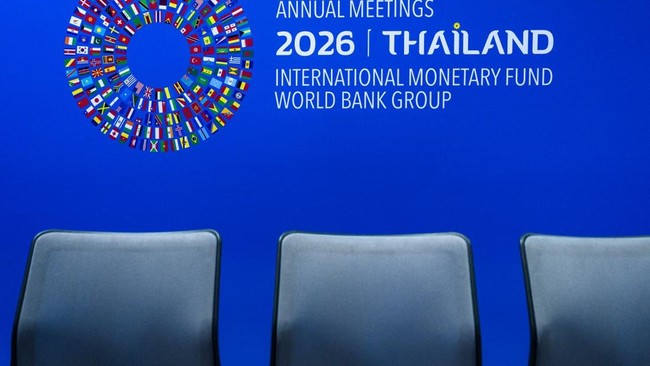
Jakarta, CNBC Indonesia – Global finance officials have gathered in Bangkok, Thailand, for the International Monetary Fund (IMF) and World Bank annual meetings, running from Monday (12 October 2026) to 18 October. The meetings are taking place amid growing concern over the effects of the war in the Middle East, surging energy prices and mounting government debt.
Held at the Queen Sirikit National Convention Center, this year’s annual meetings are in the spotlight as the global economy faces pressure from several directions. The war involving the United States, Israel and Iran has entered its eighth month, disrupting energy supplies and increasing inflation risks.
IMF Managing Director Kristalina Georgieva said on Sunday that about 18,000 people had registered to attend. That is around 4,000 more than at the previous annual meetings held outside Washington, in Morocco in October 2023.
This is the first time in three years that the IMF and World Bank annual meetings have been held outside Washington. Despite the large turnout, however, several global finance officials are unable to attend because of domestic commitments.
Iran war and energy crisis in focus
World Bank President Ajay Banga said the global economy had so far proved more resilient than feared when Iran closed the Strait of Hormuz, a route that previously carried about 20% of the world’s oil supply.
Nevertheless, fresh pressures are emerging. Rising diesel and fertiliser prices, combined with the threat of a strong El Niño, could add to the strain on the global economy.
Banga said the combined impact of higher energy and fertiliser costs, debt burdens and weather risks was a challenge that needed to be addressed simultaneously. He said the World Bank had not lowered its global growth forecast.
The institution is continuing to monitor developments. In energy markets, G7 countries have agreed to release 100 million barrels of diesel and crude oil from emergency reserves amid pressure to bring fuel prices down.
US President Donald Trump has also announced an agreement with Russia to supply additional diesel to the global market. Washington has granted a temporary exemption from US sanctions on Russian diesel until April 2027. The move drew criticism from Ukrainian President Volodymyr Zelenskyy, who said easing sanctions without a commitment to de-escalate the war risked prolonging the conflict.
Since the war began on 28 February 2026, more than one billion barrels of oil have been released, mainly from commercial onshore stocks. Industry players have warned, however, that supplies of oil available to the global market are dwindling, leaving energy markets increasingly vulnerable to fresh supply disruptions and price rises.
IMF warns of global debt threat
Alongside war and energy, government debt is a major item on the agenda in Bangkok. The IMF has warned that global public debt has reached its highest level since the Second World War and is expected to exceed 100% of global gross domestic product (GDP) before 2030.
Advanced economies, particularly the United States, have high debt-to-GDP ratios. Developing and low-income countries are more vulnerable, facing high borrowing costs, capital outflows and pressure from food and energy prices.
In a speech ahead of the meetings, Georgieva warned that the challenges facing the global economy were intensifying. The IMF forecasts global economic growth of 3% in 2026, although growth projections for some countries may be downgraded.
Countries affected by the war, including Ukraine and Gulf states facing Iranian attacks and falling energy exports, are expected to come under greater pressure.
IMF research released the previous week also found that spikes in food and energy prices are increasingly becoming triggers for crises. Such conditions can worsen inflation expectations, increase poverty and threaten economic stability.
Developing countries face Rp7,153.6 trillion debt bill
Developing countries are likely to bear the heaviest pressure as they repay external debt while global interest rates remain high.
Developing countries collectively face US$400 billion (about Rp7,153.6 trillion, using Bank Indonesia’s middle exchange rate, or JISDOR, of Rp17,884 per US$1) in payments to external creditors during 2026. Average interest payments have already exceeded 10% of government revenue.
This situation limits governments’ fiscal room to fund public needs, investment and social protection programmes. Unlike in the early stages of the Covid-19 pandemic, when G20 countries agreed to suspend debt payments for the poorest nations, support for a similar policy is now considered more limited.
Some low-income countries are also concerned about changes to IMF lending-programme conditions, which are moving towards fewer reforms but more far-reaching demands for change. The policies are feared to trigger painful spending cuts.
Iolanda Fresnillo of Eurodad, an organisation advocating debt justice, warned that increasingly stringent loan conditions could intensify pressure on people in developing countries.
She cited Kenya, which has sought to avoid debt restructuring through cuts to public spending and higher taxes. The policies sparked large demonstrations, particularly among young people.
US finance official to be absent
The Bangkok meetings are also taking place amid rising geopolitical tensions. The absence of US finance officials is notable.
US Treasury Secretary Scott Bessent will not attend. Washington is sending two senior officials in his place because Bessent has to deal with several domestic priorities.
Meanwhile, Federal Reserve Chair Kevin Warsh is scheduled to attend. He will take part in a public event with Georgieva on 16 October.
Bessent’s absence has also drawn attention because the United States is chairing the G20 this year. Several other finance ministers are also missing the meetings because of budget business and elections in their respective countries.
Josh Lipsky, vice-president for international economics at the Atlantic Council, said the links between national security and international finance were becoming increasingly difficult to separate. The closure of the Strait of Hormuz and the conflict in the Middle East, he said, show how geopolitical crises can directly affect trade, energy prices and global economic stability.
The IMF and World Bank meetings in Bangkok are therefore an important opportunity for policymakers to assess interconnected risks, from war, energy and climate change to public debt. For developing countries, the challenge is not only to sustain economic growth but also to preserve their ability to fund people’s needs as borrowing costs rise.
Source: jawawa.id (https://jawawa.id/newsitem/imf-and-world-bank-meet-behind-closed-doors-in-bangkok-today-what-is-at-stake-1791766250)
Originally published by CNBC Indonesia (https://www.cnbcindonesia.com/news/20261012060248-4-775164/imf-world-bank-4-mata-di-bangkok-hari-ini-ada-apa-dunia), translated from Indonesian