
Illegal Semeru Climber Survives Four Days in 375-Metre Ravine
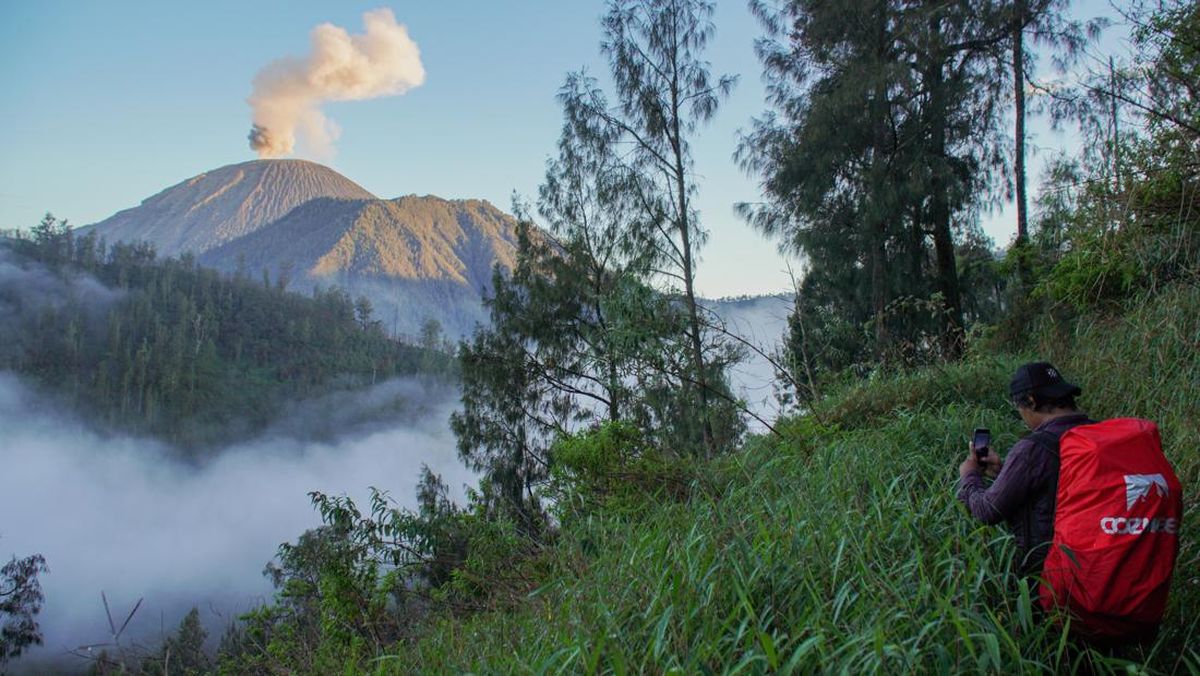
An 18-year-old climber named Cakra fell into a 375-metre-deep ravine on Mount Semeru, East Java, on Monday (1 June). A joint Search and Rescue (SAR) team is battling to evacuate him as of Friday (5 June). The rescue operation is using a slope rescue method because of the extreme terrain and the victim’s status as an illegal climber.
The incident began when the victim recklessly climbed Mount Semeru via an unofficial route at Candi Jawar Purbakala, Ampelgading District, Malang Regency, on Saturday (30 May). Official climbing routes are currently completely closed due to volcanological activity.
‘The route used is not an official tourist climbing route managed by the Bromo Tengger Semeru National Park Agency (TNBTS). To date, climbing to the summit of Mount Semeru remains closed owing to volcanological activity,’ said Rudijanta Tjahja Nugraha, Head of the TNBTS Agency, on Friday.
The victim was reported to have fallen into the ravine on Monday at around 10.00 WIB. Before communications were cut off, Cakra managed to send his last coordinate point and ask for help from his parents.
After intensive searching, the victim’s position was finally located, but the team on the ground faced major obstacles due to steep, rugged terrain with minimal access. Nanang Sigit, Head of the Surabaya SAR Office and SAR Mission Coordinator, said the victim was found with a severe injury to his right leg. The SAR team immediately provided emergency treatment to immobilise the victim’s ankle joint. ‘To minimise movement and prevent further swelling, the survivor’s leg had to be splinted,’ said Nanang.
Evacuating Cakra has proven a major challenge for the Joint SAR Team. Apart from the ravine’s depth of hundreds of metres, the absence of a safe anchor point above the victim’s position forced the team to devise a solution and apply the slope rescue method. Nanang explained that this method involves positioning the victim lying on their back on a flexible rolling stretcher, then pulling them up gradually using a strict rope safety system. ‘The steepness of the terrain was also deemed more suitable for evacuation using the slope rescue method, and with this method the evacuation can be carried out in stages,’ Nanang added.
The process of pulling the stretcher from the bottom of the ravine began on Thursday (4 June) afternoon, with close escort on the right and left sides of the stretcher. Given the steep route and high risk to the safety of both the victim and the rescue team, the pulling is being conducted with extra caution and in shifts. ‘From the ravine, the survivor is evacuated using slope rescue to the joint SAR team assembly point above, and then from above he will be carried on a stretcher down to the command post,’ he said.
The Surabaya SAR Office received a report of this accident on Tuesday (2 June) evening and immediately deployed the Malang SAR Alert Unit to the location. It took about 8 hours of trekking from the nearest command post just to reach the victim’s coordinates. This lengthy evacuation process is estimated to be completed only by Friday evening, heavily depending on weather dynamics on Mount Semeru as well as the victim’s physical condition and the stability of the joint SAR team on the ground.