
Illegal Migrants Dig Tunnels, Lithuania on High Alert at Border
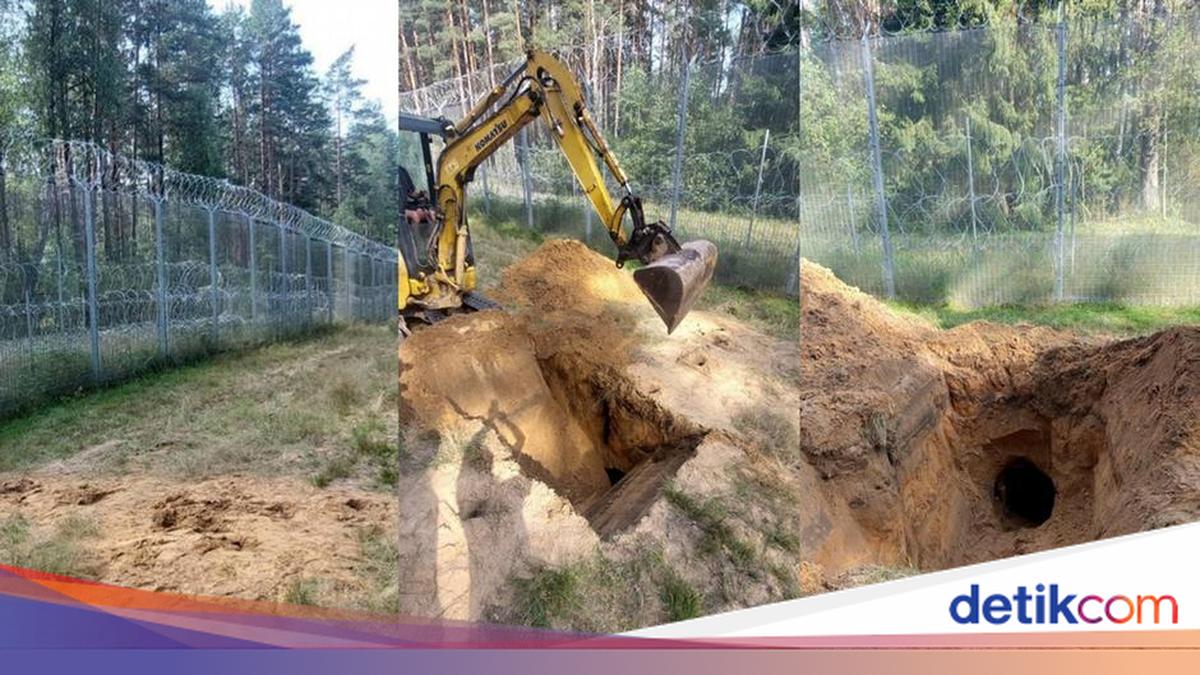
Underground tunnels have become a new route used by migrants to enter Lithuania illegally from Belarus. Rather than scaling the reinforced border fence, they are digging their way underneath. Experts assess that the emergence of these tunnels is not merely a matter of illegal migration, but could also be part of Belarus’s efforts to maintain pressure at the border and create political instability in Lithuania.
Lithuanian border guards say they have discovered 12 such tunnels since the start of the year, scattered along the border with Belarus. The length of the tunnels on the Lithuanian side reaches 25 metres. They expect to find more tunnels.
Lithuania’s border with Belarus is approximately 700 kilometres long, with around 550 kilometres of it fenced.
“We have a ground-based seismic system that can easily detect prolonged, high-intensity vibrations,” General Rustamas Liubajevas, commander of Lithuania’s State Border Guard Service, told DW. “We then wait outside the tunnel until the digging reaches its final stage. When the migrants emerge, we apprehend them.” He added that up to 40 migrants exiting through such tunnels have been arrested.
The Lithuanian Prosecutor’s Office confirmed to DW that a preliminary investigation is underway into approximately 20 individuals suspected of involvement in the illegal tunnel digging. They may also face human smuggling charges. As the investigation is ongoing, the media are currently not permitted to visit the tunnel sites.
Liubajevas expressed surprise that migrants would attempt to cross underground. “It takes a lot of effort to dig a tunnel, while the migrants are caught almost immediately. At most, only one small group has managed to get through,” he said.
The complexity of the tunnels leads Liubajevas to believe the migrants were not working alone. “They could not have done it without logistical support from the Belarusian authorities, because they needed a lot of materials, such as wood, to reinforce the tunnel walls,” he stressed. He added that Belarus appears intent on “maintaining a high level of tension at the border.”
Belarusian President Alexander Lukashenko has denied facilitating migration flows into neighbouring countries. Similar migrant tunnels have previously been found in neighbouring Poland.
Margarita Seselgyte, Director of the Institute of International Relations and Political Science at Vilnius University, agrees with Liubajevas’s assessment. “Belarus controls its border very tightly, and the country is not part of the natural migration route for migrants from Afghanistan, Iran, or Sri Lanka,” she told DW. In her view, Minsk at the very least allowed the digging activity to proceed without intervention.
Seselgyte views the tunnels as a “hybrid attack aimed at creating anxiety in our society.” “There is no vacuum in the security world. When Lithuania closed the gaps and reinforced its border fence, Belarus is now helping migrants pass underneath it,” she said.
According to Seselgyte, Minsk is aiding its ally, Moscow. Russia launched its full-scale invasion of Ukraine in February 2022, partly from Belarusian territory, where Russian forces were deployed under the pretext of military exercises. “Lithuania is very vocal on defence against Russia, both in terms of conventional and hybrid threats, at the EU and NATO level. They want to silence that voice by creating chaos in our country,” the political scientist said. “The main goal is likely to weaken support for Ukraine and disrupt European unity,” she added.
Linas Kojala, CEO of the Vilnius-based Geopolitics and Security Studies Centre, said the tunnels keep border guards busy, even though few migrants manage to enter. He described the tunnels as “another phase of the weaponisation of migration attack we have been facing since 2021.”
That year, tens of thousands of migrants entered Lithuania, Poland, and Latvia via Belarus. The EU described the event as a “state-sponsored instrumentalisation of migrants at the EU’s external border” orchestrated by Lukashenko. “Latvia, Poland, Lithuania, and other countries have since built up the external border and we have managed to reduce illegal migration to a minimum,” Kojala told DW. Lithuanian border guards recorded 1,652 attempted illegal entries into the country in 2025.
However, according to Kojala, the numbers will never drop to zero unless Minsk addresses the problem from the Belarusian side. “And that is unlikely to happen. Belarus is clearly trying to create as many problems as possible,” he said.
Robert Gonzci, an analyst at the Budapest-based Migration Research Institute, noted that Belarus is not the first country to use migration as a strategic instrument. “This is a relatively cheap and low-risk way to exert pressure on another country. There have been many documented cases of governments creating or manipulating migration flows since the 1950s,” he wrote in an email to DW. He added that even the Assyrian Empire, which collapsed in the 7th century BC, used migration to strengthen imperial control. Gonzci did not rule out the possibility that independent smuggling networks, not fully controlled by Belarusian authorities, could be behind the newly discovered tunnels.