
IKN Development Accelerates: New Project Tenders to Open, State Assets Grow
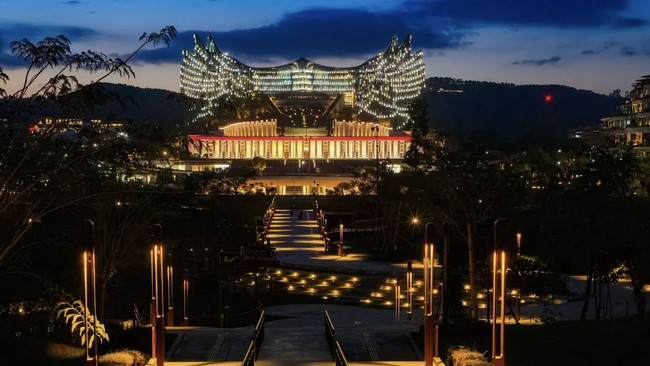
The Nusantara Capital City (IKN) Authority has confirmed the complete finish of the first phase (batch 1) of construction. After completing the main roads, the government is now focusing on building the legislative and judicial areas as part of the target to make IKN the political government centre by 2028.
Simultaneously, the IKN Authority (OIKN) has also proposed an additional budget of Rp2.7 trillion to Finance Minister Purbaya Yudhi Sadewa to support the next phase of development (batch 3), the management of built assets, and land acquisition.
OIKN Head Basuki Hadimuljono, during a working meeting with Commission II of the Indonesian House of Representatives (DPR RI) at the Parliament Complex in Jakarta on Thursday (16/7/2026), revealed that the additional budget proposal was submitted to the Ministry of Finance on 18 June 2026. The funds will be used to finance the batch 3 development under a multi-year scheme from 2026 to 2028.
For the 2026 fiscal year, the IKN Authority received a budget ceiling of Rp5.47 trillion, consisting of Rp423 billion for personnel expenditure, Rp732.5 billion for goods expenditure, and Rp4.3 trillion for capital expenditure. Basuki disclosed that as of 30 June 2026, the accrual-based budget realisation had reached 80.2% after accounting for all procurement contracts. Meanwhile, realisation based on the Fund Disbursement Order (SP2D) issued by the Ministry of Finance was recorded at Rp1.23 trillion, or approximately 26.2% of the budget ceiling.
Basuki also outlined development achievements throughout 2025. From the usable budget ceiling of Rp9.04 trillion, following adjustments to the central government’s budget blocking policy, expenditure realisation reached Rp8.51 trillion, or 94.13%. The majority of this budget was used for capital expenditure worth Rp7.66 trillion to complete various development projects in the IKN area.
He explained that the batch 2 development will run until 2027 and is focused on constructing buildings for legislative and judicial institutions along with their supporting areas. After the meeting, Basuki stated that the progress of the legislative and judicial area development has now reached approximately 15%. In the near future, the IKN Authority will also tender a project for the construction of housing for apparatus who will be assigned to the area.
According to Basuki, the ongoing development is still focused on the office areas and buildings. Afterwards, the government will continue with the construction of residential areas concurrently with the completion of supporting regulations. He confirmed that the legislative complex development will continue to be accelerated until the end of 2027 as part of the preparations for relocating the political government centre to IKN.
He explained that the judicial area will include the Supreme Court (MA), Constitutional Court (MK), and Judicial Commission (KY) buildings, along with their areas and housing. Meanwhile, the legislative area will encompass the DPR, MPR, DPD complexes, a plenary session hall, and housing for officials and staff.
Beyond physical development, the IKN Authority’s asset value has also continued to increase. As of 31 December 2025, total assets recorded on the balance sheet reached Rp71.96 trillion, an increase of Rp13.59 trillion compared to the end of 2024 position of Rp63.35 trillion. Basuki stated that this increase reflects the acceleration of physical development throughout 2025. The IKN Authority’s net worth also rose to Rp71.41 trillion, an increase of Rp12.74 trillion compared to the previous year, indicating that state spending for IKN development has been transformed into state assets managed by the IKN Authority.
On the other hand, Basuki confirmed that public transport in IKN will initially still rely on an electric bus fleet. The government has no plans yet to build rail-based transport modes such as LRT or MRT.