
IHSG weakens tracking global markets amid oil price surge and geopolitical tensions
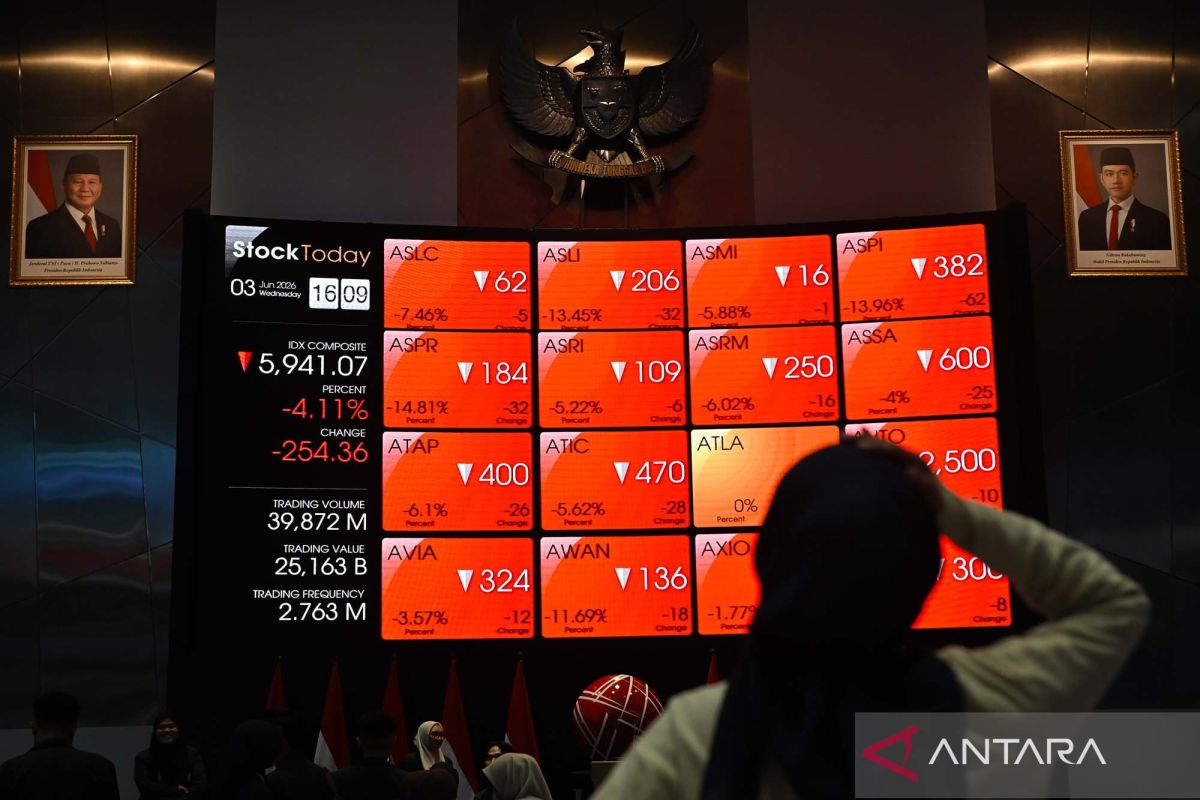
The Indonesia Stock Exchange (BEI) composite index (IHSG) moved lower on Friday, tracking global stock markets amid a surge in global oil prices triggered by escalating geopolitical tensions in the Middle East. The IHSG opened down 48.33 points, or 0.77 percent, at 6,266.98. Meanwhile, the LQ45 index of 45 leading stocks fell 6.66 points, or 1.06 percent, to 620.46.
"If selling pressure continues, the IHSG has the potential to test the support area of 6,262, 6,181, down to 6,103. Meanwhile, if it manages to strengthen again, resistance is at 6,377-6,394, then 6,454," said Kiwoom Sekuritas Indonesia Head of Research Liza Camelia Suryanata in her analysis in Jakarta on Friday.
From overseas, geopolitical tensions escalated again after the Iran-backed Houthi group attacked two Saudi Arabian tankers in the Red Sea. The situation worsened global oil distribution disruptions, with ship traffic in the Strait of Hormuz reportedly down by about 75 percent. United States President Donald Trump warned that the US would hold Iran accountable if similar attacks occurred again.
Amid these geopolitical tensions, crude oil prices experienced an increase, breaking through the level of 100 US dollars per barrel, thus driving inflation expectations and increasing the likelihood of a rate hike by the central bank. West Texas Intermediate crude oil prices surged more than 6 percent to above 92 US dollars per barrel, while Brent crude rose more than 6 percent to breach 100 US dollars per barrel, its highest since early June 2026.
On the other hand, market participants’ focus remains on the direction of the US Federal Reserve’s monetary policy, following the surge in global energy prices which has increased expectations that the Fed may keep interest rates high for longer or even consider a rate hike if inflationary pressures increase. Nevertheless, liquidity is expected to begin improving in the short to medium term with the return of foreign capital flows and the re-placement of SAL funds into Himbara banks, potentially driving M2 growth in the coming months.
"However, the long-term outlook is still overshadowed by the risk of tightening if the Fed turns more hawkish again, geopolitical tensions drive up oil prices, or the government withdraws SAL funds again to strengthen fiscal space," said Liza. Meanwhile, the inaugural issuance of Indonesia’s Panda Bond in the Chinese financial market recorded a bid-to-cover ratio of 2.4 times, with investor demand reaching approximately 17 billion Chinese Yuan compared to the issuance value of 7 billion Chinese Yuan.
In trading on Thursday (23/07), European markets fell in unison, with the Euro Stoxx 50 weakening 1.63 percent, the UK’s FTSE 100 index down 0.73 percent, Germany’s DAX index down 1.56 percent, and France’s CAC 40 index down 1.64 percent. Wall Street in the US also fell on Thursday (23/07), with the S&P 500 index down 1.21 percent to 7,408.30, the Nasdaq Composite index down 1.87 percent to 25,454.81, and the Dow Jones Industrial Average down 0.97 percent to 51,711.65. Regional Asian stock markets this morning included the Nikkei index down 3.12 percent to 64,351.00, the Shanghai index down 0.55 percent to 3,855.45, the Hang Seng index down 1.14 percent to 24,923.72, the Kospi index down 3.35 percent to 6,859.54, and the Strait Times index down 0.57 percent to 5,549.94.
Source: jawawa.id (https://jawawa.id/newsitem/ihsg-weakens-tracking-global-markets-amid-oil-price-surge-and-geopolitical-tensions-1784861643)
Originally published by Antara (Indonesian) (https://www.antaranews.com/berita/5663725/ihsg-melemah-ikuti-bursa-global-dipicu-harga-minyak-tensi-geopolitik), translated from Indonesian