
IHSG weakens as market gives short-term response to MSCI review
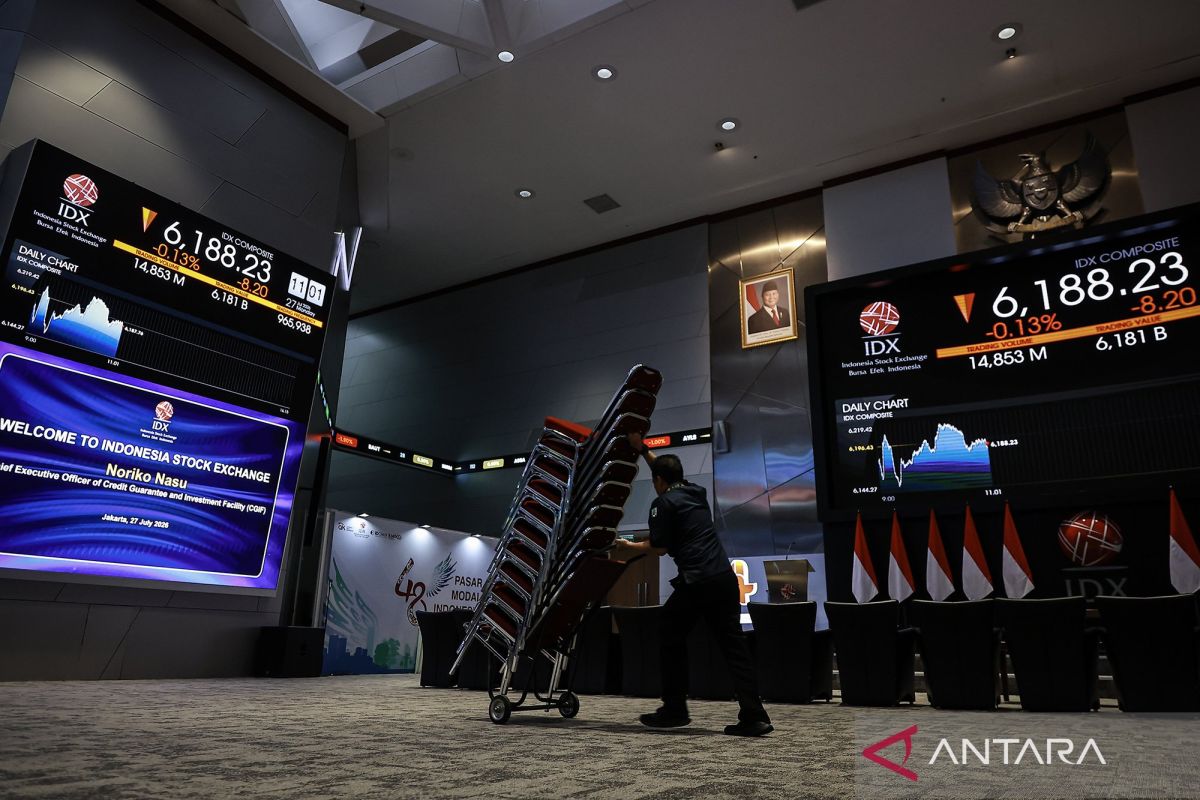
The Jakarta Composite Index (IHSG) on the Indonesia Stock Exchange (BEI) moved lower on Thursday, reflecting a short-term market response to the results of MSCI’s review of Indonesian equities for the August 2026 period. After opening higher, the IHSG weakened by 33.46 points, or 0.52 percent, to 6,340.39 as of 09.15 WIB. The LQ45 index of 45 leading stocks fell 4.00 points, or 0.63 percent, to 629.84.
Head of Research at Kiwoom Sekuritas Indonesia, Liza Camelia Suryanata, stated that as long as the IHSG holds above the 6,308–6,269 range, the opportunity for a breakout above 6,377 remains open, with upside targets of 6,462 to 6,550 and major resistance around 6,635 to 6,723. Conversely, a failure to breach 6,377 and a drop below 6,308 could see the index test 6,269 and then 6,247 as key support areas.
Domestically, MSCI’s August 2026 index review resulted in changes to the composition of Indonesian stocks. Two stocks were removed from the MSCI Global Standard Indexes, with one of them downgraded to the MSCI Global Small Cap Index. Another stock was transferred into the MSCI Global Small Cap Index, while MSCI also removed nine Indonesian stocks from that index. Consequently, nine Indonesian stocks remain in the MSCI Global Standard Index, with approximately 33 still listed in the MSCI Global Small Cap Indexes. MSCI did not alter the country composition of the Emerging Markets within the MSCI Frontier Emerging Markets Index following its Annual Country Review 2026.
On the fiscal front, Indonesia’s government debt reached Rp10,293.69 trillion as of June 2026, equivalent to 41.26 percent of GDP, marking an increase of Rp1,819.79 trillion, or 21.5 percent, since end-September 2024. Debt growth of 67.5 percent since 2020 has outpaced nominal GDP growth of 64.9 percent, while the interest payment-to-revenue ratio rose to 19 percent from 14.6 percent in 2022. Although still below the 60 percent of GDP threshold, the trend warrants caution to maintain fiscal sustainability.
Globally, market sentiment was somewhat positive after US Consumer Price Index data for July 2026 met expectations, with headline inflation rising 0.1 percent month-on-month and slowing to 3.4 percent year-on-year, while core CPI increased 0.2 percent month-on-month and eased to 2.5 percent year-on-year. The data reduced pressure on the Federal Reserve to raise interest rates, lifting the probability of the Fed holding rates in September 2026 to 62 percent from 54 percent. However, markets remain wary of potential inflationary pressures in August due to surging oil prices. Investors are now awaiting US Producer Price Index and Personal Consumption Expenditures data, which are the Fed’s preferred inflation gauges.
Geopolitical tensions also remain in focus after the US and Iran clashed anew over control of the Strait of Hormuz. US President Donald Trump claimed full American control over the waterway, while Iran insisted the strait would not be reopened until the US ceases hostilities and meets certain demands. Attacks on commercial vessels in the Bab el-Mandeb area have further heightened concerns over energy supply chain disruptions.
European stock markets closed lower on Thursday, with the Euro Stoxx 50 down 0.16 percent, the UK’s FTSE 100 down 0.10 percent, Germany’s DAX down 0.20 percent, and France’s CAC 40 down 0.50 percent. Wall Street was mixed, with the S&P 500 up 0.30 percent to 7,749.19, the Nasdaq Composite up 0.50 percent to 26,588.49, and the Dow Jones Industrial Average down 0.30 percent to 53,770.16. In Asian trading this morning, the Nikkei rose 1.62 percent to 68,614.00, the Shanghai Composite gained 0.45 percent to 3,964.40, and the Kospi surged 4.08 percent to 6,847.41, while the Hang Seng fell 0.27 percent to 25,370.81 and the Straits Times Index slipped 0.55 percent to 5,689.26.