
IHSG weakens as market adopts 'wait and see' stance amid positive global and domestic sentiment
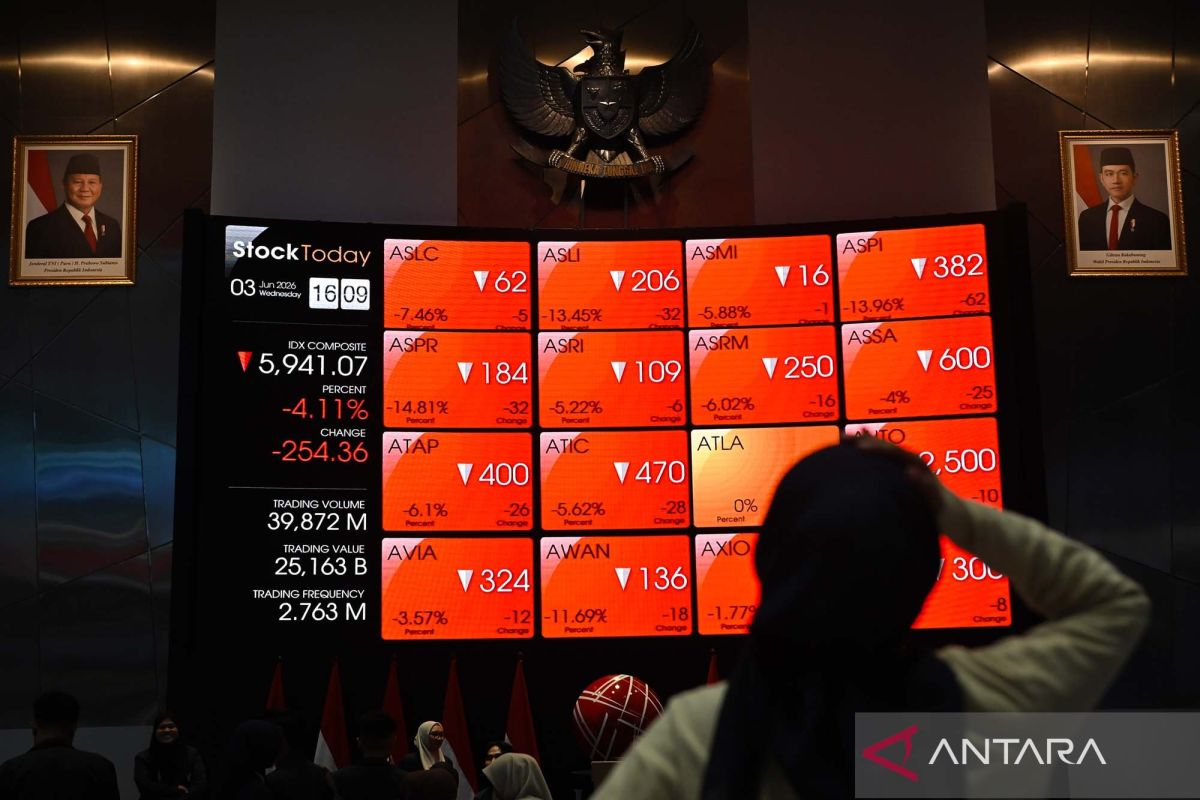
The Indonesia Stock Exchange (BEI) composite index (IHSG) moved lower on Tuesday morning as market participants maintained a wait-and-see approach despite positive sentiment from both global and domestic fronts. The IHSG opened down 19.34 points, or 0.33 percent, at 5,801.45. Meanwhile, the LQ45 index of 45 leading stocks fell 4.02 points, or 0.70 percent, to 568.99. “If a rebound occurs, the IHSG has the potential to test resistance at 5,996-6,013, and if it can break through that area, the strengthening could continue towards 6,097 to 6,221-6,287. However, if the 5,722 support level fails to hold, the risk of a deeper correction towards 5,677 to 5,594 remains open,” said Liza Camelia Suryanata, Head of Research at Kiwoom Sekuritas Indonesia, in a study in Jakarta on Tuesday. From the global front, market sentiment tended to be positive with investors refocusing on the technology sector after last week’s sharp correction. However, market participants remained cautious ahead of the release of US employment data on Thursday, which will provide clues on the direction of the Federal Reserve’s interest rate policy. On the other hand, Deutsche Bank data showed that technology-based ETFs and mutual funds experienced an outflow of 9.3 billion US dollars last week, reflecting that some investors are still diversifying into other sectors. During this week, market participants are still awaiting US Job Openings and Labor Turnover Survey data, a speech by Fed Governor Kevin Warsh, US Non-Farm Payrolls data, and the US unemployment rate. Meanwhile, geopolitical tensions returned to the spotlight after the United States and Iran launched attacks on each other over the weekend. Iran reportedly attacked several ships passing through the Strait of Hormuz, while the US retaliated by striking Iranian military facilities. Nevertheless, market concerns eased slightly after US President Donald Trump stated that Iran had proposed a diplomatic meeting in Doha, Qatar, although the Iranian government denied any negotiation agenda. “This condition has caused the geopolitical risk premium to rise again but has not yet triggered panic in global financial markets,” Liza said. Domestically, market participants are awaiting Indonesia’s Manufacturing PMI data, June inflation data, and trade balance data, which will serve as indicators of the strength of economic activity and the direction of Bank Indonesia’s monetary policy. On another front, the government continues to strengthen economic fundamentals through a combination of fiscal, monetary, and banking liquidity policies. The Ministry of Finance decided to return the excess budget balance funds amounting to Rp110 trillion that had previously been withdrawn from the Association of State-Owned Banks, so that the total placement of government funds in banks remains at Rp281 trillion and has been extended until the end of December 2026. In addition, the government has also prepared an additional Rp100 trillion as a standby facility to maintain banking liquidity amid high credit demand, which as of May 2026 was still growing at 11.5 percent year-on-year. From the monetary side, Bank Indonesia’s policy of raising the BI Rate by 100 basis points throughout 2026 is beginning to show positive results. As of 26 June 2026, foreign fund flows into Government Securities and Bank Indonesia Rupiah Securities instruments had reached approximately 9 billion US dollars, reflecting increased investor confidence in Indonesian financial assets. According to Liza, the combination of foreign capital inflows, strengthening banking liquidity, and government support for investment and exports has the potential to be a positive sentiment for the stability of the rupiah, the bond market, and the banking sector. In trading on Monday, European bourses moved variably, with the Euro Stoxx 50 up 0.04 percent, the UK’s FTSE 100 down 0.21 percent, Germany’s DAX down 0.20 percent, and France’s CAC 40 down 0.20 percent. Meanwhile, US Wall Street markets uniformly strengthened on Monday, with the Dow Jones Industrial Average up 0.59 percent, the S&P 500 up 1.17 percent, and the Nasdaq Composite up 2.07 percent. Regional Asian stock markets this morning saw the Nikkei index strengthen 0.54 percent to 69,885.00, the Shanghai index weaken 0.33 percent to 4,060.48, the Hang Seng index weaken 1.39 percent to 22,757.00, and the Strait Times index weaken 0.40 percent to 5,187.90.