
IHSG Weakens 0.76% in First Session, Here's Why
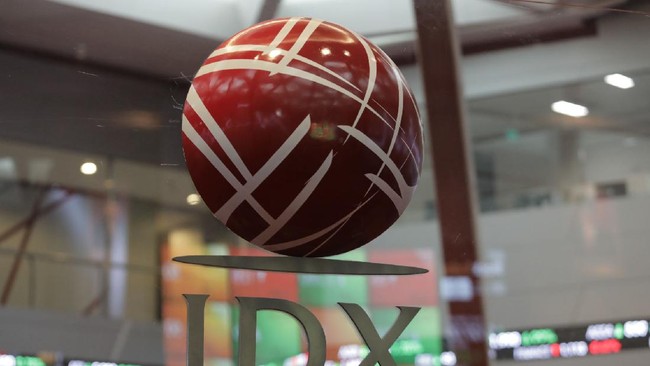
Jakarta, CNBC Indonesia – The Composite Stock Price Index (IHSG) has been under pressure since the start of trading today, Tuesday (15/9/2026).
The IHSG was down 49.77 points, or 0.76%, to 6,484.92. By the end of the first session, 333 shares had risen, 317 had weakened and 313 were unchanged.
At the opening of trade, the index moved to an intraday high of 6,549.60 and touched a low of 6,461.01, indicating fairly strong selling pressure in the domestic stock market.
According to Stockbit data, transaction volume reached 167.54 million lots, with a transaction value of Rp7.16 trillion and a frequency of around 1.06 million trades.
On the regular market, transaction volume was recorded at 158.62 million lots with a value of Rp6.20 trillion. The frequency of transactions on the regular market had reached around 1.06 million.
On the negotiating market, transaction volume stood at 8.93 million lots with a transaction value of Rp956.21 billion and a frequency of 196 trades. Meanwhile, transactions on the cash market were relatively small, with a volume of 350 lots, a transaction value of around Rp9.01 million and five transactions.
Based on Refinitiv data, the stocks weighing on the IHSG came from the financial sector, which fell 1.49%, followed by the energy sector at -1.40% and utilities at -0.75%.
The stocks dragging the IHSG lower included PT Cipta Selera Murni Tbk (CSMI), PT Himalaya Energi Perkasa Tbk (HADE), PT Bumi Teknokultura Unggul Tbk (BTEK), PT Fortune Indonesia Tbk (FORU) and PT Multi Garam Utama Tbk (FOLK).
Meanwhile, stocks cushioning the IHSG’s correction included PT Danasupra Erapacific Tbk (DEFI), PT Communication Cable Systems Indonesia Tbk (CCSI), PT Transkon Jaya Tbk (TRJA), PT Alakasa Industrindo Tbk (ALKA) and PT Semacom Integrated Tbk (SEMA).
As background, the IHSG’s movement today has been overshadowed by a number of domestic and international sentiments.
Domestically, investors are focused on the change of finance minister from Purbaya Yudhi Sadewa to Suahasil Nazara. Globally, tensions from the war in the Middle East, the direction of The Federal Reserve’s interest rate policy, and the release of Chinese economic data are all factors that could influence market movements.
At home, market players will be watching the direction of fiscal policy under Suahasil’s leadership. After being sworn in on Monday (14/9/2026), Suahasil affirmed his commitment to safeguarding the health and credibility of the State Budget (APBN), including ensuring the deficit remains below 3% of Gross Domestic Product (GDP). Certainty over fiscal policy direction is important for investors amid pressure on the rupiah exchange rate and global uncertainty.
Externally, the escalation of the Middle East conflict has reignited concerns over global energy supplies. The Iran-backed Houthi group launched attacks on Saudi Arabia on Monday (14/9/2026), after Saudi’s East-West oil pipeline was disrupted by earlier strikes.
Meanwhile, the Strait of Hormuz remains closed, and diplomatic efforts to reopen it face obstacles.
These conditions have pushed world crude oil prices higher. In Monday’s trading, West Texas Intermediate (WTI) crude futures rose 1.24% to US$102.65 per barrel, while Brent gained 1.18% to US$106.93 per barrel.
The rise in oil prices could add to inflationary pressure and increase energy costs, making it a concern for stock markets, particularly in oil-importing countries.
External pressure is also coming from the outlook for US monetary policy. Bank Indonesia (BI) has warned that the era of higher-for-longer interest rates poses a challenge for developing countries. A stronger US dollar and rising US government bond yields could drive capital flows towards developed-market assets, putting pressure on the rupiah and domestic financial markets.
Investors will also be watching the Federal Open Market Committee (FOMC) meeting taking place on 15-16 September US time. Markets expect The Fed to raise interest rates by 25 basis points, with the probability of an increase towards the 3.75%-4.00% range at 92.4% according to CME FedWatch.