
IHSG Trading Halt Triggered by MSCI’s Move to Consider Reclassifying Indonesia’s Market
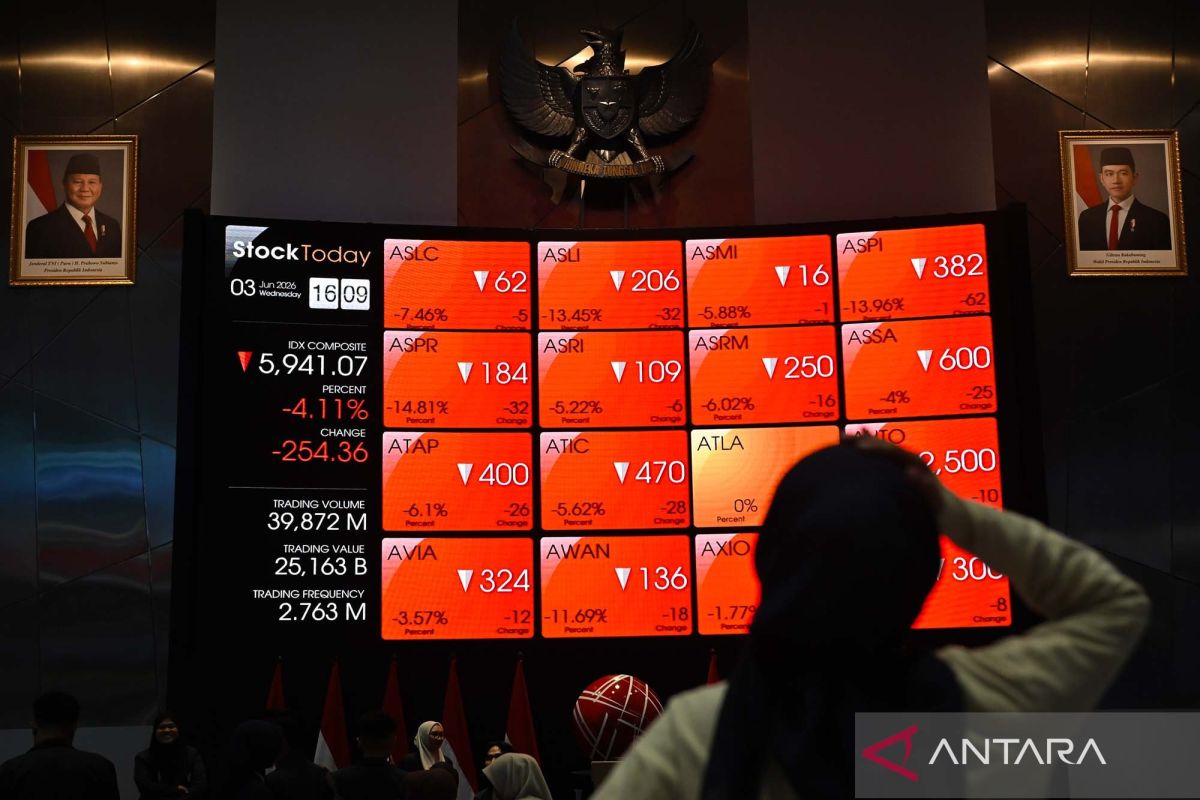
Jakarta (ANTARA) – The Indonesia Stock Exchange’s (IDX) Composite Stock Price Index (IHSG) fell 8 per cent on Friday morning, breaching the threshold for a trading halt, after MSCI announced a consultation on changing Indonesia’s capital-market classification from Emerging Market to Standalone Market.
The IHSG opened down 469.86 points, or 8.01 per cent, at 5,393.92, triggering a trading halt. The LQ45 index of 45 leading shares fell 49.14 points, or 8.33 per cent, to 540.95.
“If support at 5,828 is breached, corrective pressure could continue, closing gaps in the 5,805–5,744 and 5,704–5,695 areas, with 5,700 the next psychological support level. If that level also gives way, the IHSG risks falling further towards 5,300, its previous low,” Liza Camelia Suryanata, Head of Research at Kiwoom Sekuritas Indonesia, said in a report in Jakarta on Friday.
MSCI has opened a consultation with market participants to review the classification of the MSCI Indonesia Indexes from Emerging Market (EM) to Standalone Market across all relevant global and regional composite indices.
MSCI will accept feedback on the proposed reclassification until 30 April 2027 and will announce its decision before 30 June 2027. The index provider said the plan would proceed unless clear evidence emerged of material improvements in Indonesia’s market governance and functioning.
Since January 2026, MSCI has frozen some changes to Indonesian equity indices after investors raised concerns about opaque ownership structures and alleged coordinated trading.
Although the authorities have announced reforms—including disclosure of shareholdings above 1 per cent, more detailed investor classifications, reporting on High Shareholding Concentration (HSC), and a roadmap to raise the minimum free float to 15 per cent—market participants say implementation has been inconsistent and has not been accompanied by significant enforcement.
“If the reclassification goes ahead, Indonesia risks foreign capital outflows, selling pressure on shares and increased volatility,” Liza said.
Meanwhile, interest payments on government debt in the 2027 state budget are projected to reach Rp650.31 trillion, or 18.93 per cent of state revenue, potentially narrowing fiscal headroom.
S&P Global Ratings has maintained Indonesia’s rating at BBB with a stable outlook. However, a persistently high ratio of interest payments to general government revenue—above 15 per cent—remains a risk to watch.
A 50–100 basis-point rise in risk premiums could add around Rp9–18 trillion a year to interest costs as new government securities are issued. The government therefore needs to strengthen tax revenues, improve spending productivity, control new borrowing, and maintain fiscal credibility and consistent market reforms to preserve investor confidence.
Internationally, global market sentiment has turned defensive amid growing doubts about the sustainability of investment in artificial intelligence (AI) and whether technology infrastructure companies can generate returns commensurate with their substantial capital expenditure.
“Concerns centre on the use of debt and supplier financing support, which could create artificial demand through circular financing arrangements,” Liza said.
Meanwhile, tensions in the Middle East have raised the risk of disruption to global energy supplies. An attack on a commercial vessel in the Strait of Hormuz sank a Singapore-flagged container ship and pushed tanker rates in the Persian Gulf to record highs.
The US military was reported to be drawing up plans for new strikes against Iran that could involve a MOAB, while Iran said it was ready to attack US warships. Attacks on Saudi Arabia also threaten the recovery of oil supplies.
The prospect of escalating trade tensions between China and the European Union has also weighed on Chinese equities, as investors assess the risks to trade relations and economic growth.
The Federal Reserve is expected to hold interest rates at its October 2026 meeting, although market participants are beginning to price in the possibility of a 25-basis-point increase at the December 2026 meeting.
A 1.3 per cent month-on-month rise in the US Producer Price Index (PPI) and 0.8 per cent growth in retail sales strengthened the case for the central bank to maintain tighter policy for longer.
Most European markets rose on Thursday (15 October). The Euro Stoxx 50 fell 0.31 per cent, while the UK’s FTSE 100 gained 1.08 per cent, Germany’s DAX rose 0.33 per cent and France’s CAC 40 advanced 0.78 per cent.
US markets all closed higher on Thursday (15 October). The S&P 500 gained 0.33 per cent to 7,744.10, the Nasdaq Composite rose 0.08 per cent to 26,713.03, and the Dow Jones Industrial Average climbed 1.08 per cent to 52,177.69.
Asian markets were mixed on Friday morning. The Nikkei rose 1.90 per cent to 65,651.3, the Hang Seng fell 1.03 per cent to 24,062.72, the Kospi gained 3.30 per cent to 5,737.05, the Shanghai Composite declined 1.59 per cent to 3,707.48, and the Straits Times Index rose 0.24 per cent to 5,416.99.
Source: jawawa.id (https://jawawa.id/newsitem/ihsg-trading-halt-triggered-by-mscis-move-to-consider-reclassifying-indonesias-market-1792119172)
Originally published by Antara (Indonesian) (https://www.antaranews.com/berita/5790489/ihsg-trading-halt-dipicu-msci-buka-peluang-ubah-klasifikasi-bursa-ri), translated from Indonesian