
IHSG Surges Over 1%, Approaches 5,800 Level
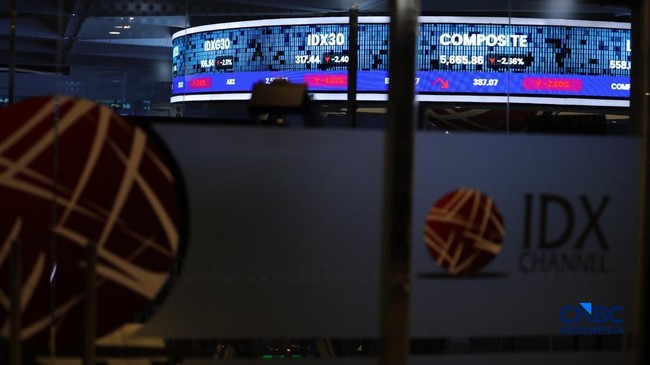
The Indonesia Composite Index (JCI) opened stronger in trading on Thursday (2/7/2026), continuing the gains recorded in the previous trading session.
At the market opening at 09:00 WIB, the JCI rose by 0.26%, or 15 points, to the 5,709.84 level. A few minutes after the market opened, the JKS was recorded advancing more rapidly by over 1%, approaching the 5,800 level.
As of 09:16 WIB, the JCI had strengthened by 1.22%, or up 69 points to 5,764. The highest position of the JCI during this morning’s trading reached the 5,773.48 level.
Transaction value was recorded at approximately Rp 1.68 trillion, with a trading volume of 2.78 billion shares traded across 200,000 transactions. A total of 356 stocks strengthened, 162 stocks weakened, while 165 stocks remained stagnant.
The issuers with the largest transaction values at the start of today’s trading were BBCA, BBRI, BMRI, BRPT, and TPIA.
Entering the second day of the second semester of 2026, the Indonesian financial market faces several sentiments, ranging from economic data to the speech by Fed Chairman Kevin Warsh. A trade deficit, a collapse in the Manufacturing PMI, rising inflation, and the Fed’s continued hawkish stance could exert pressure on both the Rupiah and the JCI today.
Indonesia’s trade balance recorded a deficit for the first time in six years. The Central Bureau of Statistics (BPS) announced that Indonesia’s trade balance experienced a deficit of US$1.61 billion in May 2026. The deficit occurred because the export value was recorded at US$23.20 billion, while imports reached US$24.81 billion.
This deficit is the first since April 2020, when Indonesia’s trade balance also recorded a deficit of US$0.38 billion.
BPS also noted that inflation in Indonesia was 0.44% month-to-month (mtm) in June 2026. Calendar year inflation reached 1.79%, while annual inflation stood at 3.34%. The inflationary pressure recorded in the Consumer Price Index (CPI) for that month was higher than the May 2026 condition, which experienced 0.28% mtm inflation.
Meanwhile, Asia-Pacific markets moved lower at the opening of trading on Thursday (3/7/2026), following the decline on Wall Street as investors engaged in profit-taking on technology stocks, particularly the semiconductor sector.
According to CNBC, South Korea’s Kospi index led the regional decline, plunging 5.36% at the market opening. This sharp decline prompted the Korea Exchange (KRX) to temporarily halt trading for five minutes to dampen market volatility, while the small-cap Kosdaq index fell by 3.55%.
In Japan, the Nikkei 225 index weakened by 0.70%, while the Topix managed a slight gain of 0.13%. Meanwhile, Australia’s benchmark index, the S&P/ASX 200, corrected by 0.59% at the start of trading.
Negative sentiment in Asia followed the movement of the US stock exchanges, which closed lower on Wednesday local time. The Dow Jones index briefly surged 423.46 points and touched an intraday record high before erasing all gains to close nearly flat. Meanwhile, the S&P 500 index fell 0.2% and the Nasdaq Composite corrected by 0.7%. This weakness occurred as investors reduced exposure to chip manufacturer stocks, which had previously been the market’s primary driver.