
IHSG Strengthens Following Asia Amid Trump's Renewed Delay of Attack on Iran
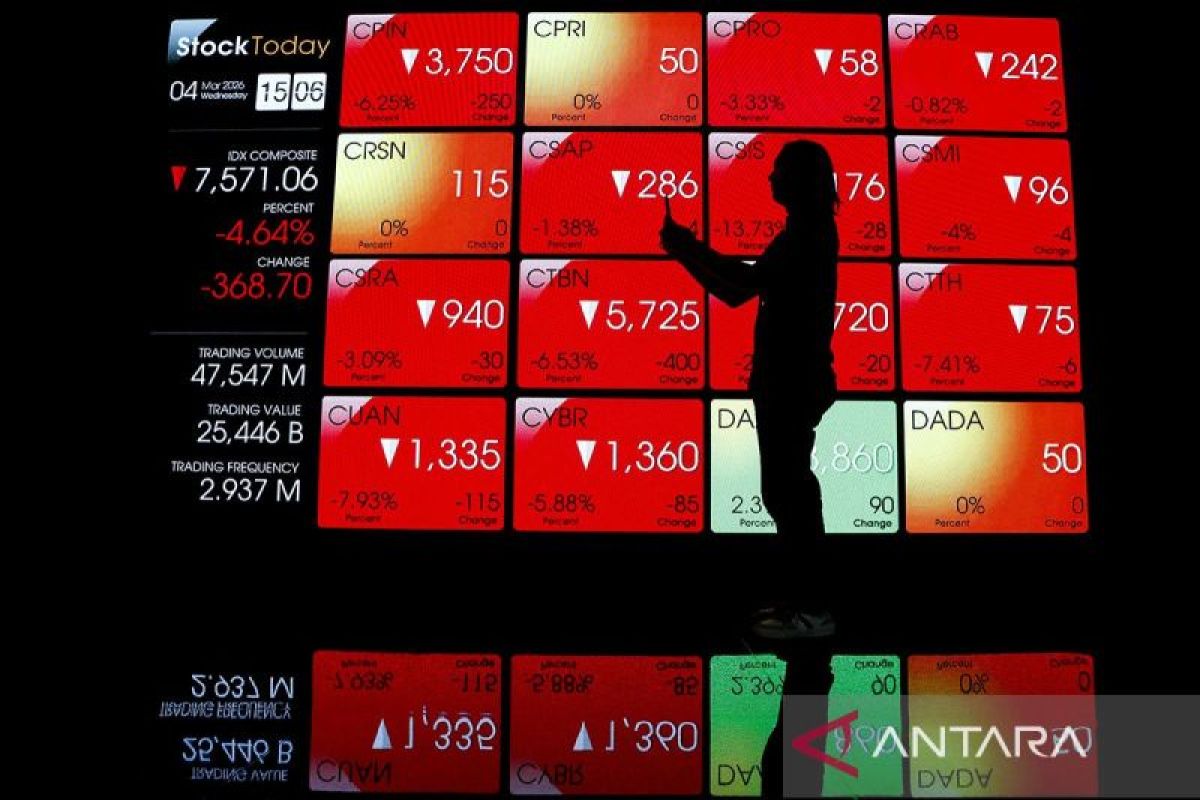
Jakarta (ANTARA) - The Composite Stock Price Index (IHSG) of the Indonesia Stock Exchange (BEI) moved higher on Wednesday morning, following Asian markets, as US President Donald Trump once again delayed an attack on Iran for two weeks.
The IHSG opened up 191.38 points or 2.75% at 7,162.41. Meanwhile, the LQ45 index of 45 leading stocks rose 22.61 points or 3.22% to 724.27.
“Based on technical analysis, we see the IHSG potentially strengthening in a limited manner with support and resistance at 6,920-7,240,” said Associate Director of Research and Investment at Pilarmas Investindo Sekuritas, Maximilianus Nico Demus, in his analysis in Jakarta on Wednesday.
From abroad, tensions had previously escalated after Trump threatened to attack Iranian infrastructure if no agreement was reached by 20:00 US time.
However, Trump ultimately delayed the attack again, stating that he was in very intense negotiations with Iran, after Pakistan ultimately requested a two-week extension for negotiations.
As such, 21 April 2026 will become the new deadline to determine whether negotiations succeed or not following the delay.
With the postponement of the attack, oil prices fell sharply, with WTI dropping 14.63% to $96.43 per barrel and Brent declining 12.86% to $95.22 per barrel at 09:18 WIB.
On the other hand, from the US, market participants are awaiting the release of the FOMC Meeting Minutes on Thursday (09/04), to gauge the Fed’s projections in making decisions on interest rates.
In addition, various US inflation data such as Personal Income, Consumption, and Spending, PCE Price Index, GDP Price Index, and CPI will also be major focuses for market participants. US inflation data will serve as a reference for the Fed in setting its monetary policy.
Domestically, the Ministry of Finance emphasised that the state budget remains strong despite rising global oil prices. The government has conducted fiscal simulations across various oil price scenarios ($80–100 per barrel) and ensured the deficit remains around 2.9% of GDP.
Moreover, steps for spending efficiency and mitigation strategies have been prepared to cushion the impact of rising energy prices. Overall, the state budget is assessed to have sufficient room to absorb global pressures, maintain fuel subsidy stability, and remain stable even in the worst-case scenario.
Nevertheless, the state budget’s sensitivity to rising oil prices remains high, so fiscal space could be pressured if energy prices stay elevated for longer. Therefore, the effectiveness of spending efficiency and mitigation strategies will be key to maintaining fiscal stability going forward.
On Tuesday (07/04) trading, European stock markets weakened across the board, including the Euro Stoxx 50 down 1.07%, the UK FTSE 100 down 0.84%, the German DAX down 1.06%, and the French CAC 40 down 0.67%.
Meanwhile, Wall Street in the US mostly strengthened on Tuesday (07/04), with the Dow Jones Industrial Average down 0.18% to 46,584.46, the S&P 500 up 0.08% to 6,616.85, and the Nasdaq Composite up 0.10% to 24,202.37.
Regional Asian stock markets this morning included the Nikkei up 2,674.44 points or 5.01% to 56,104.00, the Shanghai index up 60.23 points or 1.55% to 3,950.40, the Hang Seng up 573.47 points or 2.28% to 25,690.00, and the Straits Times up 37.04 points or 0.75% to 4,995.05.