
IHSG Stagnates Today, Holds at 6,000 Level
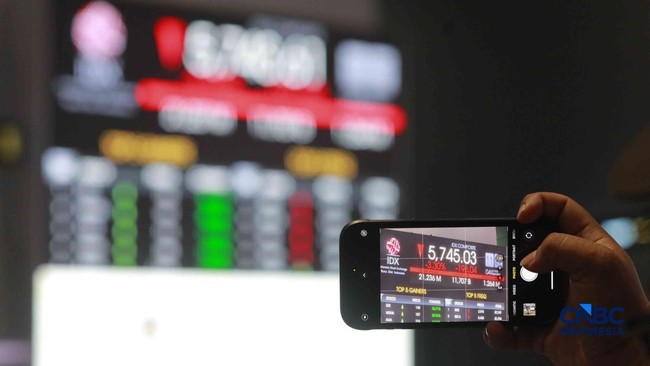
The Jakarta Composite Index (IHSG) closed almost unchanged in trading today, Tuesday (14/7/2026). The IHSG continued to experience high volatility today. After surging 1.92% at the close of trading yesterday, the IHSG initially opened in the red zone. During intraday trading, the IHSG touched a high of 6,095.02 but was unable to hold onto gains before paring its advance and returning nearly to the previous trading level. Trading value and volume surged quite high compared to the average trading days prior. Transaction value reached Rp15.36 trillion, involving 26.48 billion shares in 2.59 million transactions. Last week, the average daily transaction value was only Rp10.27 trillion, with recorded trading volume of 20.49 billion shares. Citing Refinitiv, the IHSG’s movement today was held back by a correction in major bank stocks. This was also reflected in the financial sector, which plunged the deepest at 1.71%. Bank Rakyat Indonesia (BBRI), Bank Central Asia (BBCA), and Bank Mandiri (BMRI) collectively weighed on the IHSG with respective contributions of -10.22 points, -8.82 points, and -7.35 points. Meanwhile, conglomerate-owned companies, particularly those belonging to the Bakrie and Prajogo Pangestu groups, attempted to lift the IHSG but were not strong enough. Bumi Resources Mineral (BRMS) contributed 6.7 points, Barito Renewables Energy (BREN) 5.8 points, and Energi Mega Persada (ENRG) 5.23 points. For context, during yesterday’s trading, major bank stocks propelled the IHSG sharply higher towards the end of the session. This followed an announcement from rating agency Standard & Poor’s (S&P) that it maintained Indonesia’s investment grade rating and stable outlook. The decision was welcome news after previous reports suggested the agency might downgrade the country’s outlook. S&P Global Ratings decided to maintain Indonesia’s sovereign credit rating at BBB for the long term and A-2 for the short term, with a stable outlook. The decision provided a breath of fresh air for the market and the government. Since the beginning of 2026, Indonesia has faced pressure from global rating agencies, after both Moody’s and Fitch Ratings previously downgraded the country’s outlook. Amid various global and domestic economic challenges, S&P’s decision signals that confidence in Indonesia’s economic fundamentals remains intact. In its report, S&P stated the stable outlook reflects confidence that government revenues will continue to recover, exports will improve thanks to rising commodity prices, and fiscal discipline in keeping the deficit below 3% of GDP will remain a policy anchor.