
IHSG Session 1 Rises 0.61%, Transaction Value Tops Rp 10 Trillion
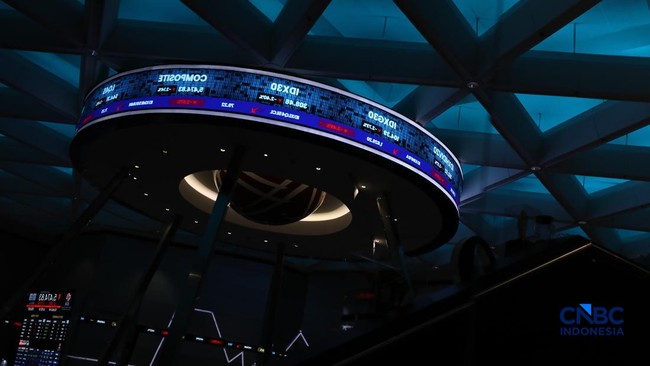
The Jakarta Composite Index (IHSG) closed the first session in positive territory on Tuesday (14/7/2026), settling at 6,074.61, a gain of 36.77 points or 0.61%. The index was supported by a majority of listed companies, with 444 stocks advancing, 191 declining, and 330 remaining unchanged. Trading activity was relatively busy, with transaction values reaching Rp 10.14 trillion, involving 18.33 billion shares in 1.75 million transactions. For comparison, the total transaction value for the entire previous trading day was only Rp 12.14 trillion, with a volume of 25.07 billion shares. According to Refinitiv, almost all sectors supported the IHSG, with only the financial sector experiencing a correction of 0.75%. The IHSG’s rise was supported by the movement of conglomerate stocks. Barito Renewables Energy (BREN) rose 6.19%, contributing 7.74 points to the index’s gain. Meanwhile, Bakrie-owned Bumi Resources Minerals (BRMS) surged 9.43%, contributing 7.44 points, and VKTR contributed 5.54 points. Conversely, major banking stocks were the main drag. Bank Central Asia (BBCA) fell 1.2%, weighing down the index by -6.62 points, followed by Bank Mandiri (BMRI) at -4.9 points and Bank Rakyat Indonesia (BBRI) at -4.38 points. Despite the busy market, the IHSG moved with high volatility. It opened with a 0.33% gain this morning but briefly dipped to a low of 6,002.9. The IHSG was also buoyed by positive news after rating agency Standard & Poor’s (S&P) maintained its investment grade rating and stable outlook for Indonesia. This decision was welcome news following earlier reports that the agency might downgrade Indonesia’s outlook. S&P Global Ratings decided to maintain Indonesia’s sovereign credit rating at BBB for the long term and A-2 for the short term, with a stable outlook. The decision provided a fresh boost for the market and the government, especially after Indonesia faced pressure from global rating agencies earlier in 2026, with Moody’s and Fitch Ratings having previously lowered the country’s outlook. Amid various global and domestic economic challenges, S&P’s decision demonstrates that confidence in Indonesia’s economic fundamentals remains intact. In its report, S&P stated the stable outlook reflects confidence that government revenues will continue to recover, exports will improve thanks to rising commodity prices, and the discipline of maintaining the fiscal deficit below 3% of GDP remains a policy anchor.