
IHSG Remains Dim Until April 2026, Like a Power Outage, Darling...
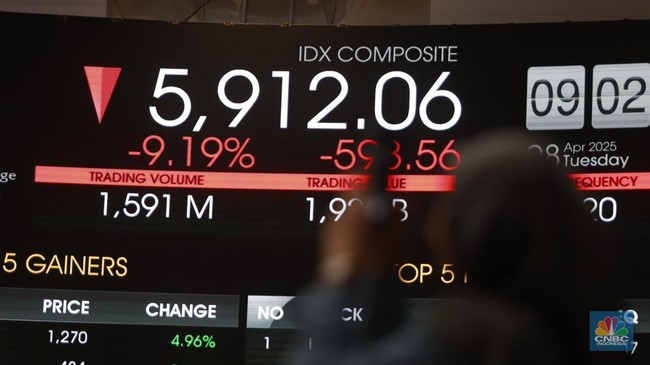
Jakarta, CNBC Indonesia - The Composite Stock Price Index (IHSG) has recorded consecutive negative performance over the first four months of 2026. This weakening has led to a highly significant cumulative decline since the beginning of the year (year-to-date/YTD).
The IHSG’s weakening over these four months has made the situation in 2026 very bleak for investors.
As of the close of trading in April 2026, the IHSG ended at 6,956.80. This position represents a correction of -19.55% YTD compared to the 2025 year-end close of 8,646.93.
Throughout the January to April 2026 period, the index’s movements closed in the red zone on a monthly basis. The details of the monthly corrections include January down -3.67%, February weakening -1.13%, March plummeting -14.42%, and April closing with a weakening of -1.30% from 7,091.67 at the end of the previous month.
The performance over these four consecutive months at the start of the year is recorded as one of the weakest opening periods in the history of Indonesia’s capital market. This consecutive weakening condition is even assessed to exceed the successive pressures that occurred during the 1998 crisis period.
Historical Anomaly in April’s Performance
The weakening that occurred specifically in April 2026 shows a clear deviation compared to the historical IHSG trend. Based on index movement data over the last 10 years, from 2017 to 2026, April generally has a positive tendency.
Data shows that the probability of the IHSG closing in the green zone in April actually reaches 60%, with an average positive growth of 0.86%. The -1.30% decline in April this year breaks the usual recovery trend.
Here is a detailed comparison of historical IHSG performance data for the first four months over the last 10 years:
Domestic Dynamics and Global Pressures
This string of negative performance is inseparable from a combination of domestic sentiments and external pressures. On the domestic side, the market responded to various dynamics, including massive selling pressure due to warnings from MSCI that triggered a comprehensive stock exchange overhaul and related issuers’ free float.
The policy of suspensions or temporary trading halts by the stock exchange authority during that period also made market participants take a very conservative stance. This was exacerbated by the rupiah exchange rate movement under pressure to Rp17,340/US$.
Meanwhile, from an international perspective, global stock exchanges are also facing high volatility due to the war in the Middle East involving the US and Iran.
Geopolitical tensions in the strategic region affect the stability of sea trade routes and energy commodity prices, creating concerns about global inflation by the end of this year.
On the other hand, US macroeconomic policies, particularly regarding the direction of leadership transition at the Federal Reserve and interest rate expectations due to the possibility of rising inflation, remain key determinants of capital flows.
Tightening global liquidity makes emerging markets like Indonesia very vulnerable to foreign fund withdrawals.
This dual pressure from domestic fundamentals and global sentiment has forced the IHSG to undergo a very deep price adjustment.
The first four months of 2026 indicate that investors are still recalculating risk profiles, maintaining cash positions, and re-evaluating issuers’ resilience amid the macroeconomic uncertainty looming over the first half of this year.