
IHSG plunges by more than 4 percent, analysts highlight domestic sentiment
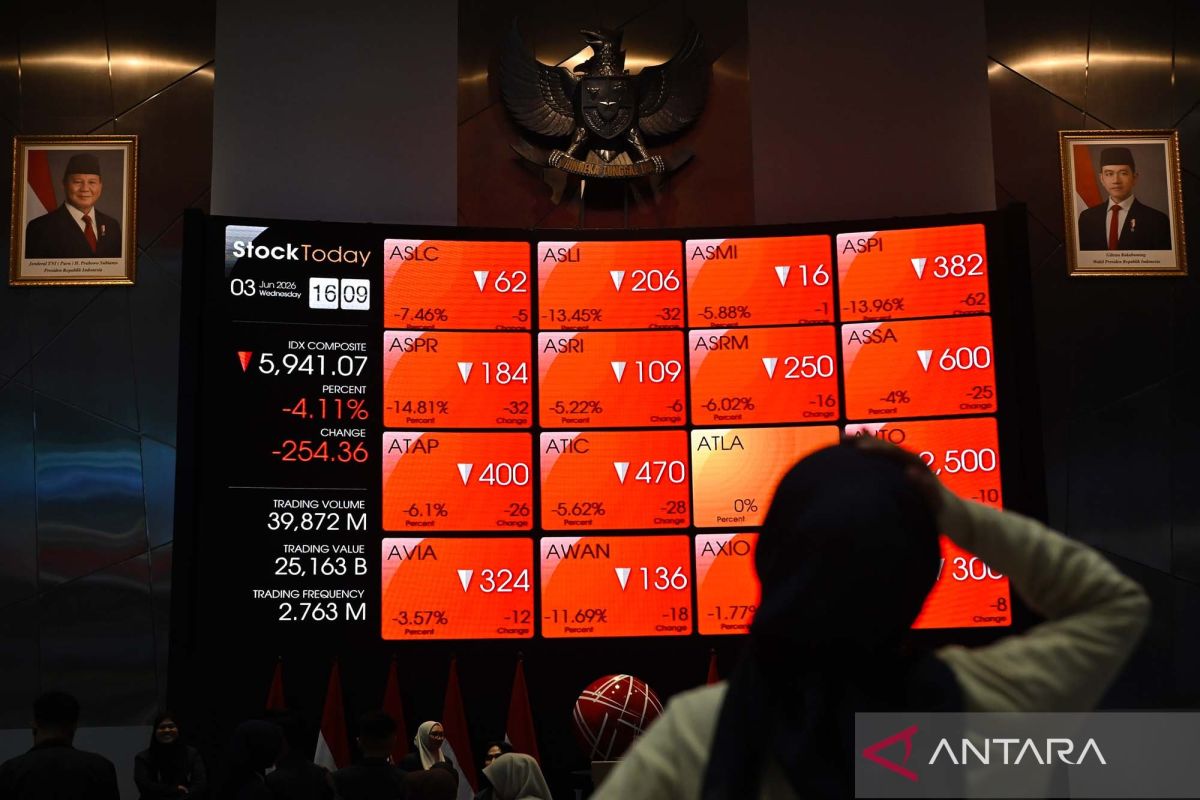
Jakarta (ANTARA) - The Jakarta Composite Index (IHSG) continued to experience a sharp correction in trading on Thursday, with a decline of more than 4 percent.
As of this writing, the IHSG was down 246.14 points, or 4.14 percent, to 5,694.91. Market observer and Founder of Republik Investor, Hendra Wardana, said the sharp correction in the IHSG indicates that the market is facing a fairly serious crisis of confidence.
“The sharp correction in the IHSG, which broke through the psychological level of 6,000 and closed at 5,941 on June 3, 2026, is a signal that the market is experiencing a fairly serious crisis of confidence,” said Hendra in Jakarta, Thursday.
According to him, the weakening of the stock market is not only influenced by external sentiment, but is also exacerbated by a number of domestic factors.
The weakening of the rupiah is influenced by concerns about the single-window export policy, as well as the continued outflow of foreign funds, which is a factor that encourages investors to reduce their investment in risky assets in Indonesia.
Hendra sees this condition as contrasting because most Asian stock exchanges are actually moving higher.
“This shows that the pressure on the domestic market comes more from internal factors than external ones,” he explained.
He said the market tends to move based on perceptions of risk and future prospects, not solely influenced by optimistic statements about the economic situation.
When the government states that the economic fundamentals are still strong, but at the same time the rupiah continues to weaken, the IHSG becomes one of the worst-performing indices globally this year.
“Investor confidence is a very valuable asset. When policy certainty decreases and market players find it difficult to project the direction of the economy in the future, investors tend to choose to wait or even move their funds to other countries that are considered more stable,” said Hendra.
From the perspective of capital flows, Hendra noted that foreign investors again recorded net sales of around IDR 864 billion in trading today. Meanwhile, cumulatively since the beginning of the year, foreign funds that have exited the Indonesian stock market have reached around IDR 67 trillion. The large outflow of capital explains the continued selling pressure on large-cap stocks that have been the main pillar of the index.
He estimates that market volatility will remain high as long as foreign capital outflows continue and there are no positive catalysts to restore global investor confidence in the Indonesian market.
However, Hendra believes that the current conditions do not have to be overreacted. He sees that many leading stocks have experienced a fairly deep correction so that their valuations are starting to become attractive to long-term investors.
However, he warned that a market that is in the midst of a sentiment crisis often moves irrationally in the short term.
“Therefore, it is possible that the IHSG may still experience further pressure and test the next psychological area around 5,800 to 6,000 before finally finding a new balance and having the opportunity to recover gradually,” he said.