
IHSG Opens Weak, Down 0.34%
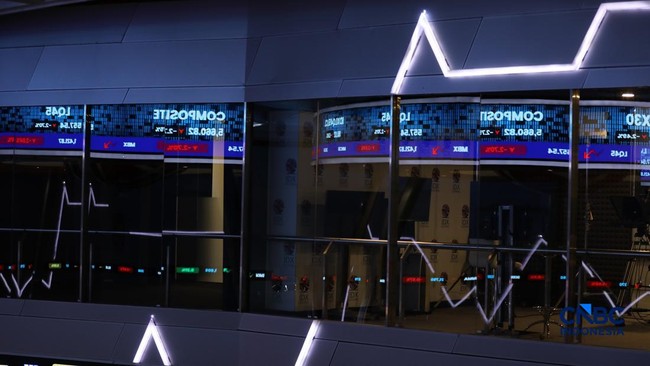
Jakarta, CNBC Indonesia – The Composite Stock Price Index (IHSG) opened weaker in Thursday’s trading session (9/7/2026), as market participants continued to monitor global sentiment and await a number of economic catalysts.
The IHSG opened at 5,853.62, down 19.75 points or 0.34% compared with the previous close.
A total of 180 stocks advanced, 215 declined and 569 were unchanged, reflecting selling pressure that continued to dominate trading during the opening session. The market capitalisation of the Indonesia Stock Exchange stood at Rp10,246 trillion.
Indonesia’s financial markets are expected to remain highly volatile today. A number of overseas sentiments are likely to weigh on the IHSG through to the rupiah, including the intensifying war and new projections for the world economy.
The United States military launched fresh attacks against Iran on Wednesday (8/7/2026), targeting Tehran’s ability to threaten shipping in the Strait of Hormuz, a route that carried roughly one-fifth of the world’s oil supply before the war broke out.
US Central Command (CENTCOM) said the strikes were in response to attacks on three merchant vessels in the Strait of Hormuz the previous day. US President Donald Trump also confirmed that the provisional understanding (memorandum of understanding) with Iran to end the conflict had “ended”, and threatened a harsher response if attacks on ships recurred.
A US official said the latest wave of strikes would be larger than the operation conducted a day earlier.
The strikes shook several cities on Iran’s southern coast, including Bandar Abbas, Iran’s largest port, as well as Konarak and Chabahar, which suffered power outages and damage to maritime facilities.
In response, Iranian state media reported that Tehran was preparing a major retaliatory attack on US military bases in the region.
Iran is also considering other measures, ranging from withdrawing from the Nuclear Non-Proliferation Treaty (NPT) and changing its nuclear doctrine, to closing the Bab el-Mandeb Strait, one of the world’s strategic shipping lanes.
The latest escalation has again dashed hopes of a permanent peace between Washington and Tehran. Tensions in the Middle East also pushed world oil prices up by more than US$1 per barrel, with Brent trading at around US$79.28 per barrel.
Meanwhile, the International Monetary Fund (IMF) has again cut its global economic growth projection for 2026 to 3%, lower than the 3.5% growth recorded in 2025.
According to its latest report, the revision reflects the lingering impact of the war in the Middle East, surging energy prices and heightened geopolitical uncertainty burdening the world’s economic outlook.
In its latest World Economic Outlook (WEO) report released on Wednesday (8/7/2026), the IMF said the conflict involving the United States, Israel and Iran was among the biggest risks to the global economy.
Nonetheless, the IMF assessed that the negative impact of the conflict could still be mitigated by rapid investment in artificial intelligence (AI) and other technologies that continue to support global economic activity.
The IMF expects global inflation to rise to 4.7% in 2026, up from 4.1% in 2025, driven by a sharp increase in commodity prices, particularly energy.
In its projection, the IMF assumes oil prices will average around US$89 per barrel, with energy prices currently some 25% higher than before the war broke out in late February.
As for Indonesia, the IMF maintained its projection of 5.0% growth in 2026 and 5.1% in 2027.