
IHSG Opens Trading Up More Than 1%
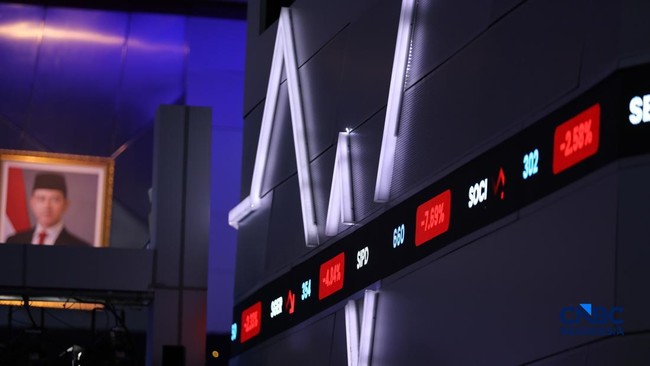
The Indonesia Composite Index (JCI) opened slightly lower in trading on Wednesday (1/7/2026), but quickly reversed course to surge into the green zone.
At the market opening at 09:00 WIB, the JCI fell by 0.05%, or a correction of 3 points, to the level of 5,640.61. Transaction value was recorded at approximately Rp 1.156,13 billion, with a trading volume of 116.23 million shares traded across 23,906 transactions. A total of 183 stocks strengthened, 112 stocks weakened, while 278 stocks remained stagnant.
A few minutes after the market opened, the JCI reversed direction into the green zone, strengthening by up to 1.09% and touching the psychological level of 5,700. The issuers with the largest transaction values at the start of today’s trading were BBCA, BBRI, BMRI, DSSA, and MAPI.
As the first day of the second half of 2026 begins, the Indonesian financial market is expected to face many challenges, both from domestic and international factors. The following are several market-driving sentiments for today:
Globally, Iran reaffirmed on Tuesday that it would not hold a meeting with high-level US envoys, leaving the prospects for long-term peace between the two nations uncertain. Tehran stated that its current focus is on finalising the details of the ceasefire agreed upon two weeks ago before discussing more complex issues, including its nuclear programme.
Meanwhile, Iran emphasised that it will continue to control traffic in the Strait of Hormuz alongside Oman and plans to begin imposing shipping tariffs in mid-August after the 60-day negotiation period ends. Despite high tensions, oil prices continue to weaken, though the UN has warned that the impact of war could potentially drive up food and energy prices in vulnerable nations. The interim US-Iran agreement also includes efforts to end the Israel-Hezbollah conflict, but implementation remains doubtful.
On Wednesday, S&P Global is scheduled to release the China Manufacturing PMI data. For reference, in May 2026, Chinese manufacturing activity moderated, with the index easing to 51.8 from a five-year high of 52.2 in April. Despite the slowdown, this achievement remains above market projections of 51.4. The growth of new orders and output moderated but remained solid, supported heavily by domestic demand.
Domestically, the Government officially began the mandatory implementation of 50% biodiesel (B50) on 1 July 2026, marking a new chapter in the national energy policy that has been built over nearly two decades. Unlike previous programme launches, the B50 implementation is not being carried out all at once. The Government has set a three-month transition period so that the distribution chain and fuel blending processes can proceed gradually before all petrol stations in Indonesia fully sell B50 on 1 October 2026.
Today, S&P Global will also announce Indonesia’s Manufacturing PMI data. Notably, the Purchasing Managers’ Index showed Indonesia’s PMI at 50.0 in April 2026, representing an improvement after the index recorded a contraction at 49.1 in March 2026. The PMI uses 50 as a baseline; above 50 indicates an expansion phase, while below 50 indicates contraction.
Furthermore, Statistics Indonesia (BPS) will publish Indonesia’s inflation data for the June 2026 period. In May 2026, annual inflation in Indonesia accelerated to 3.08%, up from 2.42% the previous month, exceeding the 2.97% expectation. This increase was primarily driven by the food sector, which surged by 4.94% due to high basic commodity prices and distribution costs across various regions. Price pressures were also evident in the housing, transport, and healthcare sectors.
On a monthly basis, the consumer price index increased by 0.28%. For the June release, the consensus projects inflation will tend to rise slightly to the 3.1% level. Indonesian inflation is expected to rise again in June 2026 due to rising food prices and a surge in non-subsidised fuel prices amid the weakening Rupiah. BPS is scheduled to announce the inflation data on Wednesday (1/7/2026).
CNBC Indonesia’s consensus from 13 institutions expects the Consumer Price Index (CPI) to experience monthly inflation of 0.30% (mtm) and annual inflation of 3.2% (yoy), higher than the May realisation of 0.28% (mtm) and 3.08% (yoy).
BPS is also scheduled to release Indonesia’s trade balance data for May 2026. The national trade balance performance was previously under scrutiny after the surplus in April 2026 shrank sharply to US$ 0.09 billion, far below the US$ 1.5 billion expectation, and became the smallest surplus since April 2020.
Meanwhile, Asia-Pacific markets opened mixed in trading on Wednesday (2/7/2026) amid the weakening of the Japanese Yen to its lowest level in 40 years against the US Dollar. Market participants are also closely watching the direction of US central bank interest rate policies and several important economic data sets to be released today.
LSEG data shows the Japanese Yen weakened to 162.28 per US Dollar, extending the decline from the previous session. This condition has made investors wary of potential intervention by Japanese authorities to curb the currency’s depreciation.
According to CNBC, the Japanese Nikkei 225 index rose 1.79% at the start of trading, while the broader Topix index rose 1.07%. In South Korea, the Kospi index gained 1.52%, though the small-cap Kosdaq index corrected by 0.42%. Meanwhile, the Australian stock market moved relatively flat, with the S&P/ASX 200 recording a slight decline of 0.05% in morning trading.