
IHSG Opens Slightly Higher Before Reversing to a 0.4% Decline Amid Global Tech Sell-Off
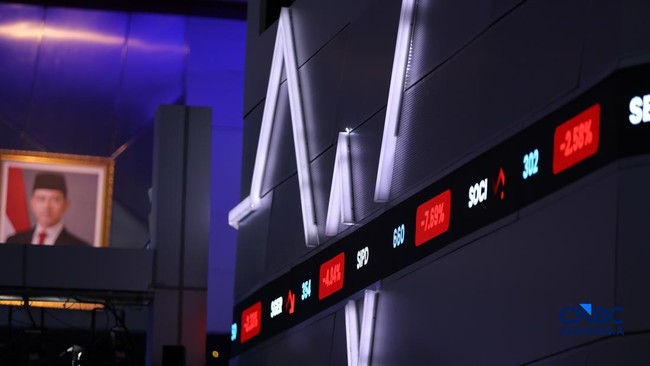
Jakarta, CNBC Indonesia – The Composite Stock Price Index (IHSG) opened slightly higher in trading on Friday (17/7/2026), amid the dominance of global sentiment still clouded by the sell-off in technology and semiconductor shares in the United States and the Asia-Pacific region.
According to Indonesia Stock Exchange (IDX) data, at the opening of trade at 09.00 WIB, the IHSG rose 4.63 points, or 0.08%, to 6,112.84. A total of 218 shares rose, 74 declined and 331 were unchanged, with transaction value reaching Rp 144.64 billion, involving 193.17 million shares in 38,282 transactions.
However, just a few minutes after the market opened, the IHSG reversed course into the red zone and weakened 0.40% to 6,081.
The most actively traded shares today were BBCA, BMRI, ASII, TPIA and PRDL.
Closing out the trading week on Friday morning, global and domestic market players were presented with a series of crucial macroeconomic data releases published on Thursday.
From the domestic front, the economic climate showed an impressive performance, marked by the release of second-quarter investment figures that set a new record, as well as the official launch of a giant gas project in Maluku.
Meanwhile, from the United States, labour market data and retail consumption figures provided confirmation of the resilience of the world’s largest economy.
Asia-Pacific markets opened lower in trading on Friday (17/7/2026), in line with the sell-off sweeping global semiconductor shares after Taiwan Semiconductor Manufacturing Company’s (TSMC) financial report triggered investor concerns.
In addition, according to CNBC, the market is also watching the weakness of Wall Street, which remains overshadowed by volatility in the artificial intelligence (AI) sector.
In Japan, the Nikkei 225 index fell 0.6% at the start of trading, while the Topix weakened 0.3%. In Australia, the benchmark S&P/ASX 200 index slipped 0.2%, while the South Korean market was closed for a national holiday.
The pressure in the market was triggered by the plunge in the VanEck Semiconductor ETF (SMH), which tumbled nearly 4% after TSMC shares fell more than 2% following the release of its second-quarter results. Although the company’s net profit surged compared with the same period last year, TSMC also raised its capital expenditure (capex) projection for this year, prompting investor caution.
TSMC’s weakness dragged down other semiconductor shares, including Marvell Technology, STMicroelectronics and Micron. Thursday’s decline means the SMH ETF has fallen 6.9% so far this week and is on track for its third weekly decline in the last four weeks.
The correction in the chip sector has also weighed on Wall Street’s main indices throughout the week. The S&P 500 fell 0.6%, while the Dow Jones Industrial Average weakened 0.2% and the Nasdaq corrected 1.5%.
Although AI-related trading, particularly in the semiconductor sector, is under pressure, the S&P 500 remains around 1% below its all-time record high reached in early June. This shows that the US stock market as a whole remains relatively resilient amid profit-taking in technology shares.