
IHSG Opens Sharply Higher as Market Responds Positively to 6 Percent Economic Growth Target
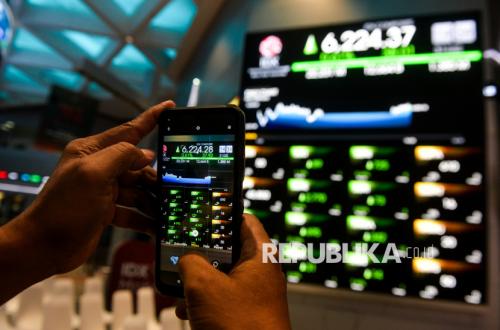
The Jakarta Composite Index (IHSG) of the Indonesia Stock Exchange (BEI) on Tuesday (18/8/2026) continued its strengthening as market participants weighed domestic and global sentiment. The IHSG opened up 46.94 points, or 0.73 percent, at 6,448.83. Meanwhile, the LQ45 index of 45 leading stocks rose 2.83 points, or 0.45 percent, to 635.11.
“If the IHSG is able to hold above 6,377, the strengthening has the potential to continue towards 6,454, then 6,500-6,600 as the next resistance. Conversely, if a correction occurs and the IHSG fails to maintain the 6,377 area, the index has the potential to test the 6,324 level, with the next support at 6,275-6,266,” said Liza Camelia Suryanata, Head of Research at Kiwoom Sekuritas Indonesia, in her analysis in Jakarta on Tuesday (18/8/2026).
Domestically, the IHSG continued its strengthening after last Friday’s trading (14/8) rose 1.59 percent, driven by sentiment from President Prabowo Subianto’s state address at the 2026 Annual Session of the People’s Consultative Assembly (MPR RI) and the Joint Session of the House of Representatives and Regional Representatives Council (DPR-DPD RI), along with the delivery of the Government’s Introduction/Statement on the Draft Law on the 2027 State Budget (APBN) and its Financial Note.
In his speech, the government targeted Indonesia’s economic growth to reach 6 percent in 2027, higher than the 5.4 percent target in the 2026 State Budget, and targeted investment realisation of Rp2,322 trillion in 2027, higher than the Rp2,041.3 trillion target in 2026.
This week, market participants will observe the results of Bank Indonesia’s Board of Governors Meeting on 18-19 August 2026, which will determine its benchmark interest rate policy and report on liquidity conditions and domestic credit growth.
Additionally, market participants will observe external debt data, money supply (M2) data, and balance of payments data, as an overview of Indonesia’s liquidity conditions and resilience to external pressures.
From abroad, market sentiment tended to be negative due to the renewed rise in crude oil prices amid the lack of significant progress in resolving the conflict in the Middle East region.
Tensions between the United States and Iran remain a concern, after the 60-day ceasefire ended without a peace agreement or concrete plan regarding the reopening of the Strait of Hormuz.
Both parties remain at odds over the conditions for opening the shipping lane, while the US plans to implement economic measures against Iran. This condition keeps the risk of energy supply disruption high.
On the other hand, moderate US inflation data for July 2026, coupled with relatively weak US labour data and US retail sales, led market participants to assess that the Federal Reserve has room to maintain interest rates at its September 2026 meeting.
The probability of rates remaining unchanged is around 67 percent, while the chance of a 25 basis point increase has fallen to around 33 percent, and market participants’ focus now turns to the minutes of the Federal Open Market Committee (FOMC) meeting from July 2026.
“The July FOMC minutes will be a key focus to see the direction of the next monetary policy,” said Liza.
European stock markets fell on Monday (17/8), with the Euro Stoxx 50 down 0.222 percent, the UK’s FTSE 100 down 0.28 percent, Germany’s DAX down 0.40 percent, and France’s CAC 40 down 0.70 percent.
US Wall Street markets also fell on Monday (17/8), with the S&P 500 down 0.50 percent to 7,748.14, the Nasdaq Composite down 0.30 percent to 26,644.91, and the Dow Jones Industrial Average down 0.50 percent to 53,460.02.
Asian regional stock markets this morning included the Nikkei index down 0.96 percent to 68,558.00, the Shanghai index up 0.12 percent to 3,987.4, the Kospi index up 1.48 percent to 7,080.41, the Hang Seng index down 0.32 percent to 25,373.81, and the Straits Times index down 0.85 percent to 5,719.26.