
IHSG Opens Higher but Quickly Reverses into the Red
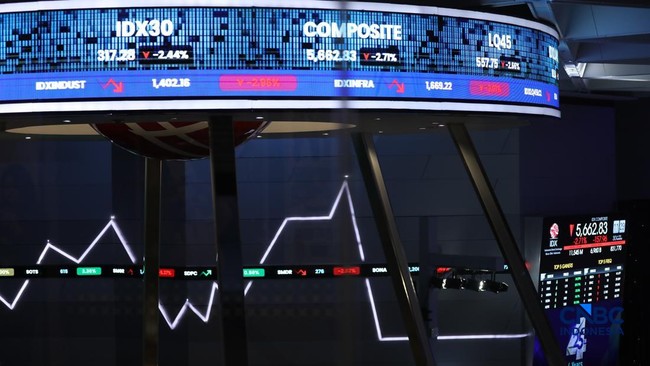
The Indonesian Composite Index (IHSG) opened higher on Monday (13/7/2026) trading, before quickly reversing direction and slipping into the red zone. According to data from the Indonesia Stock Exchange (BEI), at the opening bell at 09.00 WIB, the IHSG rose 10.37 points, or 0.17%, to 5,934.72. A total of 223 stocks advanced, 96 declined, and 340 were stagnant, with a transaction value reaching Rp161.45 billion involving 447.22 million shares in 62,926 trades. However, just minutes after the market opened, the IHSG was observed reversing course and moving into negative territory.
Entering this week’s trading, global and domestic market participants are focusing on a series of essential macroeconomic data releases. These indicators are projected to provide further clues regarding the monetary policy direction of major central banks, the effectiveness of economic recovery measures, and the impact of escalating geopolitical tensions in the Middle East on global commodity price stability. Indicators to be released include trade performance, consumer and producer inflation, economic growth, and external debt positions.
Meanwhile, Asia-Pacific stock markets opened higher on Monday despite the geopolitical tensions weighing on sentiment. In Japan, the Nikkei 225 rose 0.28% and the Topix gained 0.72%. South Korea’s Kospi added 0.58% and the small-cap Kosdaq surged 1.84%, while Australia’s S&P/ASX 200 opened relatively flat.
Ben Emons, founder of Fed Watch Advisors, noted that the potential closure of the Strait of Hormuz remains a factor weighing on market sentiment. However, he suggested that as long as there is no real prospect of the shipping lane being shut in the coming months, which would trigger a global energy crisis, investor attention will remain focused on US inflation data, monetary policy developments, and the bank earnings season.
The Wall Street earnings season will be a major focus this week, with several major US banks scheduled to release their financial results. Companies such as JPMorgan Chase, Goldman Sachs, Morgan Stanley, Bank of America, Citigroup, and Wells Fargo are among the 28 S&P 500 members set to announce their second-quarter 2026 results. Beyond the banking sector, investors are also awaiting financial reports from other major firms like Netflix, Johnson & Johnson, and UnitedHealth. These results are expected to provide insight into the state of the economy and consumer resilience in the US. Expectations for this earnings season are high; based on FactSet data, analysts forecast S&P 500 companies’ profits to grow more than 23% year-on-year (yoy) in the second quarter of 2026. Raymond James Chief Investment Officer Larry Adam stated that the technology sector will be a primary focus for investors, particularly regarding the sustainability of the artificial intelligence (AI) push on corporate profit growth. He noted that despite concerns about hyperscaler companies potentially reducing AI capital expenditure, investment plans are expected to be maintained or even increased through 2028. Adam believes the tangible benefits of AI for businesses will ensure the investment trend continues, noting that mentions of AI in company presentations across all 11 industrial sectors increased 98% year-on-year, reaching a record high and reflecting the technology’s broadening adoption. In addition to the earnings season, market participants will also closely watch the release of the US Consumer Price Index (CPI) data for June, scheduled for Tuesday local time. This inflation data will serve as a crucial indicator for the US Federal Reserve’s interest rate policy direction.