
IHSG Opens First Session Up 0.33% to 6,057 Level
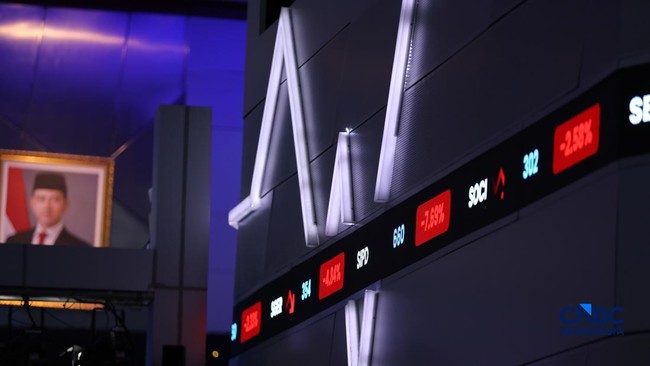
The Jakarta Composite Index (IHSG) opened higher on Tuesday (14/7/2026), amid dominant global sentiment still overshadowed by geopolitical tensions in the Middle East.
According to data from the Indonesia Stock Exchange (BEI), at the opening of trading at 09:00 WIB, the IHSG rose 19.92 points or 0.33% to 6,057.76. A total of 286 stocks advanced, 63 stocks declined, and 274 stocks were unchanged, with a transaction value reaching Rp 284.68 billion involving 366.68 million shares in 113,187 transactions.
The most actively traded issuers today were BBCA, TPIA, BBRI, BMRI and BUMI.
Today, global and domestic market participants will focus their attention on a series of essential macroeconomic data releases.
Indonesia’s financial markets were expected to strengthen in unison today after rating agency Standard & Poor’s (S&P) maintained its investment grade rating and stable outlook. This decision is good news after the rating agency was previously reported to be considering lowering Indonesia’s outlook.
S&P Global Ratings decided to maintain Indonesia’s sovereign credit rating at BBB for the long term and A-2 for the short term, with a stable outlook.
The decision is a breath of fresh air for the market and the government. This is because, since the beginning of 2026, Indonesia has faced pressure several times from global rating agencies, after Moody’s and Fitch Ratings had earlier lowered Indonesia’s outlook. Amid various global and domestic economic challenges, S&P’s decision shows that confidence in Indonesia’s economic fundamentals remains intact.
In its report, S&P stated that the stable outlook reflects confidence that government revenues will continue to recover, exports will improve thanks to rising commodity prices, and the discipline of maintaining the fiscal deficit below 3% of GDP remains a policy anchor.
Behind the decision to maintain Indonesia’s rating, S&P highlighted five main factors:
The economy remains strong, with growth projected at 5.1% in 2026 and around 4.9% per year until 2029.
State revenues are starting to recover, supported by improving tax receipts and income from the natural resources sector.
Downstreaming, Danantara, and Danantara Sumberdaya Indonesia (DSI) are considered to have the potential to increase state revenues and exports through strengthening commodity sector governance.
Fiscal discipline is maintained, with the deficit expected to remain below the 3% of GDP limit.
Policy and institutional stability remain a strength for Indonesia, including the independence of Bank Indonesia in maintaining economic and rupiah stability.
S&P assessed that fiscal and monetary indicators remain solid. The government is believed to be able to keep the fiscal deficit below 3% of Gross Domestic Product (GDP), supported by the realisation of state revenues which grew 21.4% year-on-year in the first half of 2026 to Rp1,459.4 trillion, as well as efficiency measures in strategic spending items.
In the monetary sector, S&P appreciated the operational independence of Bank Indonesia following the revision of the P2SK Law and considered the decision to adjust the benchmark interest rate to 5.75% in June 2026 as a proactive and appropriate step to maintain rupiah exchange rate stability.
Nevertheless, S&P Global also provided important notes that still need attention:
- Economy Grows, Financial Markets Under Pressure
Indonesia’s economy grew 5.6% in the first quarter of 2026. However, the IHSG lost more than 30% of its market capitalisation and the rupiah weakened around 7% against the US dollar.
- Middle East War Poses a Threat
S&P assesses that the conflict in the Middle East and disruption to the Strait of Hormuz are new risks because Indonesia still depends on oil imports.
- Oil Prices Become a Burden
The rise in commodity prices has not been able to cover the surge in oil prices, causing the trade balance to deteriorate since March.
- Policy Risks Remain
Policy changes in the resources sector are considered to have the potential to disrupt investor confidence, although the government is deemed to remain flexible.
- Debt Burden Remains Heavy
Interest payments on debt are expected to remain high in 2026-2027, triggered by high bond yields and the weakening rupiah.
- External Position Weakens
The current account deficit is expected to widen to 2.1% of GDP, while external financing needs also increase.
Financial market participants will also be anticipating a number of important data announcements, especially from the United States.
These data are projected to provide further indications regarding the direction of monetary policy from major central banks, the effectiveness of economic recovery measures, and the impact of the escalation of geopolitical conflict in the Middle East on global commodity price stability. Indicators to be released include trade performance and inflation.
Meanwhile, Asia-Pacific markets opened weaker on Tuesday (14/7/2026) as investors scrutinised the rise in United States (US) government bond yields, the corporate earnings season, and the release of US inflation data.
Investors also noted concerns that a surge in oil prices could sustain inflationary pressures, further weighing on market sentiment.
In Japan, the Nikkei 225 index fell 1.17%, while the Topix weakened 0.51%. The South Korean stock exchange also moved in the red with the Kospi plunging 2.01% and the small-cap Kosdaq stock index falling 1.8%.
Australia’s benchmark S&P/ASX 200 index opened 0.29% lower. In Hong Kong, Hang Seng futures were at 24,158, lower than the previous close of 24,213.72.
US government bond yields rose sharply as investors worried that rising oil prices would keep inflation high. This condition triggered volatility in the market ahead of the start of the earnings season for major companies on Wall Street.