
IHSG Opens 0.61% Higher at 5,932 Level
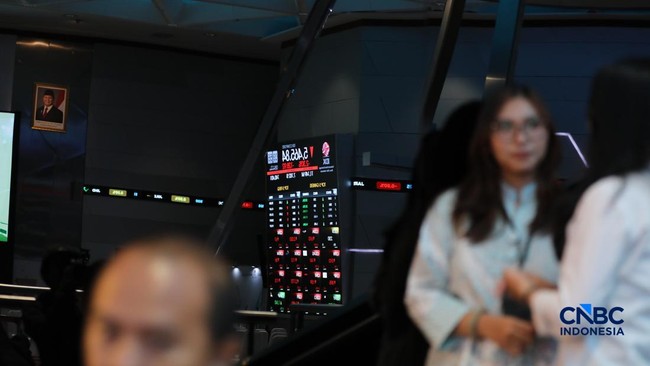
The Indonesia Composite Index (JCI) opened stronger in trading on Monday (29/6/2026), continuing its recovery efforts after a slump during last week’s trading session.
At the market opening at 09:00 WIB, the JCI rose by 0.61%, or an increase of 35.89 points, to the level of 5,932.03. Transaction value was recorded at approximately Rp 110.45 billion, with a trading volume of 142.23 million shares traded across 23,927 transactions. A total of 201 stocks strengthened, 103 stocks weakened, while 309 stocks remained stagnant.
A few minutes after the market opened, the JCI was recorded to have dipped into the red, correcting by 0.24%.
The issuers with the largest transaction values at the start of today’s trading were BBCA, BBRI, BMRI, DSSA, and MAPI.
The financial market is set to enter a week heavy with sentiment, featuring a series of important economic data from both domestic and international sources. Market participants’ focus in the coming days will be directed towards Indonesia’s inflation data, trade balance, and US labour reports, which have the potential to alter expectations regarding the direction of global interest rates.
Developments in the war will also remain a focus for investors. Investors are also closely monitoring China’s manufacturing activity, European regional inflation, and the speech by Fed Governor Kevin Warsh. This series of data is expected to be the primary determinant for the movement of the Rupiah, the JCI, bond markets, and commodity prices throughout this week.
Meanwhile, Asia-Pacific markets moved diversely in Monday’s (29/6/2026) trading following increased geopolitical tensions in the Middle East, following recent attacks between the United States and Iran. Market participants are now closely observing the potential for continued conflict that could disrupt economic stability and global energy supplies.
According to CNBC, Japan’s Nikkei 225 index fell 0.35% at the start of trading. Meanwhile, the Topix index managed to strengthen by 0.43% amidst generally cautious market sentiment.
The South Korean market experienced significant pressure, with the Kospi index dropping 2.29% at the market opening. On the other hand, the small-cap Kosdaq index actually rose by 0.97%.
In contrast, Australia’s benchmark S&P/ASX 200 index rose by 0.41%. The diverse movement across the region reflects investor responses to the heightened geopolitical risks in the Middle East.
Tensions flared again after the US attacked several Iranian military targets late last weekend. The attack was carried out in response to Tehran’s actions involving attacks around the Strait of Hormuz, one of the world’s most important oil shipping lanes.
US President Donald Trump subsequently issued a stern threat against Iran via a post on Truth Social. Trump stated that US military aircraft had struck Iranian missile and drone storage sites as well as coastal radar sites, as they were deemed to have violated the ceasefire agreement once again.
On the diplomatic front, negotiation efforts to end the conflict are reported to have reached a deadlock. A source from Pakistan involved in the negotiation process stated that talks are currently suspended, although all parties are maintaining their representatives in Switzerland to continue discussions if the situation permits.
Global oil prices also responded to these developments with an increase at the start of trading. Brent crude strengthened by 0’8% to US$72.57 per barrel, while West Texas Intermediate (WTI) rose 1.1% to the level of US$70 per barrel.
In the United States, major stock futures moved higher despite the market still being overshadowed by geopolitical uncertainty. Dow Jones futures rose 124 points or 0.2%, while S&P 500 and Nasdaq-100 futures rose by 0.4% and 0.5%, respectively.
Wall Street recently closed a diverse week, with investment rotation moving out of technology stocks into other sectors. Throughout last week, the S&P 500 corrected by almost 2% and the Nasdaq Composite plummeted 4.6%, while the Dow Jones actually gained 0.6%.
Giant technology stocks were the primary source of pressure on the market. Nvidia and Alphabet each lost more than 8%, while Meta Platforms, Apple, and Amazon fell by more than 4%.
President of Yardeni Research, Ed Yardeni, assessed that investors are beginning to experience “AI fatigue.” According to him, the market is starting to question whether the massive spending by technology companies on artificial intelligence infrastructure will yield commensurate profits in the future.
This week also marks the end of June trading. As of last Friday’s close, the S&P 500 was recorded to have declined by approximately 3% throughout this month, the Nasdaq fell by more than 6%, while the Dow Jones still recorded a gain of more than 1%.