
IHSG 'Merdeka' Breaches 8,000 During Independence Day? Possible, But There Are Conditions
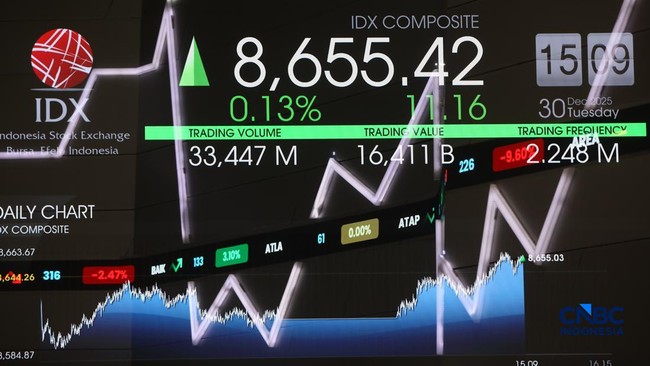
The Jakarta Composite Index (IHSG) is accelerating due to positive sentiment flooding the market. Investors and the public are now waiting to see if the IHSG can return to the 8,000 level this August, replicating a feat achieved the previous year. A year ago, ahead of the 80th anniversary of the Republic of Indonesia, the IHSG touched 8,017.07 when Indonesia’s 8th President Prabowo Subianto delivered his state address on 15 August 2025. At that time, the IHSG surged after undergoing a positive period similar to the current one. Based on today’s closing data, the IHSG ended trading on Tuesday (21/7/2026) at 6,340.02, strengthening by 108.24 points or 1.74%. To touch 8,000 before this year’s Independence Day, the index must still surge 26.18%, or add approximately 1,659.98 points. Moreover, 17 August 2026 falls on a Monday, a stock exchange holiday. The actual deadline is Friday, 14 August, according to the exchange’s trading calendar. From 22 July to that date, only 18 trading sessions are available. The IHSG did touch 8,017 on 15 August 2025, coinciding with President Prabowo’s state address. However, the rise did not happen overnight. A position close to the current IHSG occurred on 16 April 2025, when the index was at 6,400. From there, the IHSG needed 121 calendar days, or 78 sessions, to rise 25.27% and touch 8,000. By 21 July 2025, the index was already at 7,398, requiring only an additional 8.37%. This year, conditions are tougher. From 6,340 on 21 July 2026, the IHSG must rise 26.18% in just 18 sessions. It remains possible, but the index must move roughly four times faster than the rally towards 8,000 last year. Mathematically, with a starting point of 6,340.02, the IHSG needs to generate a geometric return of approximately 1.30% every day for 18 sessions without significant corrections. The IHSG is indeed experiencing a rebound. In the last eight closing sessions, the index has strengthened by about 7.02%. From its lowest point on 8 June at 5,342.14, the recovery has reached 18.68%. However, the IHSG is still down about 26.68% since the end of 2025. This means the recent rise is more accurately read as a recovery after an extreme fall, not yet as confirmation that a long-term uptrend has returned. Quantitative research using 6,437 daily IHSG observations from January 2000 to 21 July 2026 tested how extreme a 26.18% rise in 18 sessions is compared to history. From 4,470 trading starting points since 2008, only three observations subsequently recorded a minimum intraday rise of 26.18% within 18 sessions. These points emerged on 28 and 29 October 2008 and 24 March 2020, all occurring after extraordinary panic due to the global financial crisis and the pandemic. The historical hit rate is only about 0.067%. A moving-block bootstrap simulation was then performed 300,000 times, taking blocks of five-day returns to preserve short-term momentum and volatility characteristics. A parametric model provided a wider range. Assuming an annual return of 5% and volatility of 25%-40%, the probability of touching 8,000 is in the range of 0.04%-2.08%. After adding allowances for price gaps, fiscal speeches, geopolitical changes, large-cap stock movements and model limitations, the final, fairly loose estimate is a 1%-2% chance of touching 8,000. The probability of closing above that level is less than 1%. Indonesia’s economy is not in a state of crisis. Q1-2026 GDP grew 5.61% year-on-year. However, government consumption, which surged 21.81%, was one of the main drivers, while the mining sector contracted 8.2% quarter-on-quarter. The banking sector is also providing a cushion. April credit grew 9.98% year-on-year, with gross NPL at 2.17%, net NPL at 0.84% and CAR at 23.97%. These figures indicate major banks are not yet facing fundamental damage sufficient to derail an IHSG rebound. However, inflationary, currency and energy pressures limit valuation expansion. June inflation reached 3.34%, near the upper bound of Bank Indonesia’s 2.5% plus-minus 1% target. The BI Rate of 5.75% and a 10-year government bond yield of around 7.2%-7.3% make bonds a direct competitor to equities. The May trade balance recorded a deficit of approximately US$1.61 billion, with exports reaching US$23.20 billion and imports US$24.81 billion. Foreign exchange reserves of US$145.6 billion remain adequate but have declined from US$156.5 billion at the end of 2025. On the domestic side, the consumer confidence index remained optimistic at 117.8, although it weakened from 120.9 in May. Indonesia’s investment grade status is still intact. S&P maintained its BBB rating with a stable outlook on 13 July, assessing that fiscal and external weakening is likely temporary. However, Moody’s still places its Baa2 rating with a negative outlook, while Fitch maintained its BBB rating with a negative outlook due to concerns over policy certainty and consistency. Another pressure comes from MSCI. Indonesia retains its Emerging Market status, but MSCI is still evaluating share ownership transparency, free float and allegations of coordinated trading. The effectiveness of reforms by the Financial Services Authority (OJK), the Indonesia Stock Exchange (BEI) and the Indonesian Central Securities Depository (KSEI) will be reassessed in November 2026. If progress is deemed insufficient, consultations regarding a status change to Frontier Market may still be opened. These conditions make global investors tend to wait for proof, not just promises of reform. Without large foreign inflows, a 26% rally must be driven almost entirely by domestic forces.