
IHSG Falls for Three Consecutive Days; Here Are the Sentiments and Projections for Next Week
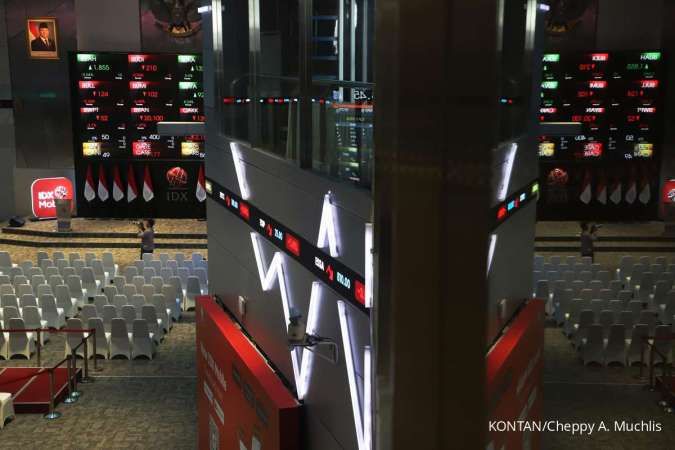
The Composite Stock Price Index (IHSG) closed in the red again at the end of trading on Friday (24/7/2026), extending its weakening trend to three consecutive days. The sharp correction was triggered by a combination of global sentiment, ranging from a sell-off on Wall Street, the slump in United States technology stocks, to a surge in world oil prices that reignited inflation concerns. Based on Indonesia Stock Exchange (BEI) data via RTI Business, the IHSG closed down 1.88% or 118 points at 6,196.43. However, on a cumulative weekly basis, the benchmark index still recorded a gain of 0.34%.
Pressure on the IHSG was evenly distributed across almost all trading lines. All sectoral indices ended in negative territory, with the non-primary consumer goods sector being the largest contributor to the decline after falling 3.04%. The weakness reflects increased investor caution amid deteriorating global sentiment, which triggered a sell-off across various sectors.
Head of Research at Korea Investment & Sekuritas Indonesia (KISI), Muhammad Wafi, explained that the sharp decline in the IHSG was inseparable from the correction occurring on the United States stock exchange. He noted that significant drops in large-cap technology stocks, such as Alphabet which fell 7% and Tesla which plunged 14% after releasing their second-quarter financial reports, sparked investor concerns over the high valuation of the artificial intelligence (AI) sector. Additionally, the surge in global crude oil prices further worsened market sentiment. “Brent crude breached USD 100.69 per barrel for the first time, exacerbating global inflation worries,” Wafi told Kontan on Friday (24/7/2026).
Wafi assessed that while signals of an IHSG recovery have begun to appear recently, they are not yet strong enough to confirm a trend reversal. He stated that the current main support level for the IHSG is around 5,950, while the psychological resistance remains at 6,471. “The two-day consecutive correction on Thursday and Friday reflects that the rebound is still fragile and highly dependent on external sentiment,” Wafi said. Given these conditions, the IHSG’s movement will remain highly sensitive to global economic developments and geopolitical dynamics.
Amid rising market uncertainty, Wafi advised investors to be more selective in picking stocks. Issuers with natural hedges and strong earnings prospects are considered better able to withstand external pressures. The energy and commodity sectors are expected to be among the beneficiaries of rising oil prices. Some recommended stocks include PT Energi Mega Persada Tbk (ENRG), PT Alamtri Resources Indonesia Tbk (ADRO), and PT Bukit Asam (Persero) Tbk (PTBA). Additionally, banking stocks with high Current Account Savings Account (CASA) ratios, such as PT Bank Central Asia Tbk (BBCA) and PT Bank Mandiri (Persero) Tbk (BMRI), are still deemed worthy of being maintained as core holdings in investment portfolios. Conversely, investors are advised to avoid stocks in consumer goods sectors that are sensitive to imports or issuers with high dependency on imported raw materials. These stock groups are considered the most vulnerable to the impact of rising oil prices and the weakening rupiah exchange rate.
Looking ahead to next week’s trading, Wafi expects the IHSG to remain volatile with a mixed tendency. He estimates the support area to be in the range of 6,185 to 6,250, while resistance is seen at 6,350 to 6,470. Market movements are expected to be influenced by three main sentiments: the release of first-half financial reports from major banks, United States inflation data, and developments in the geopolitical conflict in the Strait of Hormuz region. Despite the short-term pressures, KISI maintains its year-end IHSG projection, with a base case target of 6,000 to 6,500, noting that the main determinant will be the MSCI review in November.