
IHSG Closes Lower, Pressured by Geopolitical Risks and Global Interest Rates
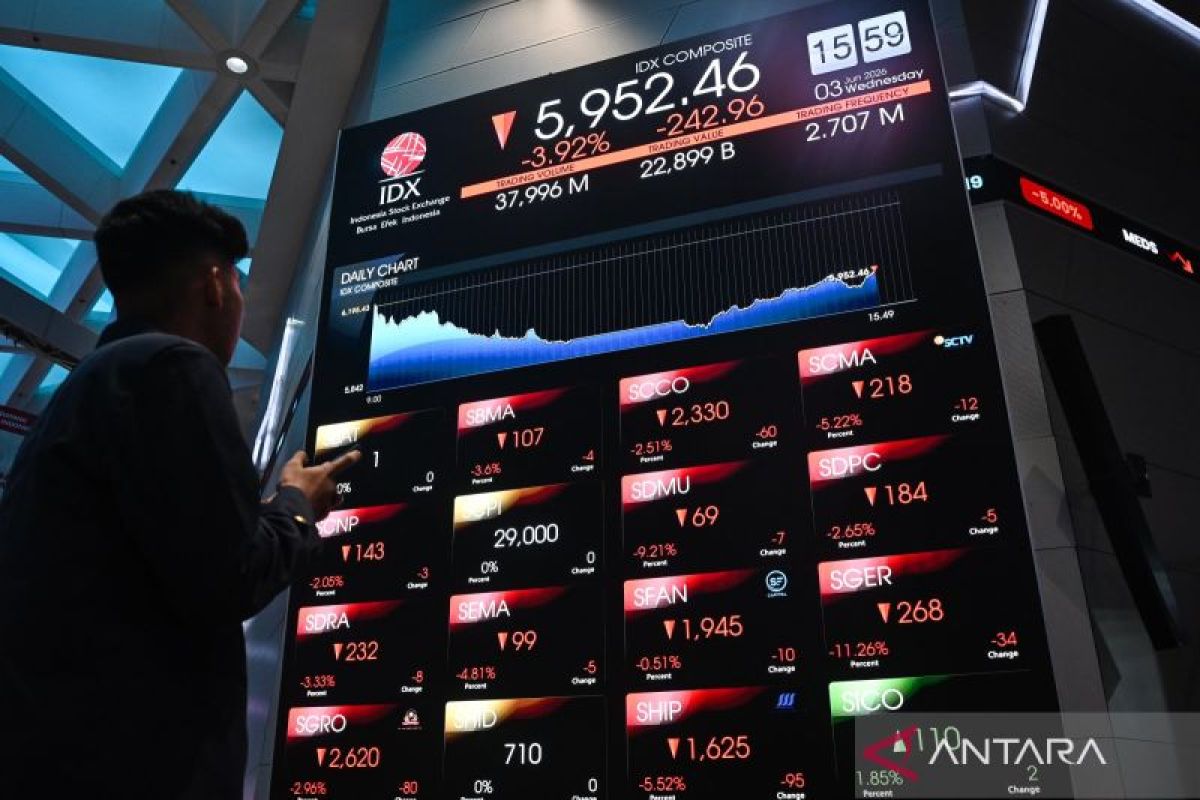
The Indonesia Stock Exchange (IDX) Composite Index (IHSG) closed lower on Monday, as market participants adopted a cautious stance amid geopolitical risks in the Middle East and uncertainty over the direction of global interest rates. The IHSG weakened by 75.34 points, or 1.28 percent, to 5,820.79. Meanwhile, the LQ45 index of 45 leading stocks fell 10.71 points, or 1.83 percent, to 573.01. “Entering this week, both external and internal pressures are weighing on the IHSG,” said Maximilianus Nicodemus, Associate Director of Pilarmas Investindo Sekuritas, when contacted in Jakarta on Monday. From the global front, Nico said the market is once again pricing in geopolitical risk as tensions between the United States and Iran heat up, threatening peace agreements. The US attacked Iranian military bases over the weekend after Iran struck the Strait of Hormuz area. Tensions escalated further after US President Donald Trump threatened to destroy the country. In a Truth Social post, Trump stated that US aircraft had just struck Iranian missile and drone storage sites, as well as coastal radar sites, for violating the ceasefire agreement. Meanwhile, Iran launched drone and missile attacks on Bahrain and Kuwait in response to the new US strikes on targets in southern Iran. Although both sides have agreed to suspend further attacks ahead of peace talks scheduled to resume this week in Doha, Qatar, uncertainty over peace remains. On the economic data front, this week market participants will scrutinise the US Job Openings and Labor Turnover Survey (JOLTS), a speech by Federal Reserve Governor Kevin Warsh, US Non-Farm Payrolls (NFP) data, the US unemployment rate, China’s manufacturing PMI, and Eurozone inflation. “The anticipated US economic data, particularly employment figures, could put pressure on the market if the results are poor,” Nico said. Domestically, Nico noted that market players continue to monitor the progress of transparency reforms in Indonesia’s capital market, government policies, and the absence of sustained foreign capital inflows. This week, the market will also observe Indonesia’s Manufacturing PMI data, June inflation figures, and trade balance data, which will serve as indicators of economic activity strength and the direction of Bank Indonesia’s monetary policy. According to Nico, domestic investors tend to be more cautious about accumulating positions or entering the market amid the current negative sentiment. “Moreover, if there is no improvement at all, wait and see will be the choice for now, especially if there are no policy improvements that have a short-term impact,” Nico said. After opening higher, the IHSG moved into negative territory through the close of the first trading session. In the second session, the IHSG remained in the red until the close of stock trading. Based on the IDX-IC Sectoral Indices, ten sectors weakened, with the infrastructure sector falling the deepest at minus 1.63 percent, followed by the basic materials and financial sectors, which fell 1.44 percent and 1.16 percent respectively. Meanwhile, one sector strengthened, with the property sector rising 0.62 percent. Stocks experiencing the largest gains included OILS, ASPI, TRUS, PMUI, AYLS, and PMUI. Meanwhile, stocks suffering the largest price declines were BHAT, BBRM, COCO, GPSO, and UVCR. Stock trading frequency was recorded at 1,205,000 transactions, with 12.99 billion shares traded, valued at Rp8.16 trillion. A total of 228 stocks rose, 467 stocks fell, and 264 remained unchanged. In regional Asian stock markets this morning, the Nikkei index strengthened 161.12 points, or 0.23 percent, to 69,522.00; the Shanghai index rose 46.64 points, or 1.16 percent, to 4,073.90; the Hang Seng index gained 335.60 points, or 1.48 percent, to 23,007.60; and the Strait Times index advanced 12.30 points, or 0.20 percent, to 5,202.48.