
IHSG Closes Down 3.56% as Investors Shun Risky Assets
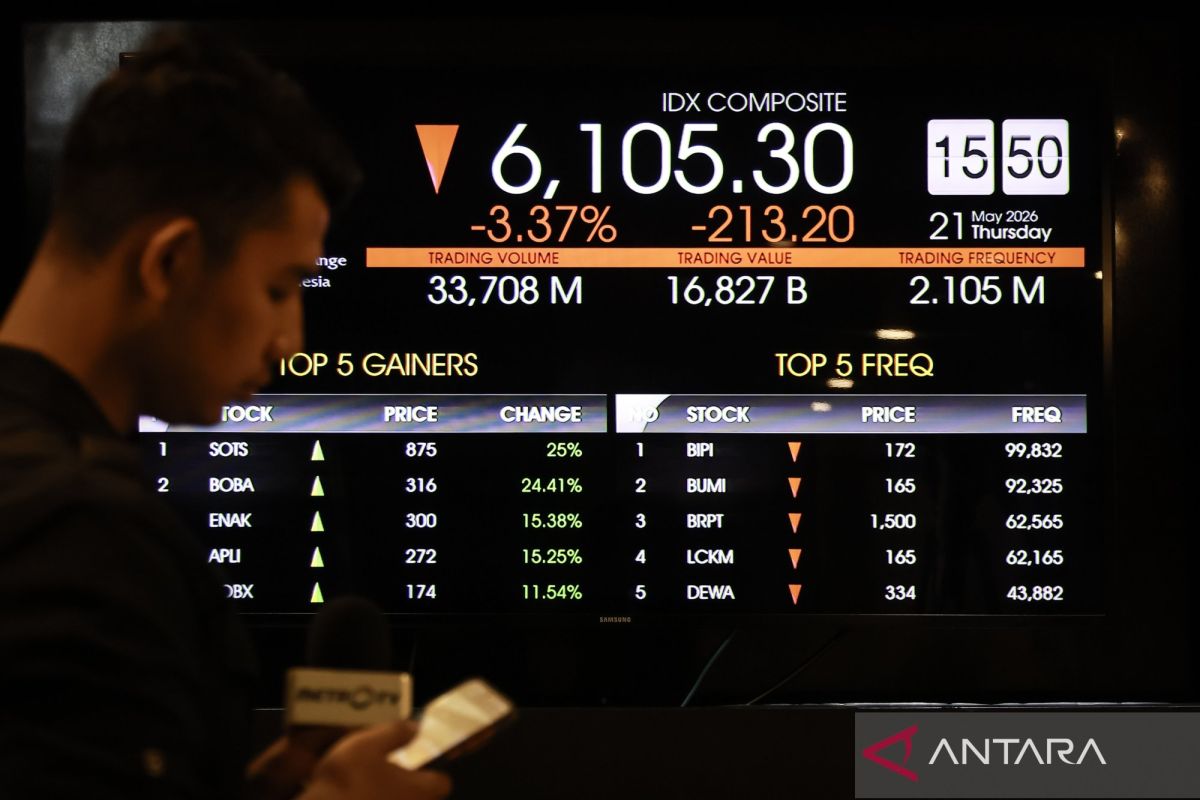
The Indonesia Stock Exchange (BEI) composite index (IHSG) closed sharply lower on Wednesday, falling 217.25 points or 3.56 percent to 5,883.88, as global investors adopted a risk-off stance, including towards emerging markets like Indonesia. The LQ45 index of top 45 stocks also dropped 20.26 points, or 3.39 percent, to 578.17.
Market analyst Elandry Pratama noted that external factors, including the direction of global interest rates, movements in US Treasury yields, and a strengthening US dollar, prompted investors to be more cautious towards risky assets in emerging markets. Domestically, the rupiah’s depreciation, which briefly touched Rp18,000 per US dollar, further pressured market sentiment and triggered profit-taking.
Pratama added that investors are also awaiting clarity on the implementation of several fiscal policies and government priority programmes to assess their impact on economic growth, the budget deficit, and future fiscal sustainability. The lack of changes to Indonesia’s status in the latest MSCI review also meant the market did not receive a new positive catalyst in the short term.
Foreign investors are currently adopting a wait-and-see approach. While Indonesia’s economic fundamentals and stock market valuations remain relatively attractive compared to some regional peers, global investors are still seeking certainty regarding exchange rate stability, the direction of global monetary policy, the effectiveness of government fiscal policies, and the consistency of planned economic programmes. This has resulted in foreign fund flows that are not yet aggressive and remain selective, focusing on stocks with strong fundamentals and high liquidity.
In the short term, the IHSG is projected to move in a consolidative pattern with fairly high volatility. Without strong positive catalysts from either the global or domestic side, the market is likely to continue moving sideways with a cautious bias. Market participants will also monitor the realisation of government fiscal policies and their impact on economic activity in the second half of 2026. However, if external pressures ease, the rupiah stabilises, and there is clarity on economic policy direction that can boost market confidence, the opportunity for a technical rebound and improved market sentiment remains open.
All eleven sectors on the IDX-IC declined, with the raw materials sector falling the deepest at 6.26 percent, followed by energy and infrastructure, which dropped 5.83 percent and 4.47 percent respectively. Advancing stocks included PTPW, BHAT, LINK, SCMA, and BINA, while decliners were led by CTTH, ARKO, BABY, BIPI, and ENRG. Trading frequency reached 2,009,000 transactions, with 24.80 billion shares traded, valued at Rp15.13 trillion. A total of 103 stocks rose, 646 fell, and 210 remained unchanged.
Regional Asian markets were mixed, with Japan’s Nikkei index falling 0.88 percent to 69,174.97, while Shanghai’s composite index rose 0.11 percent to 4,1610.81, Kuala Lumpur’s composite index gained 0.13 percent to 1,682.13, and the Straits Times index edged up 0.20 percent to 5,215.99.