
IHSG Closes Down 1.99% at 5,266
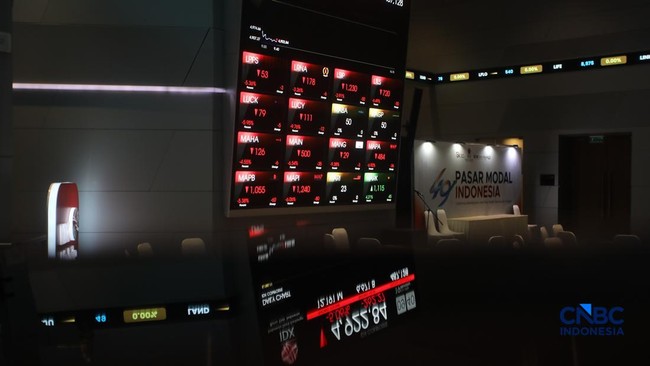
The Jakarta Composite Index (IHSG) ended the day in negative territory, closing at 5,266.13, down 106.96 points or 1.99%.
The IHSG was already lower when trading opened at 09:00 WIB at 5,357.97. It briefly rose early in the session, reaching an intraday high of 5,418.14.
However, the gains did not last. The index gradually weakened into the afternoon, with selling pressure deepening after 14:00 WIB.
The day’s low of 5,182.37 was recorded at around 15:30 WIB, approximately 235.77 points below the intraday peak. The IHSG recovered some of its losses before the close, rebounding by around 83.76 points from its low to finish at 5,266.13.
Trading volume reached 337.63 million lots, with transactions worth Rp16.23 trillion.
IDX data showed that the decline reflected the broad weakness in the market: 101 shares rose, 657 fell and 215 were unchanged.
Refinitiv data showed that the infrastructure sector weighed most heavily on the index, plunging 6.1%. Basic materials fell 3.7%, followed by technology, down 2.9%.
Among the stocks that weighed on the IHSG were PT Telkom Indonesia (Persero) Tbk (TLKM), PT Amman Mineral Internasional Tbk (AMMN), PT Bayan Resources Tbk (BYAN), PT Barito Renewables Energy Tbk (BREN) and PT Barito Pacific Tbk (BRPT).
Stocks cited as offsetting some of the index’s decline included PT United Tractors Tbk (UNTR), PT Astra International Tbk (ASII), PT Apollo Global Interactive Tbk (APLI), PT Sinar Mas Multiartha Tbk (SMMA) and PT Indocement Tunggal Prakarsa Tbk (INTP).
Indonesia’s financial markets were influenced by a range of domestic and international factors. Wall Street’s gains were seen as a potential positive catalyst.
New policies from the Indonesia Stock Exchange (IDX) were also expected to bolster investor confidence. Internationally, developments in the war and China’s economic data were among the factors expected to move markets.
Investors monitored developments in the Middle East, including talks involving Saudi Arabia, Türkiye and Pakistan with Iran, as well as easing oil prices.
Saudi Arabia, Türkiye and Pakistan met Iranian officials in Tehran on Monday to ease the conflict in the Middle East. The meeting took place amid increased Houthi attacks on Saudi Arabia and the threat of further US strikes.
The four countries agreed to continue dialogue to strengthen peace and security cooperation. Pakistan also proposed a regional non-aggression network and a conflict resolution framework acceptable to both Washington and Tehran.
Tensions remained high. US President Donald Trump left open the possibility of renewed strikes on Iran, while Tehran demanded the lifting of port blockades and oil export sanctions before discussing its nuclear programme.
Meanwhile, Egypt’s parliament approved military support to help defend Saudi Arabia. The move strengthened regional defence cooperation as the conflict disrupted shipping through the Strait of Hormuz and drove up global energy prices.
Global crude prices fell on Monday, 26 October 2026, amid hopes that the Middle East conflict could ease. However, attacks on Saudi Arabia and shipping disruption continued to keep investors on alert.
Brent crude fell 0.8% to US$115.81 a barrel, while US West Texas Intermediate (WTI) dropped 1.46% to US$101.76 a barrel.
The pullback followed gains for both benchmarks the previous week. Brent rose 6% over the week, while WTI gained 2.3%.
Despite the decline, oil prices remained high as the risk of energy supply disruptions persisted. Developments in the Middle East conflict are expected to be a key factor shaping prices ahead.
Domestically, the IDX is preparing a series of new policies to tighten capital-market supervision. These include reducing share suspensions, freezing securities accounts suspected of rule breaches and strengthening investigations into suspicious transactions.
The IDX also plans to make less use of Unusual Market Activity (UMA) announcements as an initial supervisory measure.
The committee assessing shares with high ownership concentration (High Shareholding Concentration/HSC) has been expanded to nine members, including five independent external representatives.
From 2 November 2026, HSC-category shares will also be excluded from IHSG calculations, alongside changes to the index review schedule. The measures are intended to improve transparency, safeguard trading liquidity and strengthen investor confidence in Indonesia’s capital market.