
IHSG and Rupiah Both Positive, Here Are the Triggers
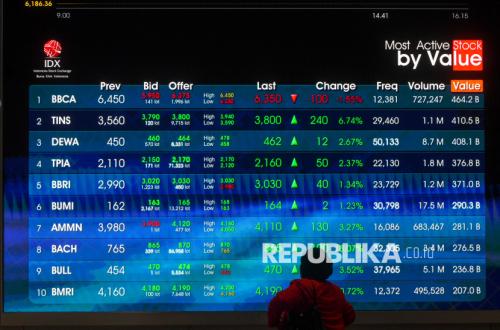
The Jakarta Composite Index (IHSG) of the Indonesia Stock Exchange (BEI) moved higher on Thursday (20/8/2026), following gains in Asian stock markets, driven by the US policy of increasing the nominal amount of long-term bond buybacks. The IHSG opened up 53.12 points, or 0.83 percent, at 6,447.25. Meanwhile, the LQ45 index of 45 leading stocks rose 5.06 points, or 0.81 percent, to 632.53.
“If the IHSG fails to break back through 6,490-6,500, the pullback could continue towards 6,377-6,355, with the next support at 6,294-6,286. As long as that area can be defended, the opportunity for the IHSG to retest the 6,490-6,500 resistance remains open. Conversely, if the IHSG manages to break through 6,500, the strengthening could continue towards 6,723,” said Head of Research at Kiwoom Sekuritas Indonesia Liza Camelia Suryanata in her research note in Jakarta on Thursday (20/8/2026).
From abroad, market sentiment improved especially after the US Treasury Department announced an increase in the nominal amount of long-term bond buybacks to at least 4 billion US dollars per operation starting 9 September 2026, from the previous 2 billion US dollars.
“The policy eases pressure on the bond market and helps support equities,” Liza said.
Meanwhile, the minutes of the Fed’s July 2026 meeting showed that a majority of officials supported keeping interest rates at their current level. However, many participants assessed that a rate hike could be necessary if inflation does not decline.
Fed officials assessed that the US inflation outlook remains highly uncertain and risks are tilted to the upside. Three regional Fed presidents had previously expressed dissent against the decision to hold rates.
On the other hand, tensions between the US and Iran continue as both sides have not reached an agreement regarding the Strait of Hormuz.
US President Donald Trump again stated that the US has full control over the shipping lane, while Iran demands a halt to hostilities and the unfreezing of Iranian assets as part of the conditions for reopening the strait.
“The deadlock keeps the risk of disruption to global energy trade routes high,” Liza said.
Domestically, the Bank Indonesia (BI) Board of Governors Meeting on 18-19 August 2026 decided to hold the BI-Rate at 5.75 percent, in line with consensus expectations.
In addition, BI maintained its domestic economic growth projection in the range of 4.9-5.7 percent in 2026, with current growth starting to move towards the midpoint to the upper bound of the projection. Macroeconomic stability remains maintained, reflected in foreign exchange reserves of 145.3 billion US dollars.
On the other hand, the government plans to cut the quota for certain subsidised fuels in 2027 to 20.09 million kilolitres, a decline of 58.5 percent, or around 28.34 million kilolitres, from 48.43 million kilolitres in 2026.
The policy is part of efforts to control energy subsidies, including Pertalite, assuming an Indonesian Crude Price of 75 US dollars per barrel in 2027.
“The quota cut could tighten public access to subsidised fuel and increase the shift in consumption to non-subsidised fuel, which could add to transport costs and pressure purchasing power, especially for lower-middle income groups,” Liza said.
European stock markets were mixed on Wednesday (19/8), with the Euro Stoxx 50 down 0.11 percent, the UK FTSE 100 up 0.14 percent, Germany’s DAX down 0.14 percent, and France’s CAC 40 down 0.1 percent.
Meanwhile, Wall Street closed higher on Wednesday (19/8), with the S&P 500 up 0.20 percent to 7,710.70, the Nasdaq Composite up 0.20 percent to 26,331.09, and the Dow Jones Industrial Average up 0.20 percent to 53,463.11.
Asian regional stock markets on Thursday morning included the Nikkei up 0.95 percent to 65,950.00, the Shanghai index up 0.54 percent to 3,915.4, the Kospi up 6.18 percent to 6,870.41, the Hang Seng up 0.77 percent to 25,696.81, and the Kuala Lumpur index up 0.14 percent to 1,733.72.