
IFAD Chief Highlights Challenges Facing Indonesian Farmers After Providing Rp36.5 Trillion
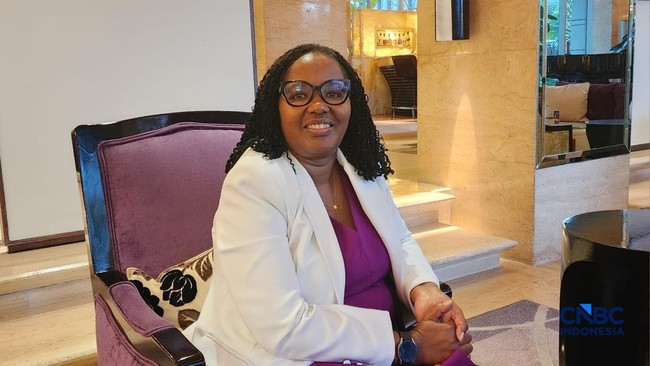
Jakarta, CNBC Indonesia — International Fund for Agricultural Development (IFAD) Vice-President Gerardine Mukeshimana has praised Indonesia’s food security at the macro level, supported by record rice reserves since April. However, she warned that El Niño has reduced rice production by 12% and placed severe pressure on smallholder farmers at the grassroots level.
In a recent interview on Thursday (19 November 2026), Mukeshimana said government rice reserves, which have helped stabilise prices, needed to be replenished by increasing production among local farmers. She also outlined IFAD’s nearly five decades of work in Indonesia, covering 21 projects with total funding of close to US$2 billion (Rp36.5 trillion).
Mukeshimana discussed challenges to farm productivity and rising global fertiliser prices, as well as the success of empowerment projects in West Java and strategies to prevent peatland fires. Here are the main points she raised on Indonesian agriculture and food security:
1. El Niño threat and pressure on farmers’ costs
Mukeshimana said Indonesia’s record rice reserves since April were crucial to protecting consumers’ purchasing power amid high food inflation. Nevertheless, farmers are facing several shocks at once, from extreme weather to high fuel, fertiliser and transport costs.
“Indonesia has had record rice reserves since April and, given the importance of rice in this country, I think that is a very good thing for protecting consumers,” Mukeshimana said.
“But, as you mentioned, El Niño is hitting, and I hear it has reduced rice production by 12%.”
She said rural poverty in Indonesia remained higher than urban poverty, leaving small-scale producers particularly vulnerable to falling back into poverty without adequate resilience measures.
Farmers therefore need a comprehensive package of support, including improved seeds, healthy soil, irrigation, financing, planning skills and agricultural insurance, for which the government subsidises 80% of premiums.
“There is no single intervention that you can say will solve all the problems or protect farmers, but I think you need to come in with a combination of different interventions,” she said.
2. YESS and UPLAND projects support young farmers and irrigation
During her visit to West Java, Mukeshimana visited the Youth Entrepreneurship and Employment Support Services (YESS) project in Bogor, which aims to attract young people to agribusiness. The programme is considered urgent because only one in five farmers in Indonesia is under 40, while the food ecosystem needs young workers throughout the downstream value chain, from production and value addition to transport, retail and input supply.
“The project has really empowered many young people, nearly 300,000, and helped establish agribusinesses or create around 27,000 jobs,” she said.
She noted that 80% of young YESS participants had chosen to stay in rural areas and develop agribusinesses. IFAD also visited the UPLAND project in Garut, co-financed with the Islamic Development Bank (IsDB), which channels river water to upland areas. This has enabled farmers in the project area to continue harvesting rice during El Niño-related drought, while also successfully engaging local private banks through a business-to-business model.
3. Preventing peatland fires and sharing solutions across ASEAN
On recurring peatland fires, Mukeshimana said Indonesia holds around 20% of the world’s peat deposits. These areas are highly flammable when drained by communities seeking to make a living.
Drawing on 15 to 20 years of experience in the ASEAN region, IFAD is promoting three main measures: rewetting peatlands alongside fish farming as an alternative livelihood, strengthening early-warning systems, and developing regulations in cooperation with neighbouring countries in Asia.
“Providing water around the area so people can rewet it is, I think, one solution. One project we have worked with managed to channel and retain water so the water table could rise. Communities use it to rewet the peatland, and they also farm fish in the water,” Mukeshimana said.
4. A two-way partnership and Rp36.5 trillion in financing
After nearly 50 years of partnership, Indonesia is one of IFAD’s largest country portfolios globally and also contributes solutions for other developing countries through South-South and Triangular Cooperation.
The UPLAND project has also helped inform the implementation of the Village Law alongside the Ministry of Villages and Development of Disadvantaged Regions. Indonesia, meanwhile, helps shape IFAD policy through its positions on the Executive Board and Evaluation Committee, and through its former role as chair of the IFAD Governing Council.
“This has been a two-way process; we cannot say it is one-way. The good thing is that we continue working together to support Indonesia and other countries around the world, so that we can learn from one another,” she said.
Of the 21 completed and ongoing projects, worth nearly US$2 billion (Rp36.5 trillion), active projects currently include US$767 million (Rp14 trillion) in direct IFAD funding and US$1.3 billion (Rp23.73 trillion) in co-financing mobilised from partners such as IsDB, the Asian Development Bank (ADB), the Global Environment Facility (GEF), the Adaptation Fund, and the Indonesian government and communities. Separately, Indonesia’s READSI project has received IFAD’s 2026 award for the best sustainable project in its global portfolio.
5. Responding to crises and surging global fertiliser prices
In response to supply disruptions and rising global fertiliser prices caused by geopolitical conflicts, IFAD is working with international financial institutions to develop plans to mitigate price impacts and finance sustainable supplies at community level.
On the ground, IFAD trains farmers to maintain soil health by producing organic fertiliser, setting up small-scale village composting facilities, and blending organic fertiliser with mineral fertilisers to reduce reliance on chemical products.
Mukeshimana stressed that IFAD does not finance corporate-scale fertiliser procurement or bulk imports by national governments. Instead, it focuses on providing smallholder farming communities with access to capital so they can buy fertiliser independently.
“Our work is at farmer level, not in corporate-scale fertiliser procurement,” she said.
Source: jawawa.id (https://jawawa.id/newsitem/ifad-chief-highlights-challenges-facing-indonesian-farmers-after-providing-rp36-5-trillion-1795683090)
Originally published by CNBC Indonesia (https://www.cnbcindonesia.com/news/20261126131945-4-788722/bos-ifad-bongkar-masalah-petani-ri-sudah-guyur-rp365-triliun), translated from Indonesian