
If Bees 'Go on Strike', Global Agriculture Could Collapse
Efforts to make agriculture more sustainable involve more than just reducing chemical fertilisers or pesticides. Agricultural systems can also utilise living organisms and natural processes to assist food production.
An agroecological approach, for instance, leverages ecosystem services such as pollination, natural pest control, and soil organisms to maintain agricultural productivity. This approach aids production by utilising the natural functions of the ecosystem, thereby reducing dependence on external inputs. Sustainable farming practices are continuously evolving across various countries.
In the latest ‘The World of Organic Agriculture 2026’ report, FiBL & IFOAM - Organics International noted that Indonesia ranks among the top 10 countries with the highest number of organic producers globally, based on 2024 data. Within these more environmentally friendly agricultural systems, bees are one of the ‘natural workers’ that play a massive role.
The Food and Agriculture Organization (FAO) notes that approximately 75% of the world’s major food crop types depend, at least in part, on pollinators. In terms of volume, about 35% of global food production is influenced by pollinators, including bees, birds, bats, and other insects.
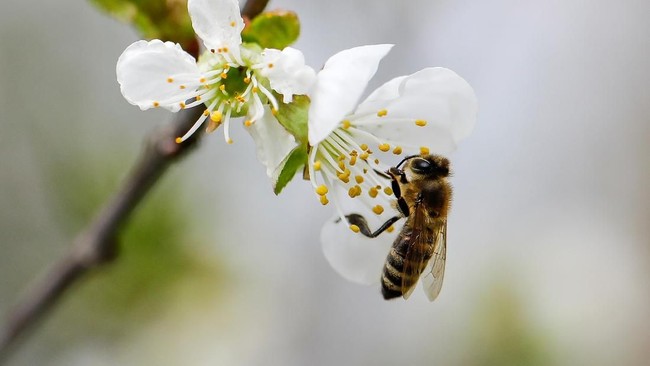
Bees are among the most important pollinators. While searching for nectar and pollen, bees transfer pollen from the male part of a flower to the female part. This process enables fertilisation, which subsequently produces fruit or seeds. This means the presence of bees is not only vital for the ecosystem; the productivity and quality of many agricultural yields also depend on their activity. A study in ‘The Role of Bees in Green Agriculture’ mentions that bee pollination can increase fruit set, fruit size, and harvest quality.
From Eggs to Pollinators
Bees have four main stages in their life cycle. According to the Agency for Agricultural Assembly and Modernisation (BRMP) of the Ministry of Agriculture, the cycle begins with eggs from day 0 to 3, followed by larvae from day 4 to 9, and pupae until approximately day 21. Once they become adult bees, the colony is divided into three castes: the queen is responsible for laying eggs, drones fertilise the queen, and worker bees forage for food, build the nest, and care for the larvae.
It is these worker bees that interact most extensively with plants while foraging for nectar and pollen. This foraging activity simultaneously provides pollination services for crops. Numerous commodities, such as fruits, coffee, cocoa, and nuts, also rely on pollination to produce fruit and seeds.
More Than Just Increasing Fruit Yields
Effective pollination can also improve the size, shape, and quality of fruit. The FAO notes that pollinators contribute to increased yields in 87 out of 115 major global food crops. Crops that depend on pollinators also serve as sources of various vitamins and essential micronutrients for humans.
On World Bee Day 2025, the FAO also warned that without pollinators, the world risks losing up to 8% of global crop production. The impact could be felt in the availability of various food commodities, particularly fruits, vegetables, nuts, and other crops that rely on pollination. Bees also generate other sources of income for rural communities. In addition to honey, bee colonies produce beeswax, propolis, and royal jelly, and can even be part of a service-based business for renting hives for crop pollination.
The Problem: Bees are Under Increasing Pressure
Agriculture’s dependence on bees faces challenges because pollinator populations are also under pressure. The journal ‘The Role of Bees in Green Agriculture’ notes that the use of pesticides and agrochemicals can reduce the abundance, diversity, and reproductive success of bees. Pesticide exposure can also disrupt foraging abilities, navigation, and immune systems.
Other threats arise from habitat loss due to agricultural intensification, urbanisation, and changes in land use. Climate change can also alter plant flowering patterns, meaning the timing of bee emergence may no longer align with the availability of food sources. Therefore, protecting bees is not enough by simply adding more colonies to farmland. Agricultural practices also need to reduce risks to pollinators through integrated pest management, organic farming, reducing chemical dependency, and protecting habitats and bee food sources.
Evidence in Indonesia
The benefits of bees in agriculture are also evident in Indonesia. Research published in 2024 shows that using stingless bees (Tetragonula laeviceps) on tomato plants can increase pollination success and yields. Compared to plants without meliponiculture, the presence of T. laeviceps increased pollination success by 30.91% and fruit yield by 68.68%.
The study concluded that utilising stingless bees can be one of the strategies to increase tomato productivity. These findings demonstrate that protecting pollinators is not just about conservation; bees can also be part of a strategy to increase agricultural productivity sustainably. However, its effectiveness depends on the ability of farmers to maintain bee habitats, preserve food sources, reduce exposure to harmful pesticides, and protect the ecological balance around farmlands. Without these measures, the expected benefits of pollination will be difficult to sustain in the long term.