
IEU-CEPA to Eliminate Tariffs on More Than 90% of Indonesia-EU Goods
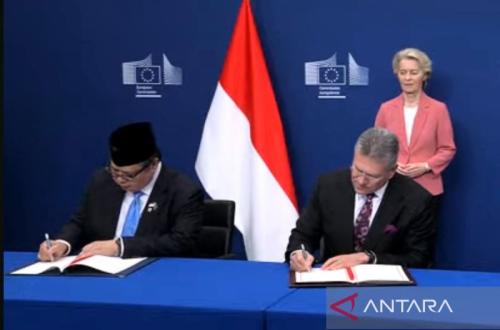
JAKARTA — Indonesia and the European Union have officially signed the Comprehensive Economic Partnership Agreement (IEU-CEPA), which will eliminate import duties on more than 90 per cent of goods traded between them. Coordinating Economic Affairs Minister Airlangga Hartarto said the agreement could save up to €600 million in trade costs each year.
The major trade pact was signed in Brussels on Saturday (21 November) and is targeted to take effect on 1 January 2027, following expedited ratification by both sides.
“The agreement is expected to save up to €600 million in trade costs every year,” Airlangga said in an interview with France 24’s World Roundup programme, according to an official statement on Sunday.
Market access and tariff removal
Under the agreement, Indonesia will gradually remove import duties on 50 per cent of tariff lines for motor vehicles from the EU over five years. Sensitive agricultural commodities, including rice, sugar and ethanol, are excluded from the tariff-removal scheme.
In bilateral trade, the EU primarily exports non-electrical machinery, chemicals and agricultural products to Indonesia. Indonesia, in turn, exports agricultural products, mechanical and electrical equipment, and manufactured goods including footwear.
Airlangga said the agreement would give Indonesian labour-intensive industries broader access to the European market. Products such as textiles, footwear, ready-made garments, food products, crude palm oil (CPO) and agricultural goods that were previously subject to EU import tariffs of 7 to 12 per cent will now have their tariffs reduced to zero.
Sustainability and environmental standards
On environmental and sustainability issues, particularly palm oil and deforestation, Airlangga stressed that Indonesia had maintained a deforestation moratorium for several years. Indonesia is also ready to supply products that meet jointly agreed sustainability standards, following the EU’s two-year postponement of the implementation of its Deforestation Regulation (EUDR).
In the mining sector, Airlangga added, Indonesia applies good mining practice standards, which are audited and disclosed in companies’ financial reports. International operators such as Freeport-McMoRan and Vale were cited as examples of compliance.
Ratification and global dynamics
Both sides are working to accelerate ratification before Indonesia’s preferential tariff access under the EU’s Generalised Scheme of Preferences (GSP) expires at the end of 2026. This is crucial to avoid a gap in tariff concessions.
Brussels scheduled the signing for Saturday so the pact could proceed to the EU’s internal procedures on Monday (23 November). Jakarta, meanwhile, has consulted the House of Representatives (DPR) on ratifying the agreement by presidential regulation.
Alongside the IEU-CEPA, Indonesia and the EU also signed an Investment Protection Agreement (IPA). It provides legal protection for investors, state-to-state dispute settlement, voluntary mediation and a framework for future negotiations.
Airlangga also placed the pact in the context of shifting global trade dynamics, noting that US tariff policies have reshaped international negotiations. Having secured a reciprocal trade agreement with Washington and the IEU-CEPA with Brussels, Indonesia is now positioned to expand trade flows with two of the world’s largest economic blocs.
“I believe the right moment has finally arrived, even amid a challenging geopolitical and geoeconomic landscape,” Airlangga said. “Co-operation between Indonesia and the European Union—two major economic powers in Europe and ASEAN—can strengthen our economies and benefit people on both sides,” he said.
Source: jawawa.id (https://jawawa.id/newsitem/ieu-cepa-to-eliminate-tariffs-on-more-than-90-of-indonesia-eu-goods-1795369856)
Originally published by Republika (https://news.republika.co.id/berita/towxwl8030000/ieucepa-hapus-bea-masuk-lebih-dari-90-persen-barang-dagangan-riuni-eropa), translated from Indonesian