
IEU CEPA Targeted to Take Effect in 2027, Indonesia Eyes European Exports and Investment
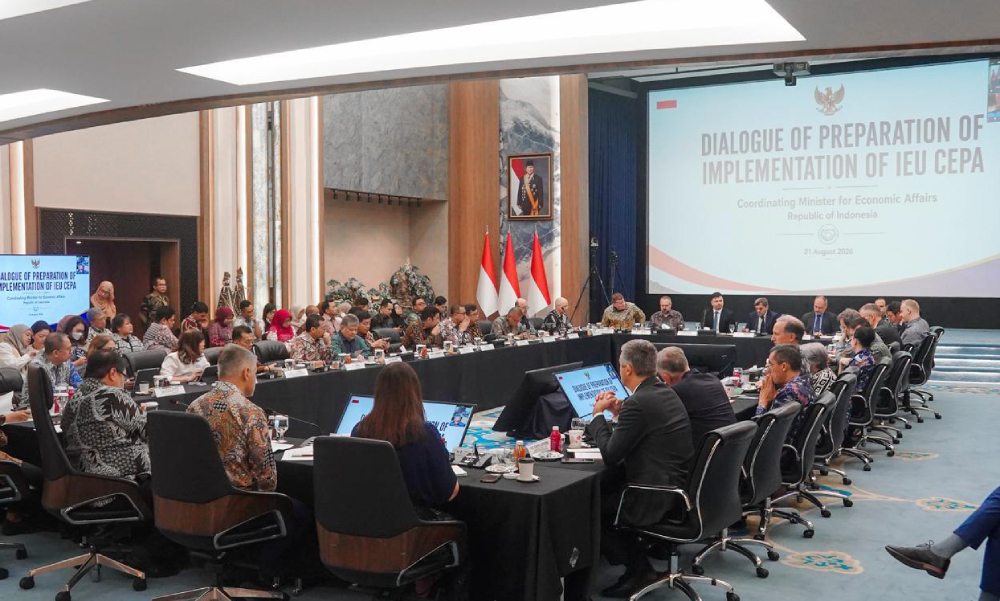
The Indonesian government is strengthening economic ties with the European Union through accelerated implementation of the Indonesia-European Union Comprehensive Economic Partnership Agreement (IEU CEPA). The agreement is considered strategic for expanding market access, increasing investment, strengthening supply chains, and enhancing the economic resilience of Indonesia and the European Union in the ASEAN and Indo-Pacific regions.
The effort was discussed in a meeting between the Indonesian government, the EU Delegation, and ambassadors of EU member states in Jakarta on Friday (21/8/2026).
Coordinating Minister for Economic Affairs Airlangga Hartarto said the government appreciates the support of the EU Delegation and its member states for accelerating IEU CEPA. “We see IEU CEPA as a game changer for strengthening trade, investment, supply chain diversification, and bilateral economic resilience in the ASEAN/Indo-Pacific region,” Airlangga said.
If IEU CEPA enters into force in early 2027, Indonesia is projected to gain broader market access to the European Union. A total of 90.4 percent of tariff lines will immediately become zero percent, while another 8.37 percent of tariff lines will undergo gradual reduction.
The policy is expected to increase exports of a number of Indonesian commodities and leading products, including palm oil, footwear, coffee, furniture, agricultural and fishery products, and the telecommunications sector.
On the other hand, the European Union will gain broader market access in Indonesia, both for industrial and consumer interests. The agreement is also expected to increase the availability of more competitive European products in the Indonesian market.
Airlangga explained that the process of finalising the IEU CEPA documents in English is ongoing. The government is targeting the agreement to be signed in October 2026. “From the development of IEU CEPA, the documentation in the English version will soon be completed and is targeted to be signed in October, hopefully,” he explained.
After signing, the agreement will be brought to the European Parliament to undergo the ratification process. Meanwhile in Indonesia, the government has consulted with the DPR and prepared a Presidential Regulation (Perpres) mechanism to accelerate its implementation.
“Indonesia will use the Perpres mechanism because it has been discussed with the DPR, so its implementation will be faster,” Airlangga said.
The government also sees IEU CEPA as an opportunity to increase investment flows from European countries. Indonesia is encouraging EU investors to invest in high-value-added sectors.
Priority sectors include advanced manufacturing, renewable energy, electric vehicles (EV), the digital economy, and the pharmaceutical industry.
The investment is expected not only to increase capital inflows but also to encourage technology transfer and accelerate national industrial transformation. “Now Europe is also becoming one of Indonesia’s investment partners as a sector, and for Europe as well. It can be seen in recent times that Indonesia has received many visits from European countries and they brought large business delegations,” Airlangga said.
According to Airlangga, accelerating IEU CEPA ratification is also important given that Indonesia’s Generalised Scheme of Preferences (GSP) facility will end at the end of 2026. Therefore, the government hopes there will be no gap in trade relations between the two parties when the scheme ends.
EU Ambassador to Indonesia and Brunei Darussalam Denis Chaibi welcomed the Indonesian government’s move to accelerate the IEU CEPA process.
According to him, the meeting with ambassadors of EU member states was a momentum to strengthen political commitment in accelerating the signing and ratification of the agreement. “This is a fantastic opportunity for EU Member States to express their political commitment to sign the CEPA as soon as possible and to follow up on the ratification process as explained by Coordinating Minister Airlangga,” Denis said.
He assessed that IEU CEPA ratification has the potential to increase the interest of European companies in investing in Indonesia. “This ratification will trigger strong interest in investing in Indonesia for European companies,” he said.
Denis also predicted that visits by government officials, business delegations, and even royal families from European countries to Indonesia will increase as IEU CEPA implementation approaches.
One of the scheduled agendas is the visit of EU Commissioner for Trade and Economic Security Maros Sefcovic to Indonesia in late October or early November 2026.
Denis added that dialogue forums between the Indonesian government and EU member states are also important for preparing the technical implementation of the agreement.
He welcomed the proposal from the Indonesian Employers’ Association (APINDO) regarding the establishment of a Joint Task Force that can involve business actors in the preparation process for IEU CEPA implementation. “Meetings like this allow EU Member States to interact more with relevant ministries, so that we can prepare for CEPA implementation and open up investment potential as Coordinating Minister Airlangga has mentioned,” Denis said.
“We are very pleased that APINDO also proposed a Joint Task Force so that business actors can be involved in CEPA preparation, both at the technical level and bilaterally.”
Source: jawawa.id (https://jawawa.id/newsitem/ieu-cepa-targeted-to-take-effect-in-2027-indonesia-eyes-european-exports-and-investment-1787377821)
Originally published by batamtoday.com (https://batamtoday.com/news/ieu-cepa-ditargetkan-berlaku-2027-indonesia-bidik-ekspor-dan-investasi-eropa), translated from Indonesian