
IEU-CEPA Opens Opportunities for Renewable Energy Sector, but Risks May Hinder European Capital Inflow
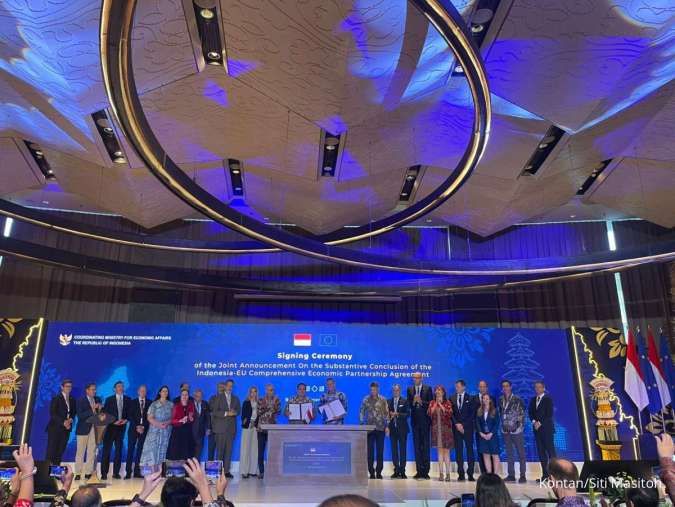
The Indonesia-European Union Comprehensive Economic Partnership Agreement (IEU-CEPA) is considered capable of becoming a driving force for the influx of investment from the European Union into the new and renewable energy (EBT) sector. However, observers believe there are several factors that could hinder the attractiveness for investors from the Blue Continent.
For information, the IEU-CEPA negotiations, which were completed in September 2025, are being accelerated for signing in November 2026, with implementation expected to begin in early 2027.
As previously reported by Kontan, the Ministry of Investment and Downstreaming/Investment Coordinating Board (BKPM) projects that the renewable energy sector will be one of the strongest sectors benefiting from the implementation of IEU-CEPA in the future.
The Chairman of the Indonesia Centre for Renewable Energy Studies (ICRES), Surya Darma, assesses that the existence of IEU-CEPA provides fresh momentum for the profile of legal certainty and investment protection.
Nevertheless, the vast potential for European investment in the renewable energy sector is not guaranteed to be realised automatically if domestic regulatory hurdles remain an issue.
“The capital flow from IEU-CEPA will not be a ‘windfall’ that immediately flows in torrents,” he told Kontan on Thursday (1/10/2026).
ICRES notes that there are at least four structural barriers that could potentially act as a brake on European investment if not resolved promptly.
First, the dilemma of Local Content Requirement (TKDN) regulations is seen as a frequent cause of investment bottlenecks. Surya continued, noting that the local renewable energy manufacturing industry is currently not yet widely prepared to meet high-tech European specifications.
“On the other hand, strict TKDN regulations hinder the entry of imported technology, which is precisely what European lenders require,” he added.
Second, the issue of buyer monopolies and the problem of power wheeling, or the scheme for the shared use of transmission networks.
Third, uncertainty regarding tariffs and negotiations. Surya highlighted that renewable energy tariff provisions do not yet reflect the economic viability of projects, while the negotiation process for Power Purchase Agreements (PPL) also frequently takes a long time.
Fourth, Surya also underlined the limited capacity of the grid. “The PLN electricity network, especially outside Java, is not yet flexible enough to absorb the fluctuating flow of renewable energy without disrupting system stability,” he added.
Overall, Surya believes that while IEU-CEPA serves as an opener of opportunities, domestic regulation remains the determining factor for investor interest.
“IEU-CEPA is a red carpet, but our domestic regulations determine whether investors are willing to walk upon it,” he concluded.
Source: jawawa.id (https://jawawa.id/newsitem/ieu-cepa-opens-opportunities-for-renewable-energy-sector-but-risks-may-hinder-european-capital-inflow-1790880635)
Originally published by industri.kontan.co.id (https://industri.kontan.co.id/news/ieu-cepa-buka-peluang-sektor-ebt-ini-risiko-yang-bisa-hambat-modal-eropa-masuk), translated from Indonesian