
IESR Urges Integration of ASEAN Clean Technology Supply Chains
Indonesia and the Philippines hold significant contributions to the global mineral supply chains required for the development of clean energy technologies.
Jakarta (ANTARA) - The Institute for Essential Services Reform (IESR) is encouraging Southeast Asian nations to strengthen the integration of clean energy technology supply chains through the development of industrial specialisation and regional manufacturing cooperation.
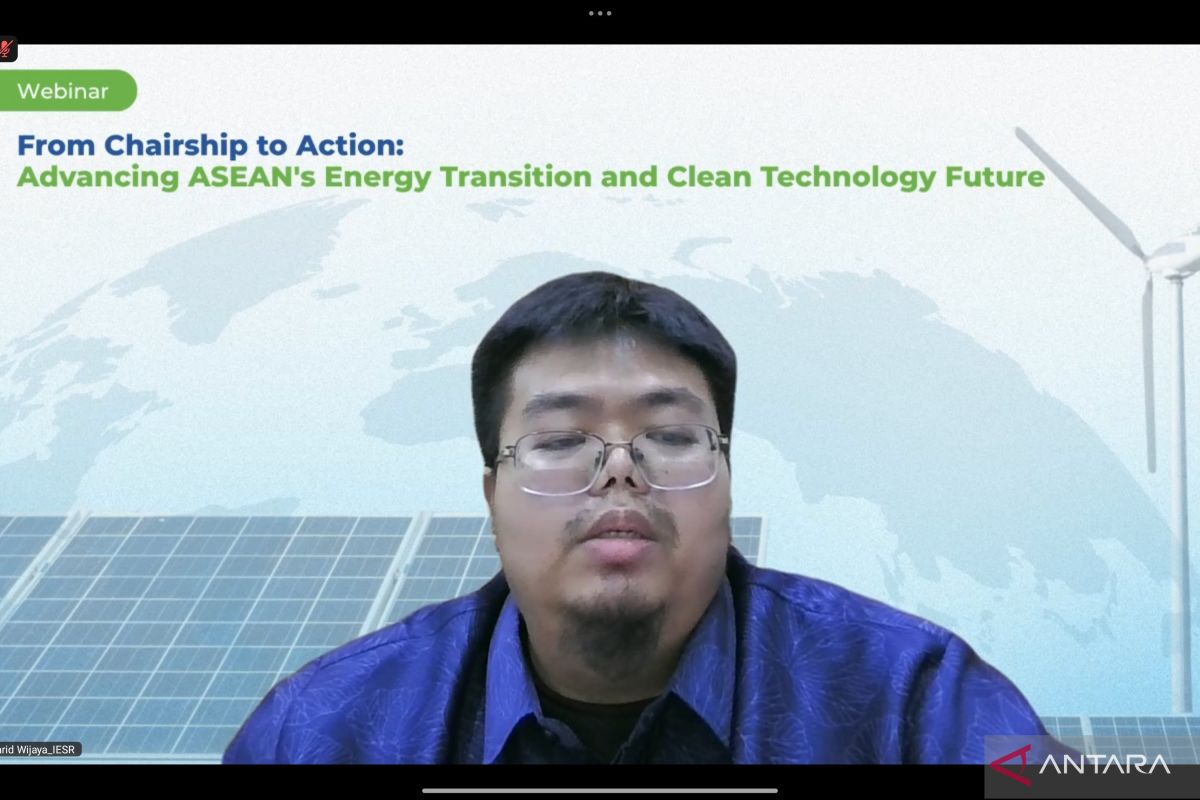
IESR Sectoral Decarbonisation Research Manager, Farid Wijaya, stated that the resource advantages and manufacturing capacities of each Southeast Asian nation need to be linked so that the region does not merely act as a supplier of raw materials, but is also capable of producing high-value-added technology products.
“Different policy scenarios from those currently underway or established, approved agreements, and the ASEAN roadmap for renewable energy action plans suggest that without financial and infrastructure support, renewable energy generation will not reach its potential level,” said Farid during his presentation at a webinar on renewable energy transition in the ASEAN region, attended online in Jakarta on Monday.
Farid noted that the economic growth of the ASEAN region is becoming one of the world’s economic growth hubs, with an annual economic growth rate of approximately 5.5 per cent, and regional electricity demand is expected to continue increasing by about 4 per cent per year until 2035.
According to Farid, Indonesia and the Philippines make vital contributions to the global mineral supply chains needed for clean energy technology development. However, the capacity to process minerals into downstream products, such as battery cells and technological components, remains limited.
Without strong regional industrial policies and coordinated investment, Southeast Asian countries risk exporting raw materials while high-value-added products are produced outside the region.
Farid explained that the clean energy technology supply chain in Southeast Asia is still concentrated in certain countries. In the solar panel industry, China still dominates global production, while Vietnam, Thailand, Malaysia, and Indonesia are beginning to develop manufacturing and assembly capacities.
However, regional production capacity remains relatively small compared to the global market. This condition causes numerous clean energy projects in Southeast Asia to remain dependent on imported components.
This dependency can increase the risks of rising costs, logistical disruptions, and project delays due to changes in global supply chains.
A similar situation exists in the wind turbine industry. Several ASEAN countries have set targets for wind energy capacity development, but still rely on components produced outside the region.
Yet, according to Farid, Southeast Asian nations such as Indonesia and the Philippines possess potential in the supply chains for battery raw materials required by global networks, such as nickel, manganese, and other raw materials related to the battery component industry.
“This condition simultaneously demonstrates an opportunity to develop the clean energy component and manufacturing industry at a regional level,” said Farid.
Farid stated that ASEAN needs to build an industrial specialisation strategy by adjusting the role of each country based on its advantages and capacity.
Such cooperation could encompass the production of minerals, electronic components, electrical equipment, battery technology, and the integration of clean energy systems.
To support this move, ASEAN countries need to strengthen Tier 2 industries, align technical and quality standards, and facilitate the cross-border trade of components.
Farid also emphasised the importance of developing a circular economy to anticipate the increase in waste from solar panels, batteries, and other clean energy technologies.