
IESR Reveals Hurdles to Indonesia's 100 GW Solar Target
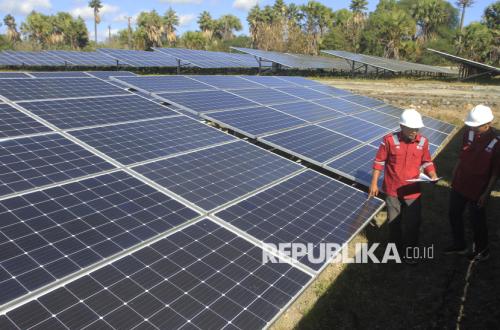
The government’s target of building 100 gigawatts (GW) of solar power plants (PLTS) will not automatically drive the growth of the national solar panel industry, according to the Institute for Essential Services Reform (IESR). The think tank assesses that strengthening market certainty, regulation, and the domestic supply chain are prerequisites for PLTS development to create added value for the national industry.
IESR launched a report titled ‘Roadmap for the Development of the Domestic Photovoltaic Solar Supply Chain’ at the Indonesia Solar Summit 2026 in Denpasar, Bali. The report states that Indonesia has the opportunity to build an integrated photovoltaic industry, but this will be difficult to realise if the domestic market remains undeveloped and government policy direction does not provide certainty for businesses.
IESR Chief Executive Officer Fabby Tumiwa said the development of the national PLTS industry needs to be supported by four main aspects: market, industrial capacity, human resources, and research and development. He noted that regulatory changes, such as those concerning the Domestic Component Level (TKDN), licensing processes, and incentives that take a long time, remain obstacles for investors. The government is therefore urged to present regulations that are more stable, transparent, and provide business certainty.
In its roadmap, IESR recommends a phased development of the PLTS industry. Until 2030, the government is encouraged to strengthen the production capacity of solar modules and cells, accelerate licensing, and provide blended financing schemes for manufacturing investment. From 2030 to 2040, Indonesia is considered to need to start building a wafer and polysilicon industry. By 2060, development is directed towards new generation solar panel technology, strengthening national research, and building a solar module recycling system.
Fabby also stated that solar energy development needs to be tailored to the potential of each region. Bali, for example, is seen as having the potential to become a low-carbon tourism destination based on solar energy, while West Nusa Tenggara (NTB) could develop a solar industry and energy storage ecosystem. East Nusa Tenggara (NTT), with a solar potential of around 369 GWp, has the opportunity to become a national renewable energy hub. Other regions such as Jambi, South Sumatra, Kalimantan, Sulawesi, and Papua also have great potential to support clean energy-based economic development.
At the same forum, Bali Governor Wayan Koster said the provincial government is preparing to increase electricity supply until 2030 through the development of rooftop and floating PLTS. One project being prepared is transforming Nusa Penida Island into a Green Island area with a target of using 100 percent renewable energy by 2030. NTB Governor Lalu Muhammad Iqbal stated his province is ready to contribute around 10 GW to the national 100 GW PLTS programme. Meanwhile, NTT Governor Emanuel Melkiades Laka Lena said PLTS development in his region will be prioritised to replace diesel power plants (PLTD) while supporting the agriculture, fisheries, MSME, and tourism sectors.