
IESR Outlines Six Steps to Achieve 100 GW Solar Power Target
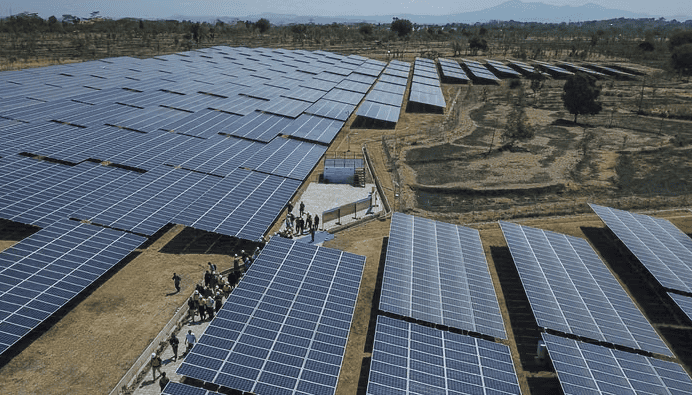
The Institute for Essential Services Reform (IESR) has welcomed the launch of the 100 GW solar power plant (PLTS) programme and battery energy storage system (BESS) by President Prabowo Subianto. The launch coincided with the start of construction of PLN’s 305 MWp solar plant and 1 GWh BESS in Gilimanuk, Bali.
IESR views the project as an important step to strengthen energy security, increase the use of domestic renewable energy sources, and reduce Indonesia’s dependence, particularly Bali’s, on fossil fuel supplies and electricity from outside the island. The combination of solar power and BESS can also improve the reliability of Bali’s electricity system by providing a local power source as well as flexibility to manage the variability of solar energy.
The choice of Bali as the launch location is considered strategically significant. Bali has declared a vision of Bali Net Zero Emission 2045, which has been developed by the Bali Provincial Government together with IESR and various stakeholders since 2023. IESR believes that central government and PLN support through investment in solar power and BESS will strengthen Bali’s efforts to achieve energy independence and net zero emissions faster than the national target.
IESR Chief Executive Officer Fabby Tumiwa said the launch and groundbreaking of the project must be the beginning of a much larger execution phase. “The success of the 100 GW solar programme is not measured by how many projects are groundbreaking, but by how many gigawatts of solar power can be built, connected to the grid, and reliably generate electricity before 2029. The biggest challenge now is to turn the President’s political commitment into an implementation machine capable of building tens of gigawatts of solar power every year,” Fabby said in a statement received on Tuesday (25/8).
IESR stressed that the 100 GW target in less than four years is highly ambitious and requires innovation in its implementation. To succeed, the programme requires a strong, consistent national implementation architecture with legal certainty. The government needs to immediately establish programme leadership with the authority to coordinate across ministries, PLN, regional governments, industry, financing institutions, and business actors.
IESR recommended six priority steps to ensure the programme can reach its target by 2029. First, immediately finalise a Presidential Regulation as the legal umbrella for the 100 GW solar programme. The regulation needs to establish targets, division of roles and responsibilities, coordination mechanisms, financing, procurement, and principles of transparency and accountability.
“The government also needs to adjust the National Energy General Plan and PLN’s Electricity Supply Business Plan to fully accommodate the additional 100 GW solar capacity and designate this programme as a National Strategic Project to accelerate licensing, land provision, grid development, and resolution of cross-sector obstacles,” Fabby said.
Second, develop a clear annual project pipeline until 2029, complete with locations, capacity, procurement schedules, grid and BESS requirements, so that investors and industry can plan investments with certainty. Third, accelerate procurement through competitive, transparent and bankable auctions to produce competitive electricity prices while attracting large-scale private capital.
Fourth, ensure electricity system readiness through the construction and strengthening of transmission and distribution, grid digitalisation, addition of BESS, as well as increased operational flexibility of the power system and removal of rooftop solar quota restrictions. Fifth, build a national supply chain with gradual, realistic local content policies based on improving competitiveness so that domestic industry development does not hinder cost reduction or the speed of solar power development.
Sixth, open a multi-track implementation approach so that achieving 100 GW does not depend solely on PLN projects. The government needs to provide space for regional governments, cooperatives and communities, industrial and commercial sectors, rooftop solar initiators, and independent power producers to help accelerate the development of solar power generation capacity.
“Towards 2029, the main key is to build a supporting ecosystem and speed in executing plans. Indonesia already has the capital, mature technology, and abundant solar potential. What is now urgent is regulatory certainty, strong governance, bankable projects, electricity grid readiness, and institutions capable of executing the programme consistently,” Fabby concluded.