
IDX Sharp Correction Amid Rupiah Pressure and Capital Outflow
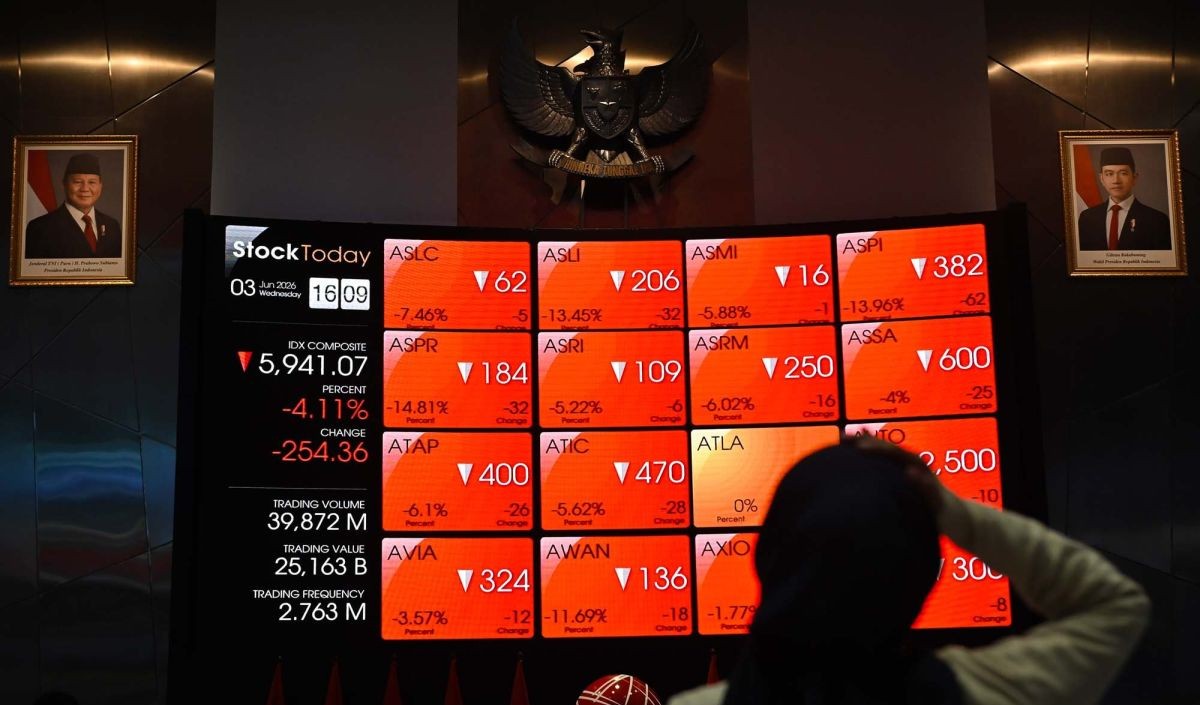
The Indonesia Composite Index (IHSG) recorded a sharp correction of 8.69% during the trading period of 2-5 June 2026. This decline was triggered by a combination of domestic and international pressures, ranging from the weakening rupiah, which breached the psychological level of Rp18,000 per US dollar, to heavy foreign capital outflows and negative global market sentiment prompting investor caution.
Hari Rachmansyah, Equity Analyst at PT Indo Premier Sekuritas (IPOT), stated that the primary pressure stemmed from the FTSE Russell index rebalancing decision, which removed several large-cap stocks, including PT Dian Swastatika Sentosa Tbk (DSSA), PT GoTo Gojek Tokopedia Tbk (GOTO), and PT Trimegah Bangun Persada Tbk (NCKL), without adding new constituents. This triggered forced selling in the related stocks and accelerated foreign capital outflows, reaching Rp7.4 trillion in the regular market. “Fundamentally, the IHSG is still under significant pressure,” Hari noted in an official statement on Monday (8/6).
Market pressure intensified after May 2026 inflation was recorded at 3.08% year-on-year, higher than market consensus. Simultaneously, the rupiah breached the Rp18,000 per US dollar mark, confirming that capital outflows are occurring in both the equity and bond markets. “The combination of these three factors creates pressure that is difficult for domestic funds to offset, making this week one of the toughest for the IHSG in recent months,” said Hari.
Globally, pressure arrived from US stock exchanges. On Friday (5/6), Wall Street saw significant selling, with the Nasdaq Composite leading the decline by 4.18% to 25,709, marking its worst daily correction since the tariff volatility in April 2025. Meanwhile, the S&P 500 fell 2.64% and the Dow Jones corrected by 1.35%.
This weakness was driven by pressure in the semiconductor sector after Broadcom failed to raise its AI chip business projections. This triggered widespread profit-taking, reflected in the decline of Marvell shares by 16%, Micron by 13%, and Intel and AMD, which both corrected by approximately 11%.
Market sentiment was also weighed down by the release of US May non-farm payroll (NFP) data, which reached 172,000, far exceeding the market expectation of 80,000. This data pushed 10-year US Treasury yields above 4.5% and increased the probability of a Federal Reserve interest rate hike by the end of the year to 72.7%. “This acts as a headwind for growth stocks,” said Hari.
He added that some selling in technology stocks was also linked to investors liquidating positions to raise funds ahead of the SpaceX IPO scheduled for 12 June 2026. The company targets a valuation of US$1.75 trillion, potentially raising up to US$65 billion, which could be the largest IPO in capital market history.
For the trading period of 8-12 June 2026, Hari believes the global market will still face several important catalysts. Investors will closely watch the US May Consumer Price Index (CPI) released on 10 June as a reference for Federal Reserve policy, followed by Producer Price Index (PPI) data a day later. Additionally, financial reports from Oracle and Adobe will serve as indicators of the technology sector’s strength.
For the domestic market, Hari expects the IHSG to remain under pressure this week. Several economic data points to be released, such as May foreign exchange reserves on Monday (8/6), the May consumer confidence index on Wednesday (10/6), and April retail sales data on Thursday (11/6), will be vital indicators to measure public purchasing power and Indonesia’s external resilience. A decline in foreign exchange reserves could heighten market concerns regarding Bank Indonesia’s ability to maintain rupiah stability.
Furthermore, the implementation of the FTSE Russell rebalancing, effective 22 June 2026, is expected to continue shadowing the market as the forced selling process related to index adjustments is not yet fully complete.
Hari noted that bearish market sentiment still dominates as the downward trend has not shown convincing signs of a reversal. In this condition, investors are advised to adopt defensive strategies focused on capital preservation. Investors should reduce exposure to small and medium-cap stocks with limited liquidity and avoid aggressive averaging down until signs of rupiah stabilisation and a stronger price floor emerge.
For medium-term investors, Hari suggested using this momentum to selectively monitor large-cap stocks in the banking and consumer staples sectors, where valuations are historically attractive. “However, continue to enter gradually with small allocations while waiting for certainty regarding Bank Indonesia’s monetary policy direction,” he said.
Separately, Rully Arya Wisnubroto, Head of Research and Chief Economist at Mirae Asset, viewed that foreign investor selling pressure remains the main factor dragging the IHSG into a deep decline. On Friday (5/6), foreign investors recorded a net sell of approximately Rp3.7 trillion in the regular market, a condition where the value of sales exceeds the value of purchases. Selling pressure was particularly concentrated in large-cap banking stocks, such as BBCA.