
IDX Records 7 IPOs Raising Rp 2.16 Trillion up to August 2026
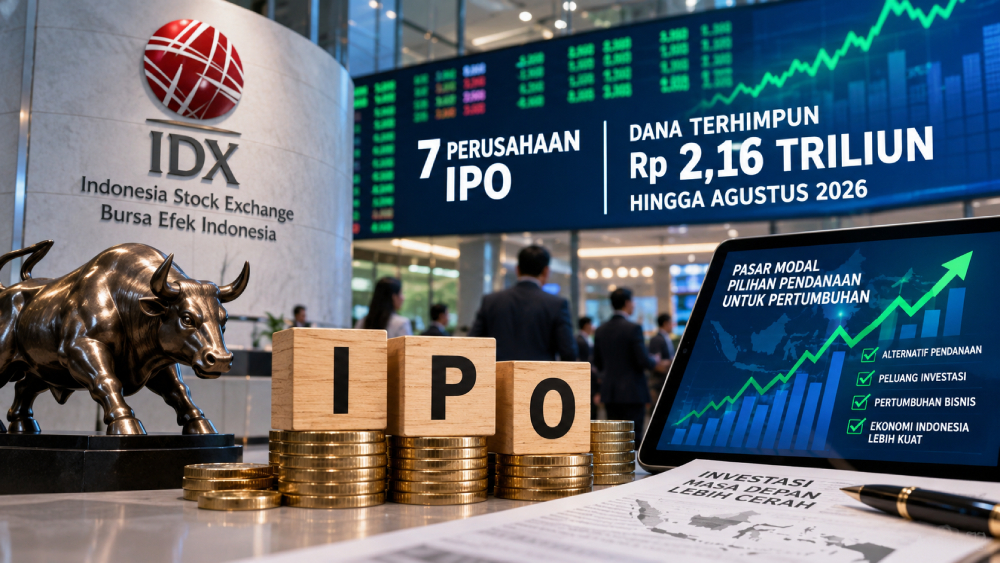
The Indonesia Stock Exchange (IDX) has recorded that seven companies have officially listed their shares on the exchange up to the end of August 2026. From these initial public offerings (IPOs), the total funds raised reached Rp 2.16 trillion.
In addition to the seven companies already listed, there are seven more companies currently in the IPO pipeline. This condition indicates that the Indonesian capital market remains one of the alternative funding options for the business world while simultaneously expanding investment choices for the public.
The Head of the IDX Listed Company Development Division, Listyorini Dian Pratiwi, stated that the increasing number of companies conducting IPOs reflects the continued interest of the business community in the capital market as a source of funding. “The increasing number and scale of companies conducting IPOs shows that the Indonesian capital market remains an attractive funding choice for businesses,” said Listyorini.
According to her, the increase in the number of listed companies also provides more alternatives for the public to diversify their investment portfolios.
IPO is More Than Just a First-Day Momentum
An IPO is the process by which a company offers shares to the public for the first time. Once the public offering is complete, the company’s shares are listed on the IDX and can be traded on the secondary market.
For companies, an IPO can serve as an alternative funding source to develop business operations and encourage improvements in corporate governance. For investors, an IPO provides an opportunity to hold ownership in a company that has newly attained public status.
IPO activities often attract investor attention due to share price movements during early trading. Many new stocks experience price increases on their first day, creating a perception that IPO stocks always offer profits.
However, price increases during early trading do not necessarily reflect the company’s fundamental value or guarantee long-term stock performance. Once listed on the exchange, share prices move based on the mechanism of supply and demand. Movements can also be influenced by company performance, industry conditions, the economy, and market sentiment.
Therefore, investors need to avoid making decisions based solely on the euphoria when a stock begins trading. Listyorini assessed that an IPO should not be viewed as the peak of a company’s journey or merely as a momentum on the first day of trading. “An IPO is the starting point for a company’s growth in the Indonesian capital market,” she said.
She added that companies that have completed an IPO are expected to utilise various corporate actions in the following years, grow alongside the capital market, and treat the capital market as a ‘house of growth’ to support sustainable business expansion.
Four Things to Consider Before Buying IPO Stocks
Listyorini reminded investors to conduct analysis before purchasing IPO stocks. There are at least several important aspects to consider:
1. Study the Company Prospectus
The prospectus is a primary information source for potential investors. This document contains various information regarding the company profile, business sector, financial condition, business strategy, the planned use of IPO proceeds, and the risks faced by the company.
Investors also need to scrutinise the use of IPO proceeds. These funds may be used for business expansion, capital expenditure, debt repayment, or other needs as outlined in the prospectus. After a company is listed, investors must also monitor the actual implementation of fund usage through the Report on the Realisation of Fund Usage (LRPD).
This is in line with OJK Regulation Number 40 of 2025 regarding the Use of Public Offering Proceeds, which came into effect on 22 June 2026. This regulation governs, among other things, the obligation to submit and announce the LRPD and the information that must be included in the report.
2. Understand the Company’s Business Model
Investors should not only know the offered share price. Understanding the business model is a crucial part of assessing a company. Aspects to consider include target markets, revenue sources, competitive advantages, and the company’s strategy for business development.
Investors also need to look at the prospects of the industry in which the company operates. A clear business model and an industry with growth opportunities can be key considerations, while still accounting for the accompanying risks and uncertainties.
3. Scrutinise Valuation and Business Prospects
The IPO share price cannot be the sole indicator of whether a stock is cheap or expensive. Investors need to look at the offering price in relation to the value and fundamentals of the company. One approach is to compare the valuation with other listed companies that have similar characteristics or operate in the same sector.
Ratios such as the Price to Earnings Ratio (PER) and Price to Book Value (PBV) can serve as analytical tools, while still considering the characteristics and prospects of each individual company. According to Listyorini, the goal of assessing an IPO stock is not merely to find cheap stocks, but to see whether the offered price is proportionate to the company’s fundamentals and growth potential.
4. Recognise Investment Risks
IPO stocks still carry risks. As companies newly entering the capital market, their performance can be influenced by internal factors as well as changes in economic and industry conditions. Share prices after listing on the IDX can also experience fluctuations due to changes in supply and demand.
Source: jawawa.id (https://jawawa.id/newsitem/idx-records-7-ipos-raising-rp-2-16-trillion-up-to-august-2026-1790146287)
Originally published by batamtoday.com (https://batamtoday.com/news/bei-catat-7-ipo-himpun-rp-216-triliun-hingga-agustus-2026), translated from Indonesian