
IDX Expands High Shareholding Concentration List to 383 Stocks: Seven Implications for the Composite Index
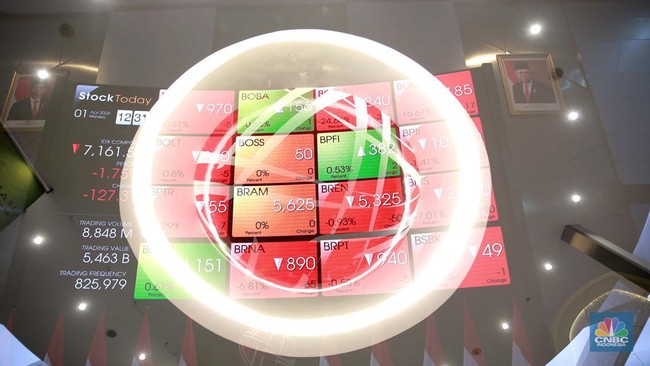
Jakarta, CNBC Indonesia — On Tuesday (10 November 2026), Indonesia Stock Exchange (IDX) President Director Jeffrey Hendrik announced that the list of stocks with high shareholding concentration, or High Shareholding Concentration (HSC), had been expanded to 383.
The move could alter the character of the IDX Composite Index (IHSG) and potentially narrow affected stocks’ access to institutional funds.
The IDX announced the addition of 300 stocks to the list, taking it from 83 to 383, after broadening the scope of its review and changing the HSC methodology. Previously, the review focused only on companies with a market capitalisation of at least Rp5 trillion.
Companies with market capitalisations below Rp5 trillion are now also included in the HSC assessment. The sharp rise in the number of listed stocks also reflects a broader review of companies on the exchange.
The change has several implications for investors and issuers, from a shift in what drives the IHSG to economic consequences for companies.
- The IHSG could come to resemble the LQ45, IDX30 and IDX80 more closely
Removing HSC stocks could make the shares driving the IHSG overlap more with large, liquid stocks included in the LQ45, IDX30 and IDX80 indices.
Those three indices consider liquidity, free-float market capitalisation, financial performance and companies’ compliance in their selection processes. As a result, liquid issuers with sound fundamentals could have a relatively greater influence on the IHSG.
This would mark a change from recent years, when the IHSG tended to move in the opposite direction to other indices such as the LQ45, which fell while the IHSG rose.
- Ownership risks could be easier for global investors to screen
The broader HSC list gives investors an additional reference for identifying stocks with highly concentrated ownership.
For investors, the information can help identify stocks requiring closer scrutiny, particularly in relation to beneficial owners, affiliated parties and the number of shares genuinely available to the public, as free-float data appears likely to be relied on less.
Greater disclosure could reduce uncertainty in the investment process. However, the HSC label may also act as a deterrent: issuers could find it harder to secure access to investors and face a yellow flag from the market.
- Access to global indices could narrow, reducing opportunities for passive investment
The consequences of HSC status could extend to global indices. MSCI has said it will continue removing stocks identified by Indonesian authorities as having high shareholding concentration.
FTSE Russell also has rules that can make stocks subject to concentration warnings ineligible for inclusion, or lead to their removal, depending on the timing and status of the warning.
Stocks that fail to qualify lose the potential buying demand of funds tracking those indices. Those removed may face selling by index-tracking portfolios.
The scale of the pressure depends on the holdings of the funds concerned. However, it could become harder for company owners to use index providers as a route for offloading shares or to rely on narrative-building of that kind.
- Issuers and controlling shareholders face an “economic penalty”
Reduced access to institutional investors can affect liquidity, valuations and the ability to raise capital.
Active investors may limit their positions or demand a lower price to compensate for ownership risks and the difficulty of selling shares. If buyer interest weakens, new share issues may also require a larger discount.
These consequences amount to an “economic penalty” for issuers and controlling shareholders. The impact will vary by company, depending on its business conditions, investor base and the depth of trading in its shares.
- The IHSG could become more representative
Once HSC stocks are effectively removed, their price movements will no longer contribute directly to the IHSG. The index could better reflect the group of stocks available for public investment.
At the same time, the relative influence of the remaining stocks will change. The IHSG could still be dominated by a few large issuers or particular sectors, so gains in the index should be considered alongside the breadth of market participation.
The IHSG could also rise while HSC stocks remain under pressure. This should help minimise the risk of market movements being concentrated in only a few listed companies.
- Removing many stocks does not automatically mean the IHSG will fall
When stocks are removed from an index, the divisor is adjusted to preserve the continuity of the IHSG’s level. The market capitalisation of excluded stocks therefore cannot be directly translated into an estimated fall in the index.
The IHSG’s direction after the adjustment will still depend on price movements among its constituent stocks and investors’ response to the policy.
The extent to which the index’s character changes will also depend on the weighting of the stocks removed. The number of affected issuers alone is not enough to show the impact on the IHSG.
The following is an example of the top 10 stocks by IHSG weighting at a level of 5,200, based on Tuesday (20 October 2026):
- Short-term pressure could drive long-term improvements
The risk of losing access to indices and institutional funds gives controlling shareholders an incentive to broaden public ownership and improve disclosure of affiliations.
The process could nevertheless cause temporary pressure. Sales by controlling shareholders or new share issues would add supply that needs to be absorbed by buyers.
Long-term benefits will depend on whether the changes lead to better-distributed ownership, sustained liquidity and consistent oversight. Even if HSC status is revoked, stocks would still need to meet the requirements before they could be considered for inclusion in global indices again.
Source: jawawa.id (https://jawawa.id/newsitem/idx-expands-high-shareholding-concentration-list-to-383-stocks-seven-implications-for-the-composite-index-1794387125)
Originally published by CNBC Indonesia (https://www.cnbcindonesia.com/research/20261111103940-128-784163/bei-perluas-daftar-hsc-jadi-383-saham-ini-7-dampaknya-ke-ihsg), translated from Indonesian