
IDX: ETFs as an Efficient Alternative Investment in Indonesia's Capital Market
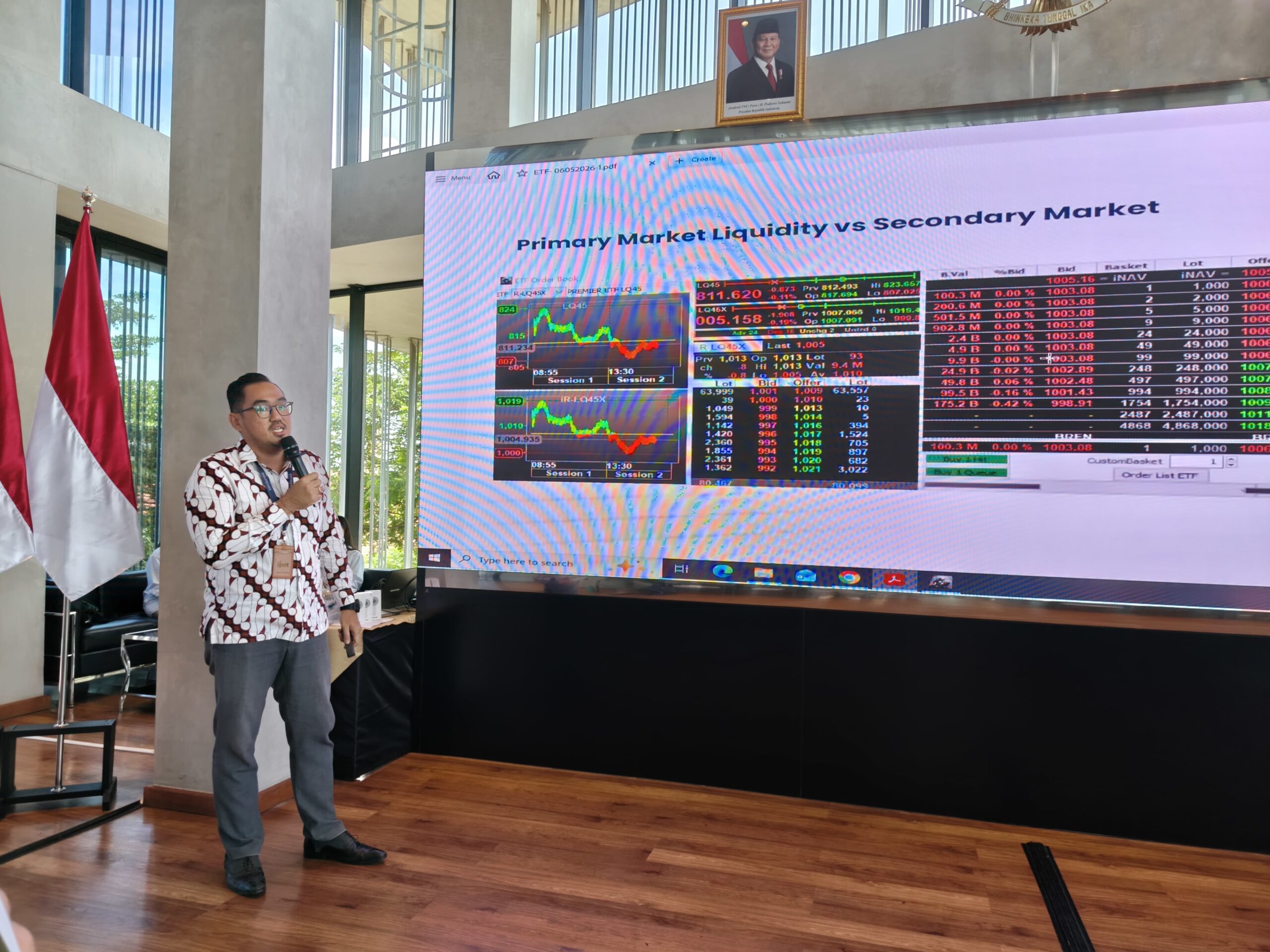
Surabaya – Exchange Traded Funds (ETFs) are being promoted once again as an efficient alternative investment in Indonesia’s capital market, particularly for novice investors seeking simplicity alongside risk diversification.
The Indonesia Stock Exchange (IDX) East Java is intensifying education through investment galleries and capital market communities to familiarise the public with ETFs. The hope is that this instrument will boost investor participation and drive transaction activity in the domestic capital market.
The Exchange Traded Fund (ETF) instrument is increasingly attracting attention as an alternative investment because it combines the characteristics of stocks and mutual funds. This product can be traded on the exchange like stocks but is managed professionally like a mutual fund.
Branch Manager of IndoPremier Surabaya, Marco Rijkaard Pereira, explained that ETFs offer high flexibility for investors as they can be transacted during exchange trading hours.
“ETFs are a combination of stocks and mutual funds. Investors can buy and sell them like stocks, following exchange hours, while still benefiting from professional management and oversight by authorities,” he said during a workshop with the East Java media on Wednesday (6/5/2026).
Historically, the first ETF appeared globally in 1976, while in Indonesia, it was introduced in 2007. Since then, the product has continued to develop with various variants, including index-based ETFs and active ETFs.
Marco explained that ETFs are generally divided into two types: passive and active. Passive ETFs follow the movement of a specific index such as IDX30 or LQ45. Meanwhile, active ETFs allow investment managers to adjust the portfolio according to market conditions.
“If passive follows the index. Active ETFs give room for investment managers to adjust the composition, for example, reducing weakening sectors and adding growing ones,” he clarified.
Compared to stocks and mutual funds, ETFs have several advantages. In terms of transparency, ETFs display the entire portfolio contents, unlike mutual funds which typically only show the top 10 assets. Additionally, ETFs provide diversification like mutual funds but with real-time trading mechanisms like stocks.
Another advantage is liquidity. ETF transaction settlements follow the T+2 scheme, the same as stocks, allowing funds to be withdrawn more quickly than mutual funds, which can take up to T+7 exchange days.
“ETFs are suitable for investors who want diversification like mutual funds but still need the flexibility and speed of stock transactions,” said Marco.
From a cost perspective, ETFs are charged broker commissions like stock transactions, while the minimum purchase in the secondary market is also equivalent to stocks, namely 1 lot. This makes ETFs increasingly affordable for retail investors.
Nevertheless, Marco reminded that ETFs still carry risks, such as market risk, changes in economic and political conditions, and concentration risk in certain sectors.
“Like other investment instruments, ETFs also have risks. Therefore, investors still need to understand their risk profile before investing,” he concluded.
On the same occasion, the Head of the IDX East Java Representative Office, Cita Mellisa, assessed that ETFs have a unique character because they combine mutual fund and stock concepts.
“ETFs are essentially mutual funds, but traded directly on the exchange like stocks. So the price is transparent and can be monitored in real time,” she said.
According to Cita, ETFs are suitable for investors who do not want the hassle of analysing individual stocks. This is because the product contains a collection of assets, such as stocks in a certain index or bonds, already managed by investment managers.
“If likened to it, ETFs are like buying one package containing many stocks. So the risk is more spread out than buying a single stock,” explained Cita.
In Indonesia, ETFs are generally passive in nature, replicating indices such as LQ45 or other indices on the Indonesia Stock Exchange. This means the ETF’s movement follows the performance of the reference index without needing complex active management. This concept makes ETFs more efficient and transparent. Investors also do not need to monitor market movements every moment, making them suitable for long-term investments.
“ETFs are suitable for investors who want to invest but do not have much time. Just buy, hold, and follow the index performance,” she concluded.
Source: jawawa.id (https://jawawa.id/newsitem/idx-etfs-as-an-efficient-alternative-investment-in-indonesias-capital-market-1778320390)
Originally published by kilasjatim.com (https://kilasjatim.com/2026/05/08/bei-etf-alternatif-investasi-yang-efisien-di-pasar-modal-indonesia/), translated from Indonesian