
IDX declines triggered by rising oil prices and Fed hawkish expectations
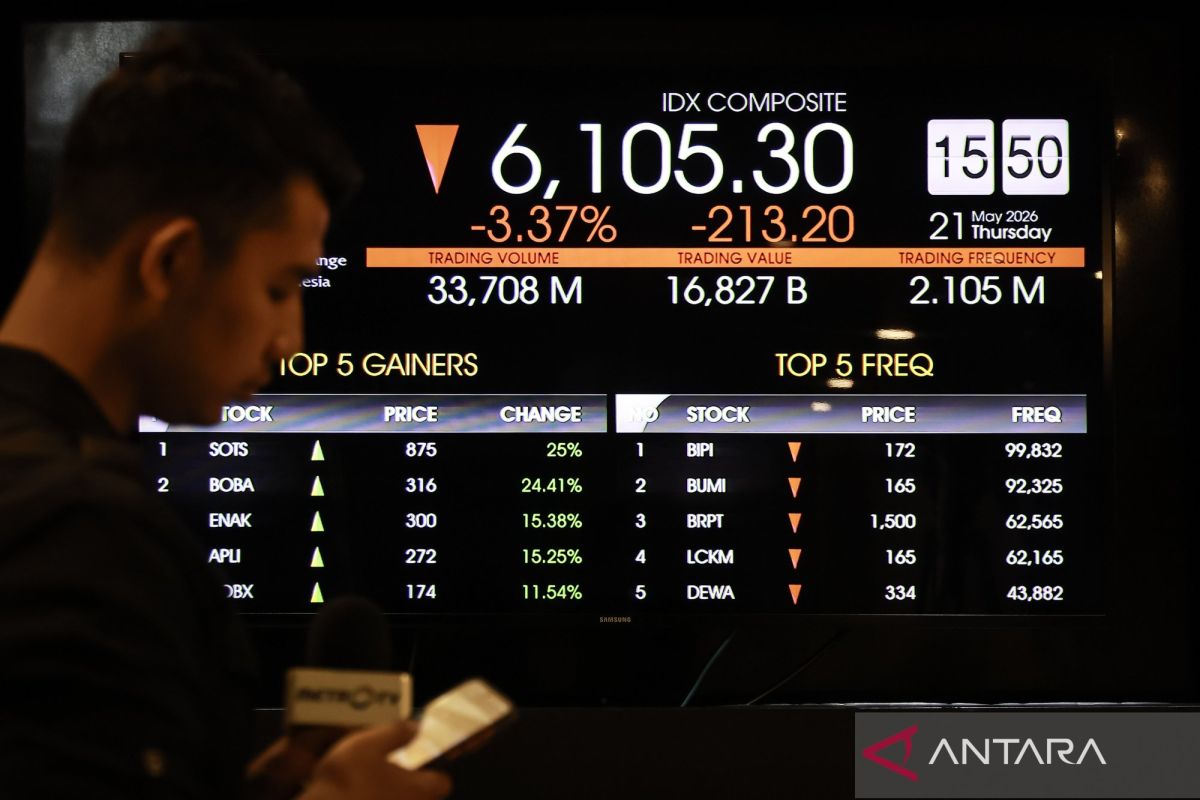
The Indonesia Composite Index (IHSG) on the Indonesia Stock Exchange (IDX) moved lower on Friday morning, following trends in Asian and global markets, triggered by the rise in global crude oil prices and expectations that the Fed will adopt a hawkish stance at its September 2026 meeting.
The IHSG opened lower by 36.55 points or 0.55 per cent to 6,552.79. Meanwhile, the LQ45 index, comprising 45 blue-chip stocks, fell 3.28 points or 0.50 per cent to 652.70.
“If it holds, the IHSG has the opportunity to rebound and test 6,673-6,723, with the next resistance at 6,859. Conversely, if it breaks below 6,520, a correction towards 6,420 is possible, with the next support at 6,377,” said Liza Camelia Suryanata, Head of Research at Kiwoom Sekuritas Indonesia, in her analysis in Jakarta on Friday.
Internationally, US Producer Price Index (PPI) data showed producer inflation pressure higher than expected, with the August 2026 headline PPI increasing by 0.4 per cent month-to-month (mtm) and 5.4 per cent year-on-year (yoy), while core PPI rose by 0.2 per cent (mtm) and 4.6 per cent (yoy).
This data has shifted expectations, with markets anticipating the Fed has stronger reasons to raise interest rates by 25 bps at the September 2026 meeting, particularly given the relatively resilient US economic and labour market conditions.
According to CME FedWatch, the probability of a 25 bps Fed rate hike at the FOMC meeting on 16 September 2026 increased to approximately 73 per cent, up from around 64 per cent prior to the PPI release.
Meanwhile, Liza noted that geopolitical risks remain a concern after the escalation of conflict between the US and Iran heightened fears regarding the sustainability of the global energy supply.
Oil prices surged sharply following the increased tensions, with Brent crude jumping 8.7 per cent to the level of US$109.97 per barrel, while WTI rose 8.54 per cent to US$104 per barrel.
“These developments increase the risk of energy supply disruptions in the longer term while simultaneously amplifying inflationary pressures in various countries,” said Liza.
Domestically, Liza stated that the rise in oil prices could potentially increase pressure on the State Budget (APBN), particularly through increased energy subsidies and compensation, given that the oil price assumption in the APBN is around US$90 per barrel.
However, she noted that fiscal space is considered sufficient, reflected by the APBN deficit of 0.91 per cent of GDP up to July 2026 and approximately 0.95 per cent of GDP in August, meaning the government does not yet see a need to increase fuel subsidy quotas.
On the other hand, Finance Minister Purbaya Yudhi Sadewa mentioned that the government could use APBN reserve funds to support a programme for the gradual opening of bank accounts for the public, with a target of up to 200 million accounts.
This programme is expected to begin implementation in 2027, as it still requires preparation and the integration of data from the Civil Registry (Dukcapil), the banking sector, and Bank Indonesia (BI).
Purbaya assessed that the budget requirement is unlikely to reach Rp11 trillion, as citizens who already hold accounts with designated banks will not need to open new ones.