
IDX Closes Session 1 Up 1.49% as Conglomerate Stocks Surge
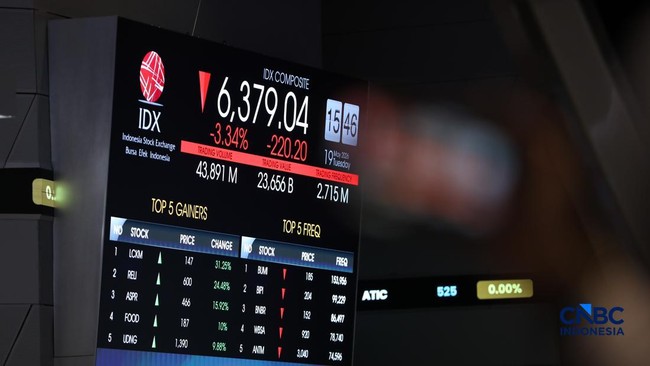
The Indonesia Stock Exchange (IDX) closed the first session in the green on Tuesday (2/6/2027), rising 91.48 points or 1.49% to the level of 6,218.86. A total of 347 stocks increased, 338 declined, and 274 remained unchanged. Transaction value reached Rp 14.81 trillion, involving 16.03 billion shares across 1.53 million transactions, bringing market capitalisation to Rp 10,938 trillion.
Shares from Prajogo Pangestu’s companies continued to dominate the market. Chandra Asri Pacific (TPIA) and Barca Pacific (BRPT) recorded the highest transaction values at Rp 4.84 trillion and Rp 2.89 trillion, respectively. Concurrently, Barito Group companies surged as the primary drivers of the IDX; CUAN and BREN hit their upper auto-rejection limits (ARA), while PTRO and BRPT rose by more than 5%, and TPIA strengthened by 12.04%.
Sinar Mas Group’s coal-related stock (DSSA), which had plummeted nearly 90% this year, also saw a significant recovery, hitting its upper auto-rejection limit. Additionally, AMMN, owned by the Salim Group, jumped by 14.85%. Other conglomerate stocks, ranging from the Bakrie Group to those owned by Happy Hapsoro, also recorded gains during today’s trading.
According to Refinitiv data, most trading sectors strengthened, with the highest increases recorded in utilities and basic materials. Conversely, the healthcare, technology, industrial, and consumer staples sectors experienced corrections. BREN was the main driver of the IDX performance today, contributing 27.67 index points, followed by AMMN with 16.71 points and BBRI with 10.98 points.
As the first week of June 2026 begins, market participants are closely watching several key macroeconomic data releases from both domestic and international sources. Furthermore, strategic domestic policy implementations and global geopolitical dynamics are under scrutiny, particularly regarding state-owned enterprises (SOEs) involved in exports.
Starting 1 June 2026, the government is implementing a series of new policies targeting the management of export foreign exchange and the stability of the foreign exchange market. A notable development is the formation of PT Danantara Sumber Daya Indonesia (DSI) to serve as a single-window export mechanism for three strategic commodities: coal, palm oil, and ferroalloy. These three commodities contributed US$66.13 billion in exports in 2025, representing approximately 23.4% of total national exports.
Coordinating Minister for Economic Affairs Airlangga Hartarto stated that this policy is part of an effort to improve natural resource governance and strengthen the oversight of export transactions, ensuring that recorded export values reflect actual transactions. The government will conduct evaluations every three months during the transition period before full implementation on 1 January 2027.
Simultaneously, the government has introduced new regulations regarding Natural Resource Export Proceeds (DHE SDA) through Government Regulation (PP) Number 21 of 2026. Non-oil and gas exporters are now required to deposit 100% of their export proceeds into specific domestic accounts for a minimum of 12 months. For the oil and gas sector, the requirement is set at 30% for at least three months. The government also limits the conversion of foreign exchange to Rupiah to a maximum of 50% and is preparing tax incentives, such as lower Income Tax rates, for compliant exporters. This policy is expected to strengthen domestic foreign exchange reserves and increase the benefits of exports to the national financial system.
Meanwhile, Asia-Pacific stock markets opened weaker on Tuesday (2/6/2026) amid rising uncertainty regarding peace negotiations between the United States and Iran. According to CNBC, this sentiment has led investors toward a cautious approach, despite major Wall Street indices hitting record highs in previous trading. In Japan, the Nikkei 225 opened down 0.52%, while the Topix corrected further by 0.98%. Pressure was also felt in South Korea, with the Kospi down 0.32% and the Kosdaq small-cap index plunging 2.5%. The Australian market also moved into the red, with the S&P/ASX 200 weakening by 0.67%. Hang Seng futures in Hong Kong stood at 25,207, lower than the previous close of 25,398.18. Market participants are monitoring the latest developments in US-Iran relations following US President Donald Trump’s comments downplaying the possibility of failed peace talks with Tehran.