
IDEAS Survey: 91 Per Cent of Online Taxi Drivers Trapped in Debt
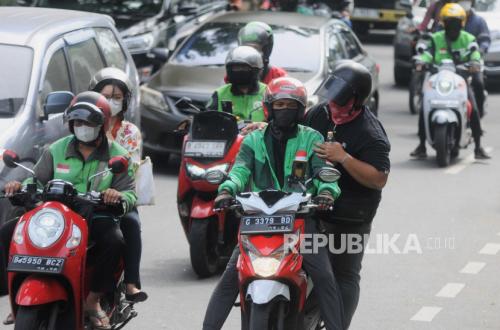
The research institute Institute for Demographic and Affamed Studies (IDEAS) has called on the government to re-evaluate policies that encourage online motorcycle taxi (ojol) drivers to be categorised as micro, small, and medium enterprises (MSMEs).
IDEAS researcher Muhammad Anwar believes this policy could not only obscure the employment relationship between drivers and application companies but also pose a systemic risk. He warns of an increased debt burden for drivers and the potential for massive defaults if drivers are forced into the MSME category through expanded access to loans, such as the People’s Business Credit (KUR).
“Classifying online taxi drivers as MSMEs by expanding loan access, including through KUR, must first consider the economic conditions and repayment capacity of the drivers. This is because the majority of online taxi drivers are currently already in a state of significant debt,” Anwar stated in a written release on Wednesday (30/09/2026).
A survey of 531 drivers across 51 regencies/cities in 13 provinces, conducted between 23–27 August 2026, showed that 91 per cent of drivers have ongoing debts or instalments. In other words, nine out of ten surveyed drivers currently have financial obligations to meet.
“This data confirms that debt is no longer a condition experienced by a small number of drivers, but is a condition almost uniformly experienced by the entire online taxi driver population,” said Anwar.
The survey also revealed that 57.97 per cent of drivers have more than one source of loans, with some drivers carrying debt across seven different channels simultaneously.
In detail, loan sources range from leasing for production tools such as motorcycles (43.89 per cent) and online loans (4ly.27 per cent), which are the two largest sources, followed by debts to relatives (40.58 per cent), paylater applications (31.06 per cent), banks (26.71 per cent), cooperatives (16.15 per cent), and even moneylenders (7.45 per cent).
“The distribution of debt across various loan channels is a common pattern found in communities with limited financial access but high urgent needs,” explained Anwar.
Anwar added that this distribution shows that the financing of online taxi drivers does not rely on a single path but is spread across various formal and informal channels, a pattern typical of groups with limited financial access but high immediate needs.
The problem becomes even more serious when looking at the scale of the debt obligations that must be settled. Aggregated data shows that 45.96 per cent of respondents with debt have remaining obligations of at least Rp 10 million. Furthermore, 25.67 per cent—or one in four indebted drivers—have remaining obligations exceeding Rp 20 million.
“This indicates that drivers are entering financing schemes with significant obligations, while on the other hand, the majority of their daily net income is below Rp 100,000 per day,” concluded Anwar.
Source: jawawa.id (https://jawawa.id/newsitem/ideas-survey-91-per-cent-of-online-taxi-drivers-trapped-in-debt-1790773128)
Originally published by Republika (https://ekonomi.republika.co.id/berita/tm6fwv423/survei-ideas-91-persen-pengemudi-ojol-terjerat-utang), translated from Indonesian