
Ibas Urges Young People to Think Critically and Engage Actively in Facing AI and Social Media
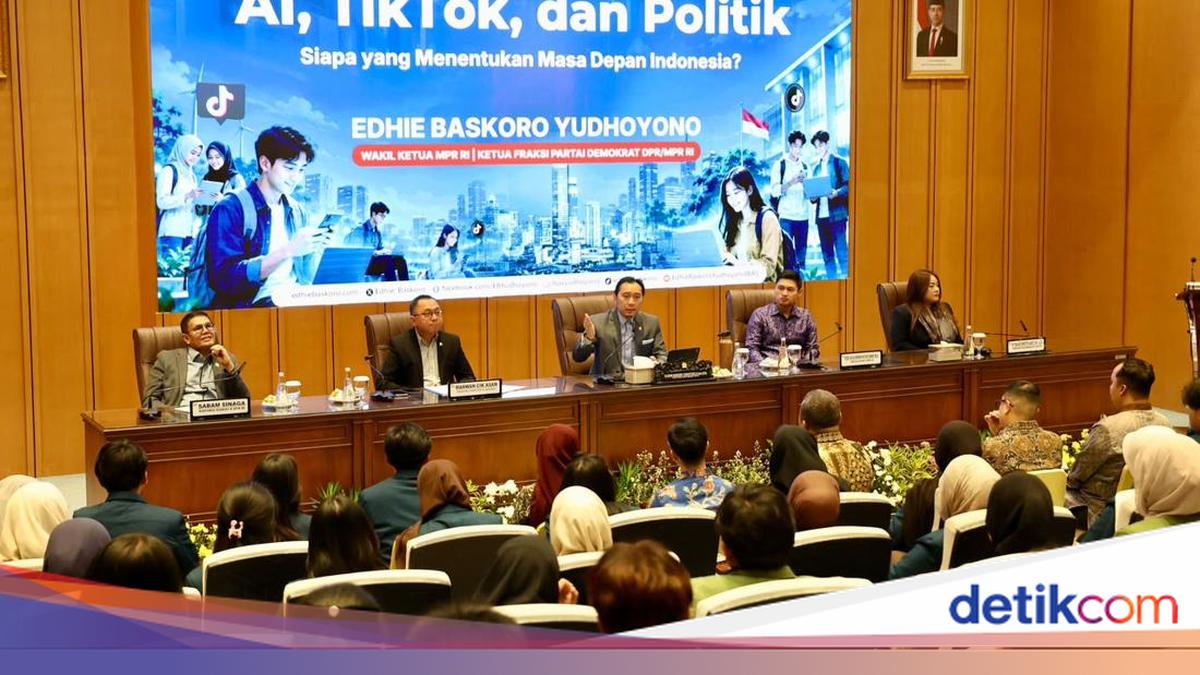
Deputy Speaker of the Indonesian People’s Consultative Assembly (MPR RI), Edhie Baskoro Yudhoyono (Ibas), has urged young people to think critically and take an active role in facing the development of AI, social media, and political dynamics in the digital era. Ibas also warned of the dangers of filter bubbles and the influence of social media algorithms on how society obtains information.
According to him, algorithms learn user behaviour based on what is watched, liked, skipped, and shared, and even how long a piece of content is viewed. This means users receive information that increasingly matches their preferences.
“Sometimes we feel we are choosing the content. In fact, the algorithm is also choosing what we will see,” said Ibas in a statement on Tuesday (8/9/2026).
The message was delivered by the Chairman of the Democratic Party Faction in the DPR RI whilst serving as keynote speaker at the National Seminar ‘AI, TikTok, and Politics: Who Determines Indonesia’s Future?’ held at the Abdul Muis Room in Jakarta on Thursday (3/9).
The issue is considered increasingly serious when such mechanisms enter the political sphere. Algorithms can dictate public perceptions of the government, public policy, and prospective leaders.
For this reason, he asked students not to swallow every piece of information circulating online without question.
“Viral does not mean correct. Information can be shared millions of times, but it can still be wrong,” he said.
This graduate of Nanyang Technological University believes digital democracy requires more than mere freedom of speech. Society must also possess the freedom to think, so as to be able to examine data, listen to other perspectives, and dare to admit mistakes.
Ibas also believes politicians must not close themselves off from developments on social media, including TikTok. Politicians must be able to be present across various public communication spaces so that their ideas and political work can be known by the public.
However, he cautioned that social media should not turn politics into a mere race for views, likes, and followers.
“Politicians may become creators. But politics is not about who is the most viral. Politics is about who can offer solutions and take responsibility for the decisions made,” said Ibas.
According to him, a high number of views does not automatically indicate quality of leadership. Likewise, a large following is not always synonymous with public trust.
“Views do not necessarily equal leadership. Followers do not necessarily equal trust. Content is also not the same as policy,” he said.
Ibas stressed that the assumption that the younger generation is apathetic towards politics is not entirely accurate. He said young people’s concern about the cost of education, job opportunities, the price of basic necessities, the environment, social justice, and the nation’s future is itself a form of political engagement.
“You do not have to follow parliamentary sessions every day. When you care about job opportunities, education, the environment, the price of daily necessities, and social justice, you are in fact already politically literate,” he explained.
He invited the younger generation to take a more active role in the democratic process and not merely voice their aspirations through social media.
“Do not just be spectators of democracy. Use the available democratic channels to convey your ideas and aspirations,” he said.
Closing the dialogue, Ibas conveyed three messages to the younger generation. First, Think Deep — thinking in a thorough, critical manner and not surrendering the process of thinking to algorithms or AI.
Second, Participate — actively voicing ideas and aspirations through democratic spaces. Third, Lead — daring to take on a role and to lead with decisions grounded in data, knowledge, reason, participation, and responsibility.
Ibas also urged students to prepare themselves to become Indonesia’s leaders in 2045.
“It may well be that in 2045, the people who become Indonesia’s leaders, entrepreneurs, scientists, judges, lecturers, professors, members of parliament, policymakers, and technology developers are you,” he said.
For information, the seminar was attended by student representatives from Brawijaya University, UIN Syarif Hidayatullah, IPB University, UPN Veteran Jakarta, Al-Azhar University of Indonesia, and Uhamka. It was also attended by several members of the Democratic Party Faction in the DPR RI, namely Marwan Cik Asan, Rizki Natakusumah, Sabam Sinaga, Bramantyo Suwondo, Hillary Brigitta Lasut, Hasani, and Zulfikar.
Source: jawawa.id (https://jawawa.id/newsitem/ibas-urges-young-people-to-think-critically-and-engage-actively-in-facing-ai-and-social-media-1788839646)
Originally published by detikcom (https://news.detik.com/berita/d-8653287/ibas-ajak-anak-muda-berpikir-kritis-aktif-dalam-hadapi-ai-medsos), translated from Indonesian