
Ibas Backs Agrotourism Development and Melon Self-Sufficiency in Magetan
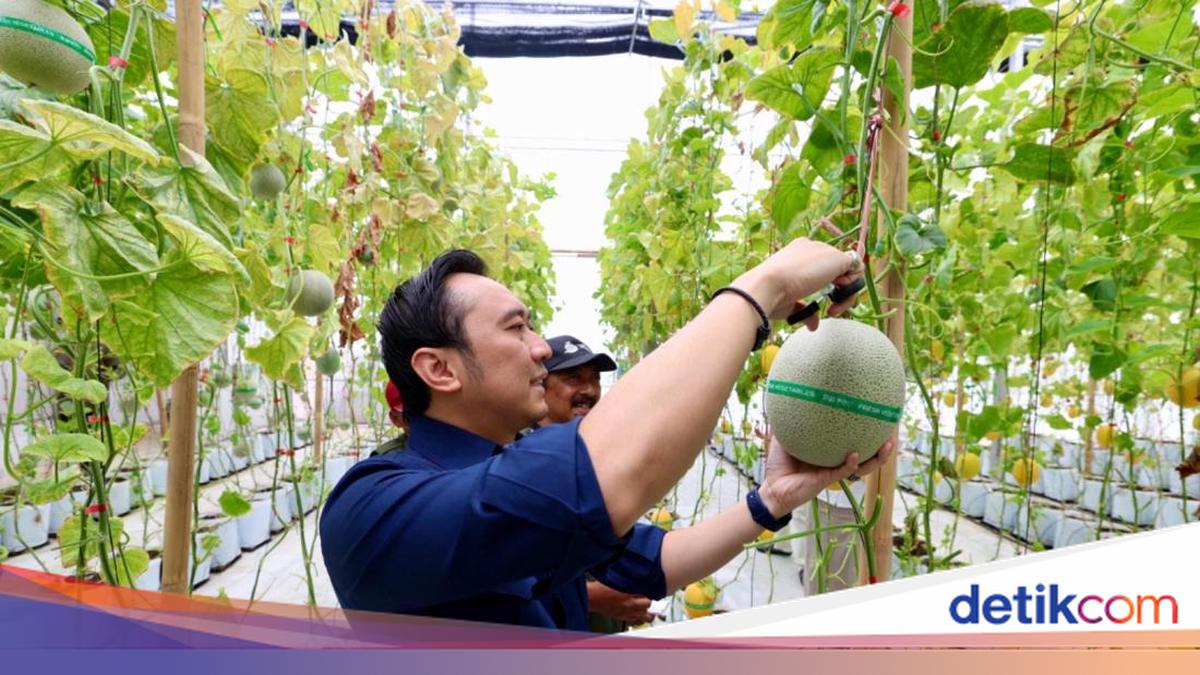
Deputy Speaker of the People’s Consultative Assembly (MPR RI) and chairman of the Democratic Party faction in the House of Representatives (DPR RI), Edhie Baskoro Yudhoyono (EBY/Ibas), has called for the development of productive agriculture and community-based agrotourism as drivers of the people’s economy in Magetan regency, East Java.
Edhie Baskoro made the remarks while attending a melon harvest and meeting with residents and a farmers’ group in Sumberdodol village, Magetan, on Friday (30 October). He inspected greenhouse melon cultivation managed by the farmers’ group under the coordination of Suparmin.
He praised the farmers’ creativity and innovation in cultivating three melon varieties: Sakata Glamour, Sweet Lavender and Kirani. The varieties have different characteristics, including colour, texture, size and sweetness.
Ibas said Magetan farmers’ success in growing high-quality melons demonstrated the considerable potential of domestic agriculture, which should continue to be developed. With sound management, technology and support for production facilities, Indonesian farmers can produce high-quality, competitive horticultural products.
“Thankfully, we do not have to travel all the way to Japan or South Korea to find high-quality melons. Here in Magetan regency, we can already produce excellent, sweet melons that are competitive in quality. This proves that Indonesian farmers have extraordinary potential,” Ibas said on Saturday (31 October 2026).
During his visit, Edhie Baskoro also saw the greenhouse technology, automatic irrigation system and growing media made from cocopeat and burnt rice husks. The system allows water and nutrients to be regulated more precisely, making cultivation more efficient.
Melons take about 70 days to grow before harvest. Farmers are also continuing to develop varieties to suit local environmental conditions and market demand.
Ibas walked between the greenhouses to inspect the plants and fruit ready for harvest. He spoke with Suparmin about the characteristics of each variety, cultivation and care, growing media and the challenges farmers face in maintaining production quality.
The visit became interactive when EBY joined in harvesting ripe melons. He sampled all three varieties—Sakata Glamour, Sweet Lavender and Kirani—and compared their flavours, textures and sweetness. He also selected and weighed some of the harvest to buy and take home, in a show of support for local farmers’ produce.
Ibas said the farming model could inspire other villages, including those with underused land. With greenhouse technology and appropriate guidance, such land could be developed into productive agricultural areas and educational tourism destinations.
Agrotourism offers new economic opportunities
Edhie Baskoro praised the farmers’ group for looking beyond fruit production by developing a pick-your-own melon attraction open to the public.
The agrotourism site has attracted visitors from several areas, including Madiun, Ngawi and Solo. As well as offering family recreation, it provides an educational experience about cultivation, fruit varieties and modern agricultural technology.
Several universities have also visited for teaching, research and community service activities.
“This is interesting because agriculture does not just produce fruit for sale; it also offers experiences, education and tourism. People can visit, learn, enjoy the village atmosphere and pick the produce themselves. This is an economic opportunity we must develop together,” he said.
He added that agrotourism could generate wider economic benefits. Visitors could support a range of local businesses, including food outlets, small and medium-sized enterprises (SMEs), souvenir sellers and village tourism services.
Magetan, he said, had considerable natural potential for developing the sector. In addition to melons, the regency is known for pomelo, strawberries, vegetables and livestock products, including its milk-producing village.
“Magetan has so much potential. Its scenery is beautiful, the air is cool, the soil is fertile and its people are creative. Let us protect and develop these strengths together so that agriculture and village tourism can progress and deliver tangible benefits to the community,” he said.
In a discussion with the farmers’ group, Ibas also highlighted the importance of access to seeds, fertiliser and agricultural facilities, as well as reliable markets, to ensure the sustainability of farmers’ businesses.
Suparmin, one of the farmers, said a key challenge was the relatively high price of melon seeds. Much of the group’s seed supply is currently purchased online.
In response, Edhie Baskoro stressed the need to strengthen domestic agricultural supply chains, including local seed production, so farmers can access high-quality seeds at more affordable prices.
He also urged farmers to manage their operations systematically, from planting schedules, fertiliser use and harvest timing to operating costs and marketing.
On fertiliser, Ibas underlined the need for affordable supplies and targeted distribution. He also warned against stockpiling, saying fertiliser must be available to all farmers’ groups and agricultural businesses.
“Farmers need certainty. Seeds must be available, fertiliser must be easy to obtain at an affordable price, agricultural facilities must improve and markets must be clear. If this whole ecosystem works, farmers will find it easier to develop their businesses,” he said.
Ibas added that he would continue to raise the agricultural sector’s needs and challenges at national level, to ensure productive economic development in regional areas receives sustained attention and support.
Supporting residents’ welfare
During the visit, Ibas also provided assistance to support and encourage the farmers’ group to continue developing its agricultural business and agrotourism activities.
He said he hoped the group’s greenhouse melon model in Sumberdodol village could serve as an example for other villages to study and replicate according to their local conditions.
According to EBY, successful development depends not only on government programmes but also on community initiative, creativity, hard work and the spirit of mutual cooperation.
“My main purpose in coming is to encourage the growth of agrotourism and Indonesian fruit production, so that people can enjoy them and they can create prosperity. We want agriculture to be more than production: it should be a livelihood, a source of pride and a future for village communities,” he said.
Suparmin, who manages the farmers’ group, welcomed the support and thanked EBY for his attention, assistance and encouragement. He said it had motivated the farmers to keep working, develop their business and contribute to the progress of the region and the country.
At the community gathering, EBY also met around 1,000 Sumberdodol residents at an event titled “Melons Go Global: Optimising Agrotourism Opportunities to Strengthen the Village Economy”. He urged everyone to maintain harmony, strengthen mutual cooperation and pay attention to young people’s education.
He said he hoped children in Magetan would continue their education, grow into intelligent and principled young people, and aspire to help build Indonesia.
At the close of the event, EBY expressed hope that the development of agriculture and agrotourism in Magetan would bring blessings, good health, happiness and greater prosperity to farmers and the wider community.
“Pick a melon, pick an opportunity, bring home a blessing. May what we plant today yield not only high-quality fruit, but also greater prosperity and a better future for the community,” EBY said.
Also attending were Luthfi Setiya Priambodo, representing the Ministry of Tourism; Magetan regency’s head of culture and tourism, Suwito; Rachmad Soewastono, head of public order and security at Panekan subdistrict; Sumberdodol village secretary Taufik Arrohman Arizal; Bara Boom Benny Setiawan, manager of the Sumberdodol village-owned enterprise (BUMDes); and Magetan regency legislator Wahyu Kurniawan.
Source: jawawa.id (https://jawawa.id/newsitem/ibas-backs-agrotourism-development-and-melon-self-sufficiency-in-magetan-1793461943)
Originally published by detikcom (https://news.detik.com/berita/d-8732962/ibas-dukung-pengembangan-agrowisata-dan-kemandirian-melon-di-magetan), translated from Indonesian