
IAPI Proposes Single Sustainability Assurance Standard
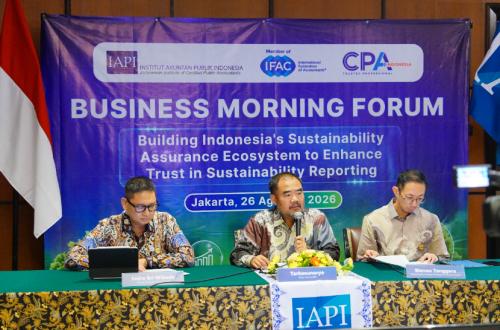
The Indonesian Institute of Certified Public Accountants (IAPI) has proposed the use of a single international standard as a reference for assurance on sustainability information in Indonesia. IAPI also asked regulators to prepare an equivalent supervisory system for all service providers before the sustainability assurance obligation comes into force.
The proposal was delivered at a Business Morning Forum titled ‘Building Indonesia’s Sustainability Assurance Ecosystem to Strengthen Trust in Sustainability Reporting’ on 26 August 2026.
The forum took place amid the finalisation of the OJK Draft Regulation (RPOJK) on the Implementation of Sustainable Finance. The regulation will require Financial Services Sector Business Actors (PUSK), Issuers, and Public Companies to disclose sustainability information.
IAPI considers the need for clear assurance standards increasingly important because Indonesia’s sustainability reporting ecosystem has not yet reached the maturity level of financial reporting. ‘This condition opens up risks of misstatement, bias, and misleading sustainability claims or greenwashing,’ according to an official IAPI statement based on a press release on Friday (28/8/2026).
To anticipate these risks, IAPI proposed three internationally adopted standards as references in Indonesia. First, SAKb 5000, which adopts the International Standards on Sustainability Assurance (ISSA 5000) as the sustainability assurance standard.
Second, Quality Management Standards (SMM) 1 and SMM 2, which adopt the International Standards on Quality Management (ISQM 1 and ISQM 2). Third, Ethics Standards for Sustainability Assurance, which adopt the International Ethics Standards for Sustainability Assurance (IESSA).
The three standards have different functions. The ethics standard regulates ethical requirements and practitioner independence, the quality management standard regulates quality systems at service provider offices, while the assurance standard regulates the implementation of sustainability assurance engagements.
IAPI also views the experiences of Malaysia and Australia as lessons for Indonesia. Malaysia applies a profession-agnostic approach that allows non-accountant service providers to participate and expands the oversight mandate of the Audit Oversight Board (AOB), while Australia places sustainability assurance within an established audit profession ecosystem.
Despite having different approaches, both countries use the same standards framework, namely ISSA 5000, ISQM 1, and IESSA. IAPI considers consistency of standards important regardless of provisions regarding who may provide sustainability assurance services.
In Indonesia, IAPI stated that the three standards will soon be available as professional infrastructure. However, the availability of standards is deemed insufficient to ensure consistent sustainability assurance quality.
Based on the stages in the RPOJK, the limited assurance obligation for Group 1 entities will take effect for the 2029 period. Therefore, IAPI considers that regulators need to prepare supervisory infrastructure before the obligation is implemented.
This infrastructure includes registration, certification, inspection, and enforcement. IAPI also considers that certification needs to cover the ability to apply quality management standards and meet ethical standards, not just technical competence.
IAPI stated that the adoption of ISSA 5000 and IESSA into public accountant professional standards is a step towards building a credible sustainability assurance ecosystem. This credibility is considered important to maintain the trust of investors, regulators, and the public in the sustainability information disclosed by companies.