
IAPI Proposes Single Standard as Reference for Sustainability Assurance, Here Are the Objectives
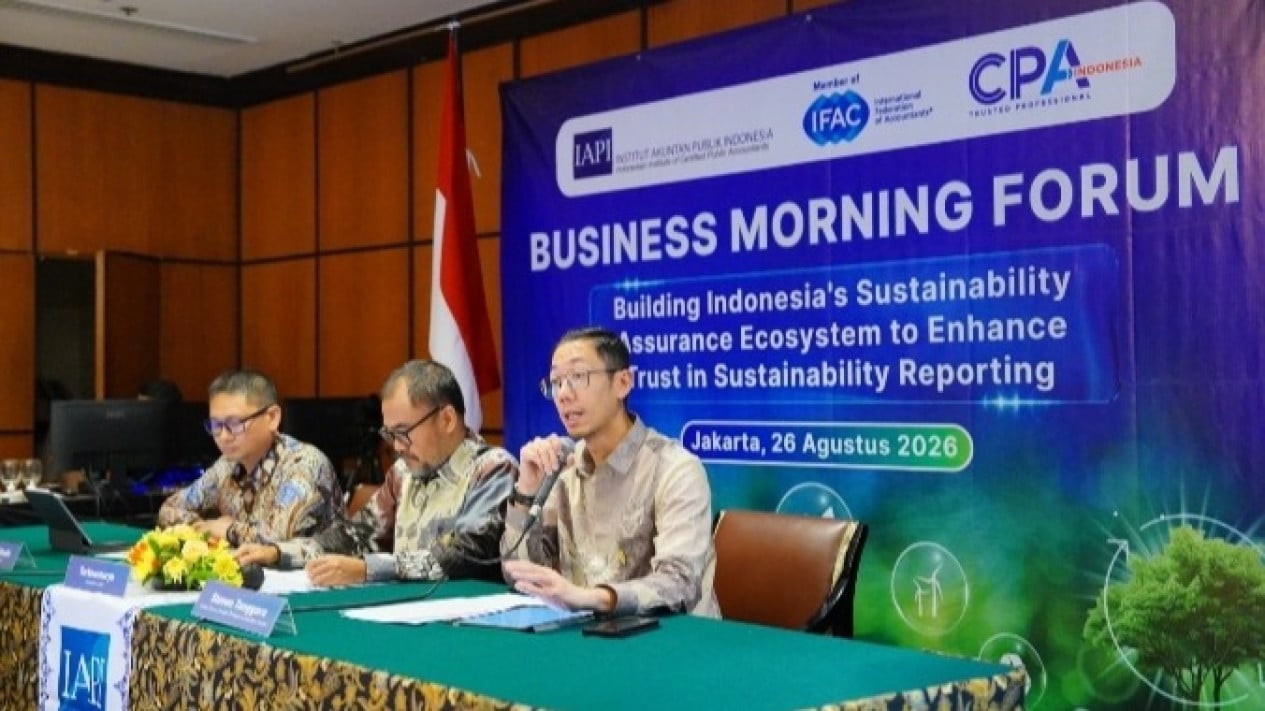
The Indonesian Institute of Certified Public Accountants (IAPI) has proposed the use of a single international standard as the official reference for sustainability assurance.
IAPI Chairman Tarkosunaryo added that his organisation is also calling for equivalent supervisory infrastructure readiness for all service providers before the assurance obligation comes into force.
He assessed that Indonesia’s sustainability reporting ecosystem currently does not yet have the same level of maturity as the financial reporting ecosystem.
“As a result, there is a risk of misstatement, bias, and misleading sustainability claims or greenwashing. This condition has the potential to erode the trust of investors and other stakeholders in the sustainability information published by companies,” said Tarkosunaryo at the Business Morning Forum in Jakarta on Wednesday, 26 August 2026.
His organisation is of the view that three standards resulting from international adoption need to be established as official references in Indonesia. First, SAKb 5000, which adopts the International Standards on Sustainability Assurance (ISSA) 5000 as the sole sustainability assurance standard.
Second, quality management standards as the foundation for implementation, namely Quality Management Standard (SMM) 1 and SMM 2 (adopting International Standards on Quality Management/ISQM 1 and ISQM 2).
Third, ethical standards for sustainability assurance (adopting the International Ethics Standards for Sustainability Assurance) as the ethical standard for all practitioners.
Tarkosunaryo explained that the three standards regulate different but complementary aspects. First, the ethical standard regulates the ethical requirements that practitioners must fulfil in carrying out engagements, including the requirement for practitioners to be independent of the entity being examined.
Second, the quality management standard regulates the components that must be fulfilled by the firm where practitioners work, to ensure that every engagement is carried out to the highest quality. Third, the assurance standard regulates the provisions for carrying out the engagement itself.
“The three are designed to operate as a single unit: practitioners who are independent and behave ethically, working under an adequate quality management system, and following clear engagement provisions, as the combination needed to effectively reduce the risk of greenwashing,” said Tarkosunaryo.
He said that the three standards, namely SAKb 5000, SMM 1 and SMM 2, and the Ethical Standard for Sustainability Assurance, will soon be available as ready-to-use standard infrastructure. However, the availability of standards alone is not sufficient to guarantee consistent quality of sustainability assurance.