
IAEI-KNEKS: Indonesia Must Strengthen MEKSI and Sharia GDP to Lead Global Islamic Economy
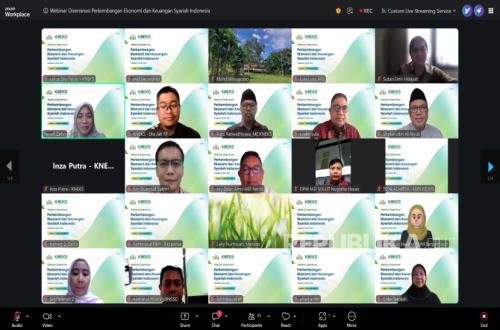
The Central Executive Board of the Indonesian Association of Islamic Economists (IAEI), together with the National Committee for Sharia Economy and Finance (KNEKS), believes Indonesia needs to accelerate the strengthening of sharia economy governance.
This can be achieved through the enactment of a legal umbrella for the Indonesian Sharia Economy Masterplan (MEKSI) and the development of Sharia Gross Domestic Product (GDP) as an instrument to measure the contribution of the sharia economy to the national economy.
The push emerged during the Webinar on the Dissemination of Indonesian Sharia Economy and Finance Developments for the Second Quarter of 2026, organised by IAEI and KNEKS on Friday (7/8/2026).
The webinar presented the latest developments across various sharia economy sectors as well as the challenges that still need to be resolved for Indonesia to achieve its target of becoming a global sharia economy hub by 2029.
IAEI Daily Chairman Muhammad Syakir Sula stated that Indonesia possesses all the prerequisites to become a world leader in the sharia economy. IAEI is committed to serving as a collaboration hub by strengthening its role in scholarship, research, and policy advocacy.
He also called on all stakeholders to build a spirit of jihad iqtisadi, viewing sharia economy development as a collective endeavour to deliver benefit and prosperity for the nation, rather than merely economic activity.
“What we need today is not only strategy, but also a spirit of collaboration and jihad iqtisadi. IAEI will continue to connect the strengths of academics, regulators, industry, and society so that this great potential can be realised into global leadership,” he said.
KNEKS Executive Director Sholahudin Al Aiyub emphasised that sharia economy development has become part of the national strategic agenda through the National Long-Term Development Plan (RPJPN), the National Medium-Term Development Plan (RPJMN), and the Asta Cita.
The next focus is strengthening governance so that all ministries and agencies have aligned policy directions. To that end, KNEKS is pushing for the strengthening of the MEKSI legal umbrella so that it has binding force in its implementation.
In addition, Indonesia is developing Sharia GDP as the world’s first instrument capable of measuring the contribution of the sharia economy sector to the national economy more comprehensively.
The measure is expected to improve the quality of planning and the effectiveness of sharia economy policy going forward. The next challenge is ensuring that all ministries and agencies move in the same direction through the strengthening of the MEKSI legal umbrella.
“At the same time, Indonesia is preparing Sharia GDP as a strategic instrument that will become a new benchmark for the contribution of the sharia economy to national economic growth,” said Sholahudin.
Meanwhile, KNEKS Director of Sharia Business and Entrepreneurship Putu Rahwidiasa explained that the halal industry sector continues to show positive development and has become one of the main drivers of national sharia economy growth.
Indonesia’s improved position in the Global Muslim Travel Index (GMTI), the increase in halal product export values, and the expansion of the halal ecosystem demonstrate the country’s growing competitiveness in the international market.
“The challenges ahead are strengthening the capacity of halal MSMEs, expanding halal certification, developing halal industrial estates, and leveraging Indonesia’s leadership in international forums, including the D-8, to expand markets and strengthen Indonesia’s position as a global halal industry hub.”
This momentum, he said, must be utilised to strengthen the competitiveness of the national halal industry while expanding MSME access to international markets.
According to KNEKS Director of Sharia Ecosystem Infrastructure and IAEI Secretary General Sultan Emir Hidayat, the strengthening of the sharia economy ecosystem must be carried out comprehensively through the acceleration of halal certification, increased sharia economy literacy and inclusion, and stronger cross-sector collaboration.
He said the success of the sharia economy is determined not only by industry growth, but also by the ability of the public to access, understand, and utilise sharia economy services in daily life.
“The sharia economy ecosystem will only grow if literacy, inclusion, halal certification, and financing develop simultaneously,” explained Sultan.
Therefore, he said, strengthening cross-sector collaboration is a prerequisite so that the benefits of the sharia economy can be felt more widely by society and accelerate the transformation of the national sharia economy.
On another note, Eka Jati Rahayu Firmansyah, representing the KNEKS Director of Sharia Financial Services, stated that the sharia financial services sector continues to record positive growth with total assets reaching Rp 10,662 trillion.
Sharia banking assets have surpassed Rp 1,000 trillion. Nevertheless, this growth still faces challenges because the sharia finance market share has not grown as fast as its potential.
Therefore, it is necessary to strengthen product innovation, improve industry competitiveness, provide policy incentives, digitalise services, and foster closer synergy between the sharia financial services sector and the halal industry and real economy so that its contribution to national economic development becomes even greater.
Bagus Aryo, representing the KNEKS Director of Sharia Social Finance, emphasised that sharia social finance has a strategic role as an instrument of national development capable of strengthening public welfare.
The optimisation of zakat, infaq, sadaqah, and waqf management needs to be directed so that it is increasingly integrated with poverty alleviation agendas and regional economic development.
The use of the National Socio-Economic Single Data (DTSEN), the strengthening of the National Zakat Index, and the development of productive waqf are important steps to improve the effectiveness of benefit distribution and expand the contribution of sharia social finance to inclusive and sustainable economic development.
Source: jawawa.id (https://jawawa.id/newsitem/iaei-kneks-indonesia-must-strengthen-meksi-and-sharia-gdp-to-lead-global-islamic-economy-1786096404)
Originally published by Republika (https://sharia.republika.co.id/berita/tje6vh472/iaeikneks-indonesia-perlu-perkuat-meksi-dan-pdb-syariah-demi-pimpin-ekonomi-syariah-global), translated from Indonesian