
I.J. Kasimo and sovereignty on the plate
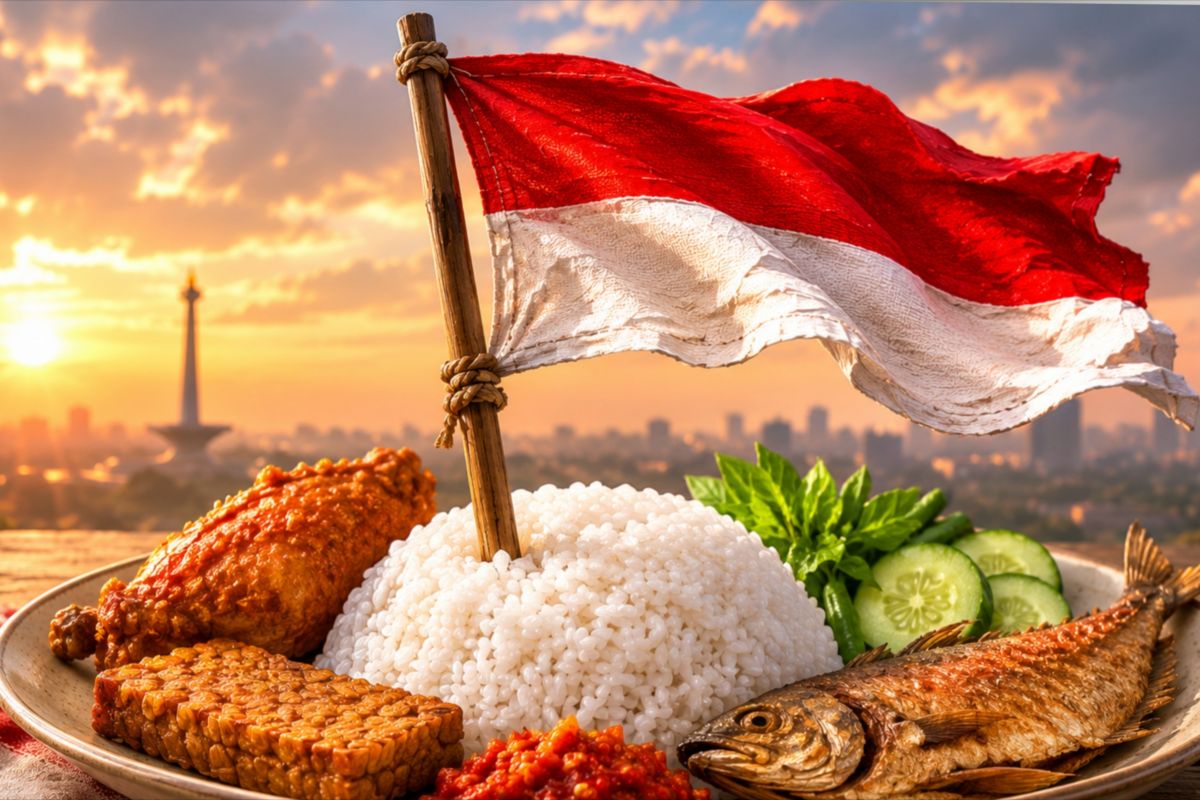
During Kasimo’s era, the threat came in the form of warship blockades. Today, the ‘blockade’ manifests as climate change, global supply chain fragility, geopolitical conflict, fertiliser price fluctuations, and speculation in international commodity markets.
Every August, the Indonesian nation has a tradition of remembering its own identity. Red and white flags appear at government offices, schools, food stalls, in front of houses, and along the fences of narrow alleyways that on ordinary days are more vibrant with laundry. Children delight in various Independence Day competitions. Adults attempt to conquer slippery areca palm trunks. Mothers also join the arena. Meanwhile, from loudspeakers, songs of struggle are played repeatedly. For a few weeks, history becomes part of the everyday landscape.
Perhaps that is indeed how we care for memory. We need ceremonies, flags, songs, and various competitions so that independence does not become merely a red date on the calendar. But every celebration has an end. After the ceremony is over, the flag is lowered, the stage is dismantled, competition prizes are taken home, and the field returns to silence. We return to our daily affairs.
It is here that the question of independence becomes more concrete: what actually keeps a nation independent? Independence may be born after passing through the roar of bullets on the battlefield or through the strike of a gavel in a diplomatic chamber. However, the breath of its sustainability must be tested on the plates of its citizens.
More than seven decades ago, a Javanese man who upheld the motto Salus populi suprema lex (the welfare of the people is the highest law) named Ignatius Joseph Kasimo Hendrowahyono had already reminded us of this. Kasimo is a national hero, but he did not lead troops on the battlefield. Nor was he an orator whose speeches are continually remembered and quoted. In historical photographs, he appears simple, bespectacled, with a face that does not immediately bring to mind a revolutionary figure.
Kasimo’s way of viewing independence was also different. He did not primarily see the Republic from the political stage or the bustle of revolution, but rather from everyday matters such as rice fields, farmers, cooperatives, seeds, livestock, food distribution, and rice on the plate. From these everyday matters we can understand his anxiety. For Kasimo, a country may well have a flag, a government, and territorial boundaries. But a nation is not truly sovereign if it has not yet been able to sustain and feed its own people.
The Republic must eat. As one of the founders of the Indonesian Catholic Party and a vocal figure in the national movement, Kasimo was not a figure who appeared suddenly. His experience fighting for people’s rights since the colonial period shaped his view of economic injustice. He became a member of the Volksraad from 1931 to 1942. After the Republic was established, he was entrusted with handling food affairs. In the first Hatta Cabinet, he served as Minister of People’s Food Supply from 1948 to 1949.
As Minister of People’s Food Supply, and later Minister of Agriculture, he bore one of the heaviest burdens after the proclamation: ensuring that the newly born nation did not starve amid the chaos of revolution. According to research by Anthony Reid (2015), during the physical revolution (1945–1949), Kasimo worked hard to overcome food scarcity caused by the Dutch blockade. He initiated a rice distribution system involving people’s militias and cooperatives to penetrate isolated regions.
Indonesia’s condition at that time was far from normal. The Republic was not only facing the military threat of the Dutch who wanted to return to power. The economic blockade disrupted food distribution, infrastructure was in ruins, and agricultural production declined. Hunger was not merely a possibility, but a threat standing at the door.
Kasimo understood something very fundamental: a country may win a war militarily, but it still loses morally and socially if its people cannot eat. From this awareness, the Kasimo Plan (1948–1950) was designed. The programme was not merely an appeal to increase harvest yields, but a blueprint for the newly established Republic to survive through agriculture.
Kasimo initiated the opening of new land, the use of superior seeds, irrigation improvements, reforestation to maintain soil fertility, and a ban on slaughtering productive livestock so that the labour force for working the rice fields remained maintained. For Kasimo, rice was not merely a matter of calorie sources, but a matter of state stability. Rice fields were a defensive fortress of the republic no less important than the front lines of battle. Paddy was not merely a crop, but a representation of politics, economics, and national dignity.
It is interesting to imagine Kasimo walking through a time corridor to Indonesia today, when food issues have once again become a national priority. The man born in Yogyakarta on 10 April 1900 would perhaps be amazed to see toll roads cutting across the island, new dams, and modern harvesting machines. However, his eyes would be sharpest on two major agendas: the Free Nutritious Meal Programme (MBG) and the rice self-sufficiency target.
When the government launched MBG targeting tens of millions of schoolchildren and pregnant women, Kasimo would certainly nod in agreement. For him, such a programme is a concrete manifestation of the principle that the republic needs a healthy people. The flow of budget funds to local kitchens can also be a strategy for investing in human resources, while simultaneously driving the people’s economy down to the village level.
Nevertheless, Kasimo would certainly raise questions about its foundations. He knew that a food distribution programme as large as MBG would only be sustainable if supported by strong domestic food availability. It is here that he would carefully observe efforts to accelerate rice self-sufficiency. For Kasimo, self-sufficiency is not merely a production figure that breaks records. Self-sufficiency is a guarantee that this nation does not…