
Hydrogen Linked to 73 Recurring House Fires at Fia's Seyegan Home
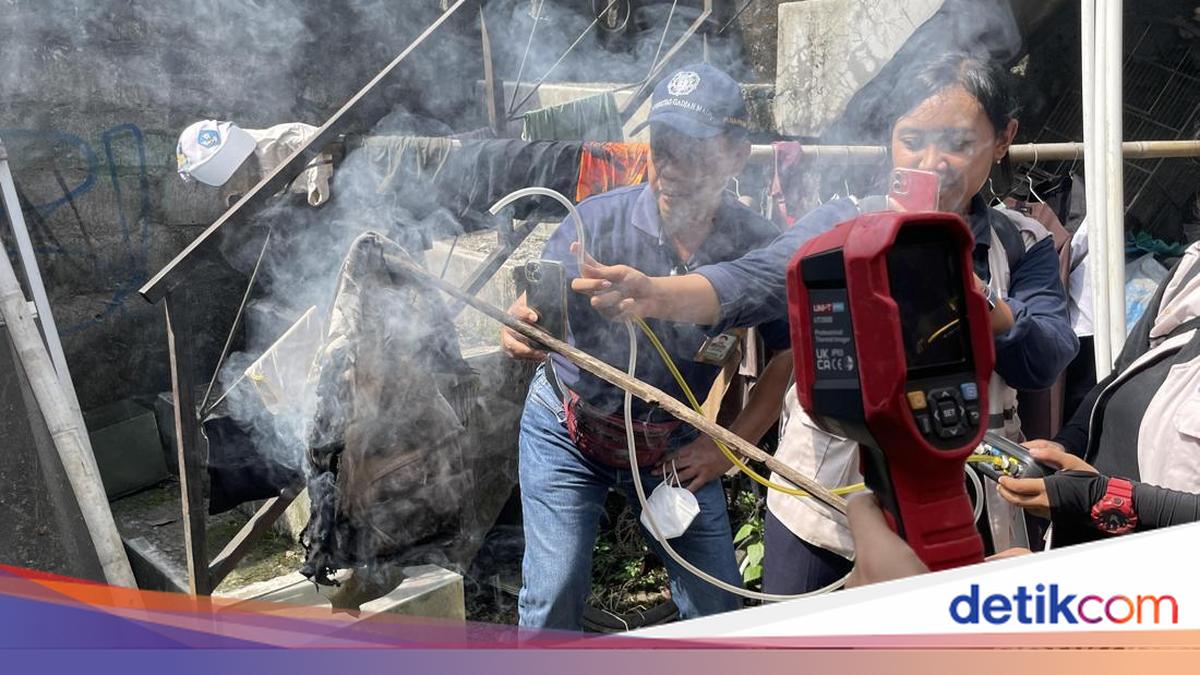
Mysterious fires have occurred up to 73 times at Mutfiana’s house in Kasuran Mriyan X, Seyegan, Sleman, over the past ten days. During one of the incidents, experts from UGM’s Faculty of Engineering monitored a rise in hydrogen levels at the site.
Fire Terror Since 23 May
According to Mutfiana, the mysterious fires first occurred at her home on Saturday, 23 May, and continued until Monday, 1 June, at noon. Yesterday at approximately 12:19 PM, clothes hanging in the bedroom suddenly caught fire, causing panic among the residents. “That incident brings the total to 73, with around 65 distinct points,” Fia told reporters at her home on Monday, 1 June 2026.
She stated that the room where the fire occurred was inspected today by UGM researchers, who were still present at the scene during the incident. “It did happen; the room was empty when the fire started. I entered and saw the flames already large,” she explained.
She added that since the first occurrence, fires have erupted seven to nine times daily on average, with most of the 65 fire points appearing in open areas. “Seven to nine times a day. The bedroom has only caught fire twice,” she said. “Many items have burned—clothes, cardboard, anything flammable,” she added.
Meanwhile, experts from UGM and BPPTKG continue to inspect the site to determine the cause and source of the fires. “It’s calmer now, but we must remain vigilant as the situation is not over. It’s not mystical—it’s real and can be studied scientifically; we await the experts’ findings in a few days,” Fia said.
Hydrogen Levels Rising Continuously
Experts from UGM’s Faculty of Engineering conducted further observations and sample collection at Fia’s residence in Seyegan, Sleman, which has experienced repeated fires. Researchers witnessed the spontaneous combustion of a hanging T-shirt in Mutfia’s bedroom yesterday afternoon. Before the fire intensified, the team used a fire extinguisher to douse the flames, but white smoke soon emerged from the T-shirt. The researchers took the T-shirt outside, where measurements showed rising temperatures and increasing white smoke.
“We just witnessed it live—after being informed by Ms Mut (Mutfia). This is an extraordinary event we observed firsthand,” said Professor Alva Edy Tontowi, Coordinator of UGM’s Entropy Slowdown Research Centre (PKPE), to reporters on Monday, 1 June 2026.
Prof Alva explained that measurements showed rising temperatures on the burning T-shirt, and one key finding today was the presence of hydrogen gas (H₂) on the garment. “We measured the temperature, which kept rising. Hydrogen levels also continuously increased,” he added.
Samples will be analysed in the lab on Tuesday, 2 June, to determine the cause of hydrogen presence. In the meantime, he advised the homeowner to clear the room to reduce flammable materials. “There are fabrics, paper, and other flammable items that could spread to other areas,” he said. “The fire moves because it’s gas-based. When hydrogen concentrations reach a certain level, it ignites,” he continued.
However, conclusions cannot yet be drawn. The presence of hydrogen, methane, and other hypotheses require further investigation for definitive results. “These are currently only hypotheses. The final conclusions will be based on lab-measured data, not mere words, but numbers,” he said.
Meanwhile, Prof Dr Ir Agung Harijoko, a member of UGM’s Faculty of Engineering research team, explained that gas detectors identified methane and hydrogen. Elevated hydrogen concentrations were detected in the bedroom where the fire occurred. “We detected methane (CH₄), hydrogen, CO₂, and O₂. The spike in the burning room was hydrogen,” Prof Agung said.
The professor of vulcanology explained that hydrogen can ignite without a spark, suggesting it may be the cause of the household items burning. However, they must still confirm the hydrogen’s source and the mechanism of its formation in the house. “Hydrogen is the suspected gas, but we need to determine its source and formation mechanism,” he explained.
The team has taken water samples from the well to check for hydrogen-producing organisms. “We need to investigate whether organic decomposition is producing the hydrogen,” he added.